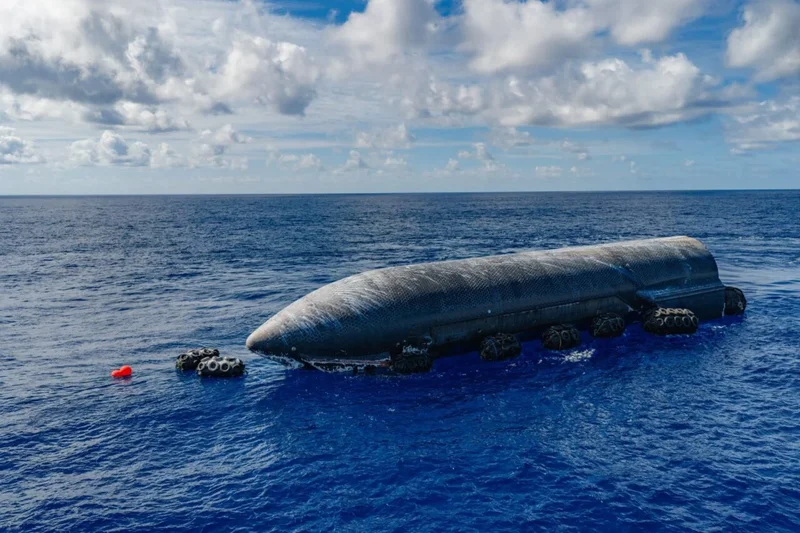
It’s been more than two weeks since SpaceX’s Starship splashed down in the Indian Ocean following a largely successful thirteenth flight test. As of Friday, the recovery team was still working to bring the upper stage, known as “Ship,” back to shore, but in a post on X, SpaceX CEO Elon Musk said it was “not looking good.”
It’s unclear if the team made any headway over the weekend. If SpaceX chooses to abandon Ship (no pun intended), it will forfeit a first-ever post-flight inspection that would help engineers improve the rocket and progress toward rapid reusability. However, Musk noted that teams have been able to “obtain close-up photos of critical regions of the heat shield and engines for future upgrades” while the upper stage remains adrift.
Unfortunately, ship recovery is not looking good right now.
Nonetheless, we were able to obtain close-up photos of critical regions of the heat shield and engines for future upgrades.
— Elon Musk (@elonmusk) August 7, 2026
A first-of-its-kind opportunity
Starship Flight 13 launched from Starbase, Texas, on July 24. This was the second flight of Starship Version 3 (V3), SpaceX’s latest iteration of the megarocket.
Following liftoff, ascent, and stage separation, the Super Heavy V3 booster made a hard splashdown in the Gulf of Mexico due to a partial engine ignition failure. The upper stage (Ship 40) continued on its planned trajectory and made a controlled splashdown in the Indian Ocean. To spectators’ surprise, it remained in one piece for the first time in the history of SpaceX’s Starship program. Not only that, but it remained airtight and afloat on the surface rather than sinking into the depths below.
Because most Ships break apart or explode upon splashdown, SpaceX did not expect to recover Ship 40, but this fully intact landing presents an invaluable opportunity. On July 28, Musk confirmed that the company would send a vessel to retrieve the upper stage, and two more vesselsâNorwegian tugboats named Normand Ranger and Skimmer Tideâlater joined the effort.
Fighting a losing battle?
The recovery team is now working to bring Ship to shore in Western Australia so engineers can conduct a thorough post-flight inspection, but according to SpaceX, it has been struggling to overcome “challenging conditions and increasingly rough seas.”
Towing the biggest spacecraft ever built into port is no easy feat even in the best conditions. The Starship V3 upper stage stands 171 feet (52 meters) tall and weighs hundreds of thousands of pounds.
If Ship 40 joins its predecessors in a watery grave, the opportunity to closely examine an intact upper stage after splashdown will slip away, too. But with the spacecraft bobbing in the ocean, SpaceX personnel have had plenty of time to photograph the heat shield and engines, so they’ve already obtained more post-flight data than usual.
Those heat shield photos could prove particularly useful, as achieving a fully durable, reusable thermal protection system is the biggest technical hurdle for the rapid reusability of Starship. While experts pointed out some signs of damage to the heat shield following the Flight 13 reentry, it looked better than ever before.
The fact that Starship has achieved its first intact splashdown is also a good sign. If it can repeat this success, perhaps SpaceX will get another chance to rescue Ship from the sea.