It’s like trying to choose the greatest marathon runner in Kenya, the greatest speed skater in the Netherlands, the greatest alpine skier in Austria or the greatest squash player in Egypt.
When Park In-bee, now 38, reached 20 career LPGA Tour victories in 2020, NBC Sports used the above analogy to describe the difficulty of choosing between her and Pak Se-ri, now 48, as the “greatest Korean female golfer of all time.” The U.S. sports outlet went a step further, saying it was “like comparing George Washington and Abraham Lincoln to determine the greatest statesman in American history.”
The point was that although the two golfers led Korean women’s golf in different eras, it is difficult to give a definitive answer to the question of which one was better.
If Pak was the “pioneer” who took Korea, then considered a “golf wasteland,” to the top of the world through her success on the LPGA Tour, Park was the “complete champion” who achieved nearly everything possible for a professional golfer.
Even during the 2026 LPGA season, when Korean players such as Kim Hyo-joo, 31, and Ryu Hae-ran, 25, have stood out, the names of Pak and Park inevitably surface whenever Korean golfers reach significant milestones. Neither is easily surpassed.
So, between the two legends, who is the GOAT of Korean women’s golf?
Pak's historic path
Pak’s victory at the 1998 U.S. Women’s Open, when she was just 21, is remembered as more than a sporting triumph. It is widely regarded as a “cultural victory” that stirred a powerful sense of national pride.
At a time when Korea was in the midst of the Asian financial crisis and IMF bailout, Pak’s image in the final round — taking off her shoes and socks, wading into a pond and hitting the ball barefoot — gave a weary and dispirited nation both a message of perseverance and hope for the future.
In particular, her pale feet contrasting with her deeply tanned calves became an iconic image symbolizing the years of grueling training she had endured. Trailing the leader by one stroke, Pak could have taken a drop and accepted a penalty, but that likely would have left her with a runner-up finish. Instead, she refused to give up and eventually won in a playoff.
Her “barefoot fighting spirit” remains one of the most iconic moments in Korean sports history. Pak won four LPGA titles that year alone and became the first Korean to win the LPGA Rookie of the Year award.
The path Pak forged became the history of Korean women’s golf itself. She won the Women’s British Open in 2001 and the LPGA Championship in 2002, becoming the youngest player at age 24 to win four major championships. In June 2007, she was inducted into the LPGA Hall of Fame.
Pak had already met the eligibility requirements for induction in 2004, but LPGA rules required a player to have spent a certain number of years as a competitor on the tour, meaning she had to wait another three years before officially entering the Hall of Fame.
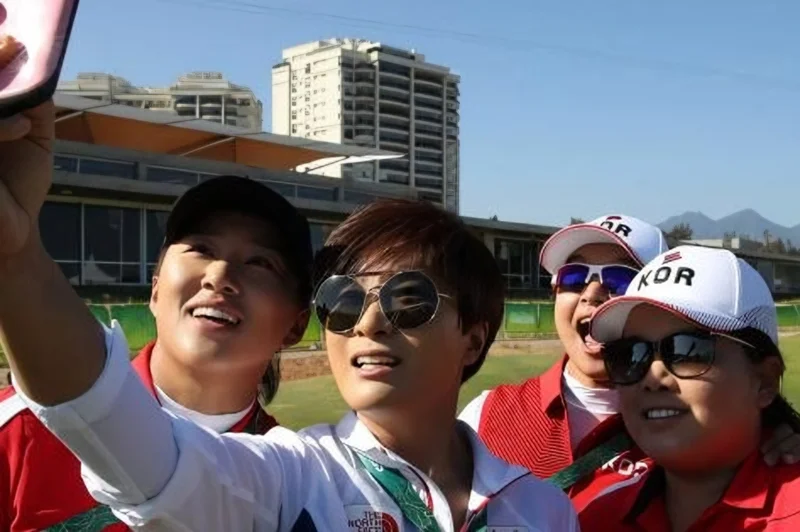
Because golf was not yet an Olympic sport during her playing career, Pak could not compete at the Games. But at the 2016 Rio de Janeiro Olympics, she made history as a coach, leading Korea’s women’s team to the gold medal.
At the time, Pak also became known for going beyond her coaching duties, personally putting on an apron and preparing doenjang jjigae, spicy stir-fried pork and other Korean dishes for her players.
That is why many believe that without Pak opening the door, the era of world-class Korean golfers such as Park would have arrived much later.
Kid who surpassed her idol
Ironically, the 2016 Rio Olympics, where Pak coached Korea to gold, also provided new fuel for the GOAT debate between the two golfers.
Pak produced an Olympic gold medal as a coach, while Park won Korea’s first Olympic gold medal in golf as a player.
From there, Park began surpassing Pak’s records one by one, earning the nickname “In-believable,” a play on her name and the word “unbelievable.”
Pak won 25 LPGA titles, including five majors, while Park finished with 21 career victories, seven of them major championships.
The argument in favor of Park gained particular momentum on Aug. 2, 2015, when she won the Women’s British Open to complete the career Grand Slam — an achievement Pak never managed.
After winning her first major at the 2008 U.S. Women’s Open, Park dominated during her peak in 2013, sweeping the Kraft Nabisco Championship, LPGA Championship and U.S. Women’s Open to become the first player to win three majors in a single LPGA season.
She also spent a total of 106 weeks ranked No. 1 in the world, became the first Korean to win the LPGA Player of the Year award, won consecutive money titles in 2012 and 2013, and in 2016 became the second Korean woman after Pak to be inducted into the LPGA Hall of Fame.
Her seven major victories remain the record for a Korean golfer.
Park’s path to becoming a star was also somewhat different from Pak’s, who endured rigorous training under the strict guidance of her “golf dad.” Park was recognized as a promising young golfer in Korea before moving to the United States in middle school, where she won numerous junior tournaments and quickly attracted attention.
In 2008, she became the youngest U.S. Women’s Open champion at 19 years and 11 months. But she then endured a four-year slump and at one point considered giving up golf altogether. Her career was revived after she met Korean golf coach Nam Ki-hyeop.
After marrying Nam in 2014, at the height of her career, Park emphasized “happy golf” and work-life balance. She has been praised for presenting a new role model that values not only competitive results but also a player’s life away from the course.
Records belong to Park, history to Pak
After retiring, Pak reinvented herself as a coach and businesswoman and, until recently, remained closely connected with the public through frequent television appearances.
Park, meanwhile, is now a mother of two. Shortly before giving birth to her second daughter, she announced her bid for a seat on the International Olympic Committee’s Athletes’ Commission and traveled around France during the 2024 Paris Olympics as she explored a new path.
She has yet to officially announce her retirement, leaving open the possibility that she could continue her playing career.
Judging solely by performance and statistics, there is little disagreement over giving the edge to Park. Seven major titles, a career Grand Slam and 106 weeks at No. 1 are objective indicators of her status as the greatest Korean female golfer in terms of competitive achievement.
But the title of “greatest player” can encompass more than statistics. It can also include the ability to change an era and rewrite the history of a sport.
By that measure, Pak was the pioneer who propelled Korean women’s golf to the top of the world.
That is what makes the debate so difficult.
If records are the priority, Park has the edge. If historical impact is the measure, Pak does.
That is also why NBC Sports compared the two to George Washington and Abraham Lincoln.
This article from the Hankook Ilbo, the sister publication of The Korea Times, is translated by a generative AI system and edited by The Korea Times.