Some couples expose their lives publicly and then begin living according to what their audience expects, and that can ultimately damage their relationship.
Stories about international married couples are not hard to find on video platforms such as YouTube.
Most are presented in the form of vlogs documenting everyday life, but the small and large incidents arising from differences in culture and language offer a unique appeal not found in other types of videos.
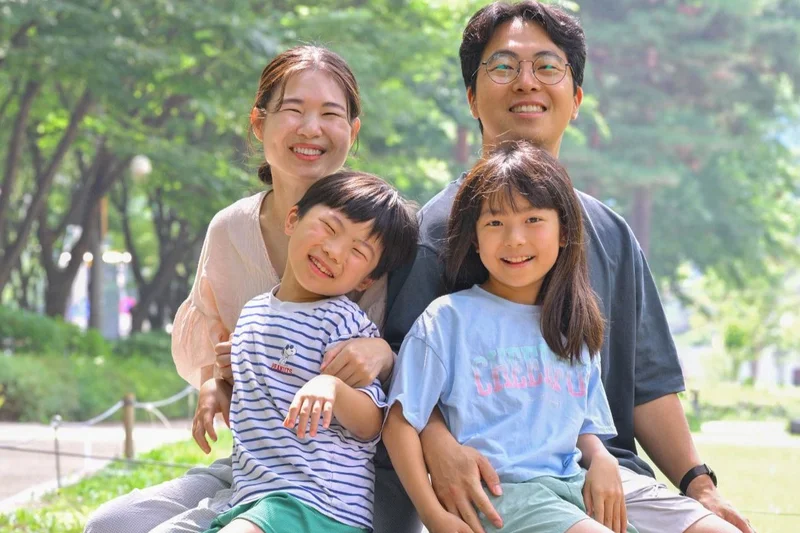
Lee Jung-jae, 41, and his Japanese wife, Aino Keiko, 42, are approaching their 10th wedding anniversary. The couple have been raising their two children while alternating between life in Korea and Japan, documenting their experiences on their YouTube channel, Hanane’s Day.
Considered among the first Korean-Japanese YouTuber couples, the couple spoke with the Hankook Ilbo at a cafe in Mapo District, western Seoul, last month about the pros and cons of being creators and the realities of international marriage.
Here are some parts from the interview.
Q: How did you meet and eventually get married?
Lee: I briefly went to the Philippines for a short-term language program in 2011. A friend I met there later went to Canada, where he met my wife, who was working there. When our friends held gatherings in Korea, they invited me, and that was how I first met her. We remained friends for about six years.
Keiko: When we first met, we were both dating other people. There was also a period of about a year when we didn't communicate at all. Then one day, he suddenly contacted me and asked if I knew any good places to visit in Osaka. We started talking a lot after that. By then, neither of us was in a relationship, and we were both at an age when we were thinking about marriage. We naturally grew closer and got married in 2017.
Q: Did you live in Japan after getting married before moving to Korea?
Lee: We had lived in Korea. I took parental leave and spent a little over two years in Okayama, Japan, my wife's hometown, starting at the end of 2023. We then returned to Korea. We plan to continue living in Korea, but if our children eventually want to attend school in Japan, we are open to moving there.
Q: What prompted you to start your YouTube channel?
Lee: I was the one who suggested it in 2019. Financial considerations were a major factor. My wife was initially opposed to the idea.
Keiko: I felt uncomfortable with the idea of revealing all of our private lives to strangers, and I didn't like the thought of people seeing me first thing in the morning without makeup. But after we started, my parents in Japan watched our videos and were able to talk with us about how much the children had grown. That made me feel that starting the channel had been a good decision. I also feel rewarded when people leave comments saying that our videos help them relax or feel healed.
Q: Were there many YouTube channels featuring internationally married couples at the time?
Lee: Not nearly as many as there are now. When I looked them up back then, there were fewer than 10.
Q: What kind of content do you mainly feature on the channel?
Lee: We focus on showing our everyday lives naturally. We don't want to write scripts and manufacture situations just to increase views because that wouldn't represent who we really are. Our principle is to simply show how we live and build a channel that we can maintain for a long time.
Q: What kinds of content have you produced so far?
Lee: When we started, our main focus was parenting. After that, we began documenting trips with the children, with food content at travel destinations being a major part of it. We also make educational videos about some of the difficulties we encounter while going back and forth between Korea and Japan.
Q: How do you handle filming and editing?
Keiko: I do almost all of the filming. I simply record things naturally as a mother and turn them into content. I learned editing by watching my husband, and I now edit the videos myself on a MacBook using Final Cut.
Q: What are some of the challenges involved in producing your content?
Lee: Since our subscribers are roughly split between Korea and Japan, it is difficult to make videos that don't trigger prejudice or misunderstanding.
For example, we once uploaded a video of taking our children to Seodaemun Prison History Hall around March 1 Independence Movement Day or National Liberation Day. Japanese subscribers did not react well, and nearly 1,000 people unsubscribed at once.
On the other hand, when we post a lot about our life in Japan, we get comments such as, “You've become Japanese,” or, when we say Japanese food is delicious, people say things like, “Then just stay there.”
When we were living in Japan and uploading videos, we kept losing Korean subscribers. When we deal with historical issues, Korean and Japanese subscribers sometimes get into arguments with each other in the comments.
Q: There have been reports that marriages between Korean men and Japanese women have increased recently. Is that actually the case?
Lee: When we started the YouTube channel, we also started using Instagram, and we received a lot of direct messages. Japanese women would contact us saying they had Korean boyfriends and asking for advice about various concerns. My wife would reply to them, and that's how I realized there were many Japanese women who wanted to date Korean men.
After we started our channel, I saw many similar channels emerge, and it felt to us as though the number of Korean-Japanese couples had increased dramatically over the past three or four years.
Q: Watching your YouTube videos, life in an international marriage can look very enjoyable.
Lee: The life of an internationally married couple isn't necessarily glamorous, prosperous or happy all the time. Influenced by YouTube and other platforms, some people develop fantasies about international marriage and even spend money pursuing relationships. If everyone who did that ended up happily married, I would wholeheartedly recommend it. But when you look around, there are many cases that eventually end in divorce.
Speaking specifically about YouTube channels, most of the Korean-Japanese couples who started channels around the same time as us — or even later but eventually gained more subscribers than we did — have divorced and deleted their channels. It's not just one or two couples.
Q: Does that mean life as a Korean-Japanese couple is particularly difficult?
Lee: Not at all. There are plenty of Korean-Japanese couples who don't make YouTube videos and live happily together. What I mean is that some couples expose their lives publicly and then begin living according to what their audience expects, and that can ultimately damage their relationship.
What people see in the videos wasn't their real life in the first place. That's what we are most cautious about. We don't want to create contrived videos just for views. We want to stick to the concept of showing our natural everyday lives.
Q: Apart from YouTube, are there other reasons Korean-Japanese couples break up?
Keiko: Some Japanese women marry Korean men while imagining, from watching dramas, that Korean men are gentle and will do everything they want for them. But that's fiction. After actually getting married and moving to Korea, they may find themselves without friends and unable to communicate properly. As their loneliness grows, they may think, “This isn't what I got married for,” and eventually separate.
Q: Are there any difficulties Korean men commonly experience after an international marriage?
Lee: When Korean husbands in international marriages get together, the first issue they mention is usually finances. Some husbands feel pressured because they believe they have to support their wives financially but don't earn enough.
They work hard, taking overtime and extra shifts because they want to earn more. But then the amount of time they spend together as a couple decreases, leaving their wives feeling lonely. They may argue over these issues, and eventually one spouse says, “Fine, then go back to Japan,” and the marriage falls apart.
I've rarely seen cultural differences alone cause a breakup. Many men enter these relationships thinking Japanese women will be more family-oriented than Korean women. That's not necessarily true. It depends on the individual. In fact, there are many men who say that after getting married, they found their Japanese wives to be strong-willed and wanting to have things their own way.
Q: Have you developed any know-how from producing videos over the years?
Lee: We keep our videos to around 12 minutes, and no longer than 15 minutes. People don't watch for that long. We also try to upload at least once a week.
Sometimes, if you don't upload for a while, a subscriber may suddenly come across one of your videos and think, “Was I subscribed to this channel?” and unsubscribe instead.
Q: How do you make money from the channel, and how much do you earn?
Lee: At present, our income from views is roughly equivalent to the minimum wage. We receive many offers for advertising, but if we do too much, we lose subscribers. So we keep it to a minimum.
We generally accept public-interest projects, such as promotional campaigns for local governments in Korea and Japan. Altogether, we include advertising in about two videos a month.
Q: What advice would you give internationally married couples who want to run a YouTube channel?
Keiko: They should think of it as a hobby rather than something to quit their jobs for. If you do that, it can feel like you're working 24 hours a day. And once children are born, they could end up being the ones who suffer.
Lee: I would tell them not to make videos that portray a fabricated version of their lives. Once you experience a video going viral because of that kind of content, you can easily become locked into making more of it. I've seen many couples develop conflicts as a result.
If you're constantly thinking, “We have to film this quickly” or “We have to upload this quickly,” you can eventually become confused about whether you're actually living a married life or simply living together to make YouTube videos.
This article from the Hankook Ilbo, the sister publication of The Korea Times, is translated by a generative AI system and edited by The Korea Times.