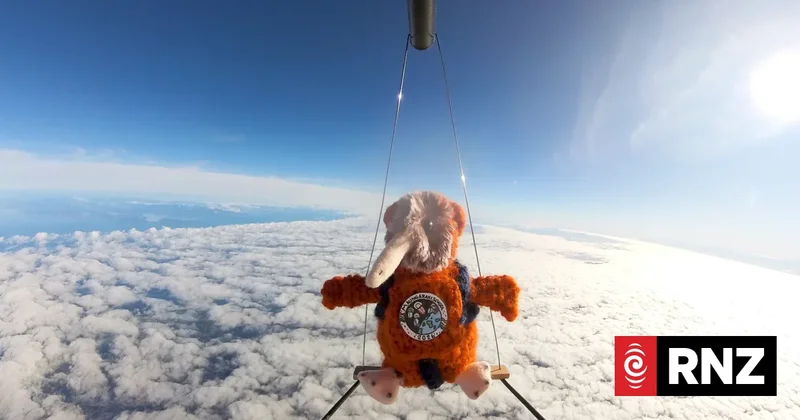
Lower Hutt primary school students have successfully launched and retrieved a weather balloon which went high into the atmosphere.
A group of 10 pupils at Maungaraki School launched a high-altitude balloon (HAB) on Tuesday from their school field.
The balloon recorded video with two 360-degree cameras, longitude, pressure, altitude and temperature during the flight, which the children used to map out its path in 3D.
Each of the pupils had a role, from looking after the trackers and electronics to wiping the camera lenses.
Armed with clipboards and enthusiasm, they milled about getting everything ready for the launch and recovery.
One student, Angad Singh, acting as avionics engineer, told RNZ he could not sleep the night before the launch due to excitement.
He said he had learnt about different kinds of electronic equipment and design.
"The wind will carry it into the Wairarapa and we'll be chasing it in a group of cars, and we're hoping that it lands in a farm so we can find it easier."
Pupil Matilda Evennett was in charge of logistics and recovery: estimating landfall location and liaising with landowners.
"There's this website ... we ... use that and then it shows us the estimate of where it's going to land," she said.
Matilda said learning more about space and rockets has made her want to study it more at high school and college.
"I just like how it's infinite and there's endless possibilities out there," she said.
Max Luke, one of the students in charge of building the box, stayed behind to feed information to the group about the balloon's potential whereabouts.
He told RNZ he had had a lot of fun learning and was excited to see the balloon launch.
His mum, Cassie, said the school had done very well to get the project done.
"It's been an awesome opportunity for him. It's just super exciting that he gets to experiment and just check out all different areas of science, maths, technology."
Maungaraki School student Angad Singh.
RNZ / Baz Macdonald
Design teacher Ashton Stuart helmed the project, organising sponsors and experts to help it come to life.
The balloon landed on a farm in Pahiatua on Tuesday afternoon, less than 10km away from the predicted landfall.
"The payload went up three times the height of Mount Everest," Stuart said.
"We've got an altitude reading of 26,700 metres - edge of space."
Stuart said the owner was excited to help.
Design teacher Ashton Stuart with the retrieved balloon.
RNZ / Baz Macdonald
The children had prepared a gift pack, filled with sweet treats and coffee, for potential landowners on whose property the balloon might land.
Because of the difficult terrain, Stuart said only he could join the farmer on a quad bike to retrieve the payload - "this tiny little orange speck in the middle of really, really dense scrub and trees".
It took 45 minutes of fording rivers, clearing dense bush, walking up steep ravines and climbing a tree to get it.
The children were brought to an ice cream shop to celebrate.
Stuart said the hands-on approach allowed the children to interact with complex physics and maths without realising it.
"For example, our balloon, there's a certain part where it's going to get up to -50, -60C.
Maungaraki School students Roniel Acheampong and Matilda Evennett.
RNZ / Baz Macdonald
"And so the challenge then is how do you plan a payload box with heat warmers and all sorts to keep those electronics alive?" he said.
He documented the massive undertaking to help other schools do the same; only a couple of schools in the country have ever done a similar balloon launch.
"I just feel so fortunate that I work in a school that really supports teachers' individual passions and interests.
"I honestly couldn't be prouder of the MASA team - the Mangaraki Aeronautic Space Administration," he said, "They've worked so hard over the past 10 weeks."
The balloon came down in trees on a farm.
RNZ / Baz Macdonald
He told RNZ he wanted to get the students excited about science, and hopefully spark an interest in a STEM career.
The project's complexity required some outside help.
MetService regularly launch weather balloons across the country.
Network operations manager at the weather agency Steve Knowles assisted the school.
"The atmosphere drives everything that we do down here on the surface. Knowing what's going on up in the upper atmosphere is extremely important," he said.
Maungaraki School students Marcus Hu, Ajay Saravanan, Max Luke, Diaz Herapath.
RNZ / Baz Macdonald
He encouraged children to learn more about space and science.
"Go for it. It's a very exciting industry. No two days are the same. And yeah, you're helping do something for the future."
The Hutt Valley Amateur Radio Club helped with the transmitters inside the payload.
Member Ray Brown has a grandchild at the school. He helped video the launch from his electronic telescope.
Maungaraki School students Roniel Acheampong, Matilda Evennett, Halley Marsh, and Dominique Rapana.
RNZ / Baz Macdonald
He said one of the biggest challenges was getting the toy kiwi bird attached to the box to stay still.
"The hair on its face was all over the place and we had to use hairspray so you could see his eyes. And the swing is held in place by bits of wire to stop it swinging, things like that," he said.
Back Row: Benjamin Ferguson, Marcus Hu, Ajay Saravanan, Max Luke, Diaz Herapath, Angad Singh and Front Row: Roniel Acheampong, Halley Marsh, Matilda Evennett, Dominique Rapana.
RNZ / Baz Macdonald
The balloon seen floating in the air.
RNZ / Baz Macdonald