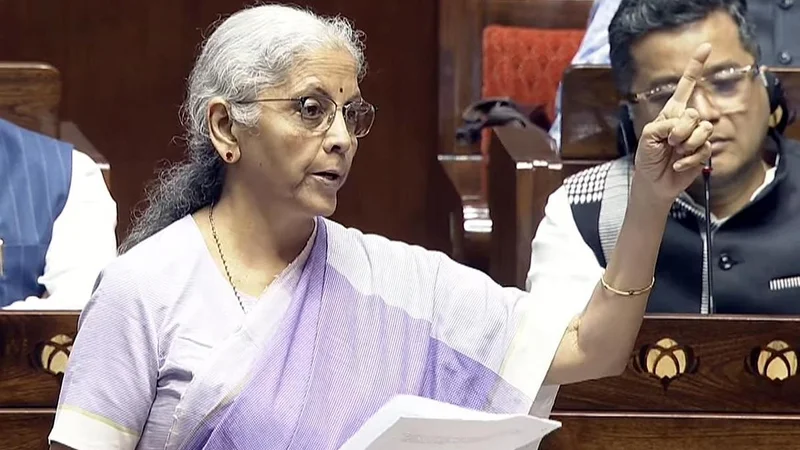
Amid the Opposition walkout, the Rajya Sabha passed the Bankers’ Books Evidence Bill and returned the Taxation and Other Laws (Amendment) Bill on Monday (August 10, 2026). Countering the Opposition’s charge that the Taxation Bill proposed further burden on small traders and consumers by imposing a tax on Unified Payments Interface (UPI) transactions, Finance Minister Nirmala Sitharaman said they would remain free for consumers. She added that once the Bill was passed, the National Payments Corporation of India could finalise the Merchant Discount Rate (MDR), which would be applied to to certain categories of merchant transactions. The Upper House had witnessed disruptions and adjournments in the morning too.
CPI(M) member John Brittas moved a statutory motion to disapprove an ordinance brought by the Finance Ministry in June 2026. The statutory motion and the Bill were discussed together. Mr. Brittas said there was no need for a hurried ordinance when the House was to meet for the Monsoon Session in July. He accused the government of being subservient to the United States and said the charges of UPI transactions were based on the U.S. diktats. He said it would create difficulties for small trades.
“The Prime Minister promised that UPI will be free for everyone,” he reminded the government. The Opposition members had walked out soon after Mr. Brittas moved his statutory motion. Mr. Brittas later returned to reply to the debate on the motion, which was objected by BJP members. During the debate, AAP member Sanjay Singh said the new Bill would create problems for the public as digital transactions had become a part of trade and commerce.
Countering all these arguments, Ms. Sitharaman said UPI had remained free for consumers since its launch, and every Indian would continue to make instant digital payments without paying a transaction charge. “Will consumers pay any UPI charge? No, consumers will not have to pay any charges on UPI transactions,” she said. Adding that vast majority of merchant transactions, including low-value transactions to roadside vendors, would continue to remain free.
‘An enabling provision’
She said the new legislation, which was passed in the Lok Sabha last week, would amend Section 10A of the Payment and Settlement Systems Act, 2007, and it was an enabling provision and it did not impose any tax or transaction charge on UPI users. “The Bill enables the government to specify, through notification, the electronic payment modes that will continue to receive statutory protection against charges. Once the Bill is passed by Parliament, the UPI and Services Steering Committee headed by NPCI will consider and decide whether any MDR should be introduced and, if so, its scope and structure,” the Finance Minister said, adding that any future MDR would apply only to a limited category of merchant transactions above a prescribed threshold.
When Mr. Brittas walked out soon after his reply, Ms. Sitharaman said Communists in this country were total cowards and they could not face facts, but “they will go on filibustering, making noise.”
The Bankers’ Books Evidence Bill, 2026, also passed by the Lok Sabha last week, makes the bankers’ books align with contemporary digital banking practices. Ms. Sitharaman said the banking and financial sector had evolved significantly over the past few decades with the emergence of Non-Banking Finance Corporations, payment aggregators, fintech companies, and other service providers with a pan-India presence. These entities perform an important role in fulfilling the banking and financial needs of the common people. It was, therefore, necessary that whenever and wherever required, they were provided a similar evidential framework, she added.
Proceedings interrupted
Earlier, the Rajya Sabha proceedings were interrupted twice in the morning session with continued protests from the Opposition demanding a statement from Home Minister Amit Shah on the police action on July 20 on protesters in Delhi. The Opposition members also raised slogans about the alleged theft of donations at the Ram Temple in Ayodhya.
Opposition MPs gathered around the front row and raised slogans, demanding that Leader of the Opposition Mallikarjun Kharge be allowed to speak. Rajya Sabha Chairman C.P. Radhakrishnan asked the protesting members to return to their seats before the request could be considered. Most of the speeches during the Zero Hour, when members can raise issues of national interest, were drowned in the din. CPI member P. Sandosh Kumar used the opportunity to question the government on the absence of Prime Minister Narendra Modi and Mr. Amit Shah in the House. As the ruckus continued, Mr. Radhakrishnan adjourned proceedings till 12 noon. As the House resumed for Question Hour at 12 noon, Power Minister Manohar Lal stood up to respond to questions on various energy-related issues. However, the Opposition parties led by the Congress continued raising slogans, disrupting House proceedings. Amid din, Mr. Radhakrishnan adjourned the House till 2 p.m.
Published - August 10, 2026 10:22 pm IST