Europe Intelligence Brief — Monday, August 10, 2026
Executive Summary
Europe Intelligence Brief for August 10: Western Europe recorded its warmest June and July ever, the Rhine, Danube and Seine are disrupting shipping and power, and three continents are now tightening their harvests at once.
Rio Times · Europe Intelligence Brief August 10
And with Africa and Asia tightening at the same time, that becomes a price signal for Latin American exporters.
Europe – The Record, and What Sits Underneath It
Warmest June and July ever measured
Western Europe averaged 21.62 degrees across June and July, the European Union’s climate service reported on Monday, 2.79 degrees above the 1991 to 2020 mean and above the previous record set in 2022. Its records run back to 1950.
The region has now had four separate heatwaves since May, which the service describes as exceptional. Eastern Europe and Scandinavia were markedly cooler, and for the continent as a whole July was only the eleventh warmest on record.
The soil is the number that matters
Surface soil moisture in Western Europe was clearly lower in July than during the drought July of 2022, with parts of Iberia, France, Germany, Austria, Hungary and Britain drier than average. The world’s oceans meanwhile recorded their warmest July on record at 20.96 degrees.
The service’s climate lead put the mechanism plainly, saying that when soils dry out they lose their ability to cool naturally, so heat builds more easily. Heat and drought, she said, are increasingly reinforcing each other.
The Rivers – Three Arteries Running Low
Shipping, irrigation and power at once
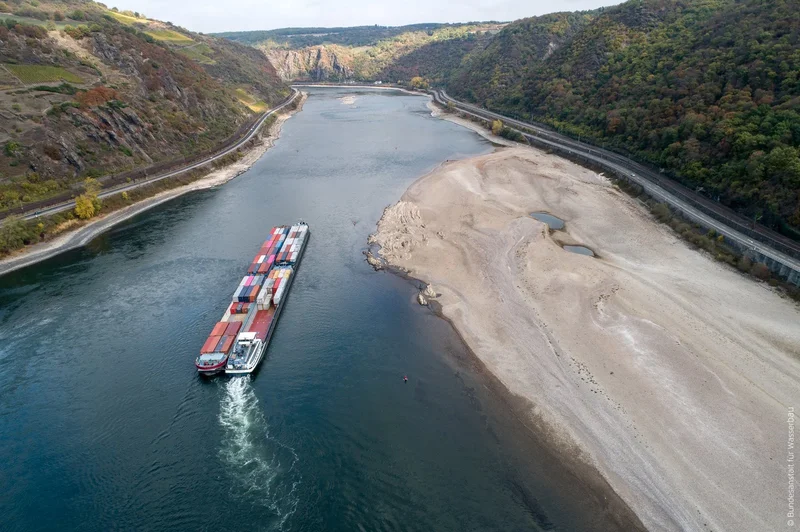
Levels on the Rhine, the Danube and the Seine are unusually low. Several countries have reported disruption to inland shipping, to irrigation and to electricity generation.
These are the arteries that move German chemicals, Dutch grain and Central European steel. When barges load light, freight costs rise across the whole corridor.
A continent discovering its own fragility
Europe has spent two decades treating its inland waterways as settled infrastructure. Three summers in five years have now shown that assumption to be wrong.
The mood is not alarm so much as a grudging recalculation. This is a continent adding a line to its cost base that was never there before.
Germany – Where the Weather Reaches the Accounts
Farms under pressure, output falling
Drought and heat are squeezing German agricultural businesses, and the farmers’ association is demanding faster action from government. German meat production has fallen again, with the decline particularly clear in poultry.
June was almost three degrees above average in Germany, with the southwest markedly warmer than the northeast. A second consecutive summer of this kind stops being weather and starts being a supply forecast.
Two numbers about German labour and tax
The trade union federation calculates that around two million employees are underpaid relative to the minimum wage each year, putting the cumulative shortfall since 2015 at roughly 64 billion euros against a statutory floor of 13.90 euros an hour. Separately, the finance minister has withdrawn a plan to tax associations more heavily after sustained criticism, striking the provision from the bill.
He said the intention had never been to reach small clubs but business associations and federations. A government retreating from a revenue measure it had just drafted says something about how little room it has.
Spain – Two Hundred Thousand Hectares and a Revised Number
The fire season moves north
Nearly 200,000 hectares have burned in Spain since the start of the year. The European climate service notes that the fire season is extending northward, and that larger fires send smoke higher and further, affecting air quality thousands of kilometres away.
Spain is the European Union’s largest producer of olive oil and a major supplier of fruit and vegetables. What burns there is felt in food prices across the bloc.
Madrid revises Ceuta upward
The government now estimates that around 80,000 people entered the North African enclave of Ceuta irregularly during the surge of late July, up from a previous figure of 72,000. The territorial policy minister gave the revised number during a visit to the exclave on Monday.
Most of those who crossed returned to Morocco within 24 to 48 hours, and the surge occurred mainly on 30 July. Revising a figure upward by eight thousand two weeks later tells you how uncertain the counting was.
Three Continents – One Harvest Tightening
The same story from Lusaka to Seoul
The World Food Programme warned last week that a strengthening El Niño could push nearly 49 million more people into acute hunger by the end of 2027, with Southern Africa among the hardest hit. In Asia, China’s own state newspaper reported economies facing food security risks while Korean employers shortened the working day for heat.
Europe has now added its own record. Three continents are tightening their agricultural output within the same fortnight.
What that means for Latin America
This is not a weather story for Latin American readers, it is a price story. Simultaneous supply pressure across Europe, Africa and Asia points to firmer markets for soy, corn, beef, coffee, sugar and wheat.
Brazilian and Argentine exporters are the residual supplier when three other continents come up short. The risk sits on the other side of the same coin, since the weather system driving all of it does not stop at the Atlantic.
Energy – The Second Cost Line
Low water meets high fuel
The same low river levels disrupting freight are also affecting electricity generation, at a moment when European energy costs remain politically sensitive. Two constraints are arriving in the same quarter.
On the Strait of Hormuz, Tehran’s stated conditions continue to increase pressure on Washington, and nothing has been settled. Any resolution would ease European input costs immediately.
The quiet week that is not quiet
France, Italy and Britain produced nothing of substance on Monday, deep in the European holiday. That silence is seasonal rather than significant.
The costs accumulating in the meantime are not seasonal at all. Europe will return to its desks in September with a harvest, a freight bill and an energy question all worse than when it left.
Europe Intelligence Brief August 10: What We Are Watching
- This week – Whether Rhine levels fall far enough to force further load restrictions on barge traffic.
- Coming weeks – European harvest estimates, after a July drier than the drought of 2022.
- September to December – The forecast peak of the El Niño already tightening African and Asian supply.
- Coming months – Spanish fire totals, already near 200,000 hectares for the year.
- September – European parliaments returning, with a harvest and freight bill waiting for them.
- Ongoing – The Strait of Hormuz, where Tehran’s conditions remain unresolved.
More from the Rio Times Intelligence Desk on August 10: the Africa Intelligence Brief, the Asia Intelligence Brief and the USA & Canada Intelligence Brief. For how these stories developed, see the Europe Intelligence Brief for August 7 and the Europe Intelligence Brief for August 6.
Frequently Asked Questions
How hot was the European summer of 2026?
The European Union’s Copernicus climate change service reported on Monday that Western Europe averaged 21.62 degrees Celsius across June and July, 2.79 degrees above the 1991 to 2020 mean and above the previous record set in 2022, in records running back to 1950. The region has had four separate heatwaves since May, while Eastern Europe and Scandinavia were markedly cooler and July across the whole continent was only the eleventh warmest on record.
What is the economic effect of the low river levels?
Levels on the Rhine, Danube and Seine are unusually low, and several countries have reported disruption to inland shipping, irrigation and electricity generation. Those rivers carry a large share of German chemical, Central European steel and regional grain freight, so reduced barge loading raises transport costs along the whole corridor.
Why does this matter for Latin American exporters?
Africa, Asia and Europe are all reporting agricultural supply pressure within the same fortnight, after the World Food Programme warned that El Niño could push nearly 49 million more people into acute hunger by the end of 2027 and Chinese state media reported Asian economies facing food security risks. Simultaneous tightening across three continents points to firmer prices for soy, corn, beef, coffee, sugar and wheat, with Brazilian and Argentine producers positioned as residual suppliers.
How many people entered Ceuta in the July surge?
Spain’s government now estimates around 80,000 people entered the North African enclave irregularly, revised upward from a previous figure of 72,000, according to the minister for territorial policy speaking during a visit on Monday. The surge occurred mainly on 30 July and most of those who crossed returned to Morocco within 24 to 48 hours.
Sources: Copernicus via Tagesspiegel, ZDF, Tagesspiegel, Cleanthinking
This article was produced by The Rio Times’ automated newsroom system. How we use AI · Report an error
LatAm Markets: Live Signals → — real-time movers, turnover leaders and FX across Latin America.