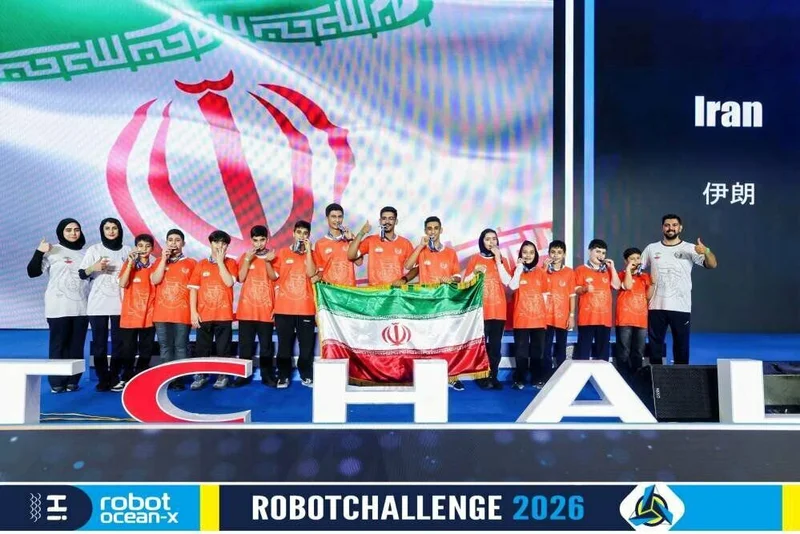
Iranian students shine at RobotChallenge 2026
TEHRAN – Thirteen Iranian students aged below 12 have showcased their scientific, technical capabilities, and creativity ranking second and third in different leagues of the RobotChallenge 2026 which was held in Beijing, China.
Each year RobotChallenge, one of the world’s largest artificial intelligence robotic championships, brings together people from all over the world who compete with self-made, autonomous robots in various competitions.
Kicked off on August 8, the event brought together participants from some 48 countries including China, Russia, Romania, Iran, Japan, Germany, and South Korea, IRNA reported.
Iranian students ranked second in Technical Report league, third in Robot Rugby- senior, and Innovation.
The achievement demonstrates the capabilities andproficiency of Iranian students in constructing and operating robots, design process, problem-solving, and the effectiveness of technical presentations.
Recent achievements
At the Rayan 2025 international artificial intelligence and programming competition, known as the World Finals, Iranian students showcased strong performance in both the AI and programming sections. In the programming section, Ali Safari was placed first. China secured second and third place, followed by India, Vietnam, Armenia, Serbia, and Pakistan, respectively, ISNA reported.
In the AI section, Iranian teams, namely no Trust issues here, Pileh, AI Guardians of Trust, AIUoK, red-serotenin, Persistence, and GGWP were placed first to seventh.
The final round of the Rayan international artificial intelligence and programming contest was held on Friday at Sharif University of Technology in Tehran, with participants from 25 countries.
Supported by the Vice Presidency for Science, Technology, and Knowledge-Based Economy, the event kicked off on November 25, attracting hundreds of contestants from the U.S., Russia, China, India, Italy, Chile, Australia, Armenia, Pakistan, Bangladesh, Belarus, Afghanistan, Ukraine, Taiwan, Romania, Singapore, Poland, Slovakia, Vietnam, Serbia, Argentina, Colombia, Kazakhstan, and Ethiopia, as well as the host, Iran.
The solo programming section was held with 60 Iranian and foreign participants who worked individually to solve nine complicated algorithmic problems within a duration of three to four hours.
The scientific competition aimed to promote knowledge, foster international networking, and establish scientific authority in AI and programming.
Enhancing algorithmic thinking, problem-solving skills, teamwork, developing innovative ideas, starting new businesses, and expanding AI engineering and programming were among the other objectives of the contest.
MT/MG