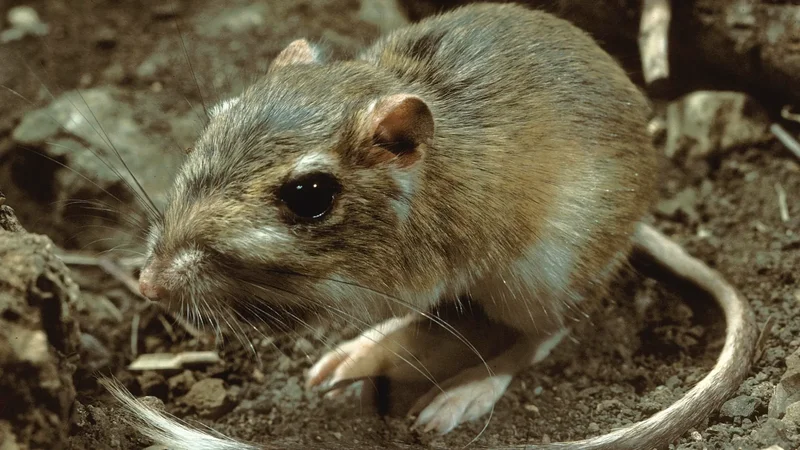
Government organizations and landowners across Texas are teaming up to help a tiny rodent that is at risk of extinction. Meet the Lone Star State’s own kangaroo rat (Dipodomys elator).
There are 23 species of kangaroo rat in North America, and the Texas kangaroo rat calls the state’s west-central Rolling Plains region home. While the small nocturnal creature looks nothing like a kangaroo, it likes to hop on its hind legs, hence the name. Texas kangaroo rats weigh up to 4.5 ounces and can reach up to to 13.75 inches in length, though that number mostly comes from their long tails, which make up more than half their size.
Unfortunately, this adorable creature is under threat, largely because of habitat loss and degradation. The species’ preferred habitat—short grasses interspersed with minimal woody cover—depends on periodic disturbances to keep the grass at the right length. The historical removal of American bison (Bison bison)and the eradication of black-tailed prairie dogs (Cynomys ludovicianus), as well as fire repression, have reduced the natural disturbances that provide the species with a suitable habitat. At the same time, its native range has been destroyed in favor of crop fields, further decimating its habitat.
In 2022 the Texas Parks and Wildlife Department (TPWD) proposed a voluntary agreement to incentivize private landowners to help conserve the rat. As part of the Conservation Benefit Agreement, landowners within the animal’s historical range collaborate with federal and state governments to protect the species and its habitat.
“The beauty of management for the Texas kangaroo rat is that the actions that it requires are already compatible with [cattle] ranching and most of the land uses you see in this region,” Darren Proppe, a biologist at the TPWD, said in a statement. “In fact, having cattle on land can be beneficial because it maintains areas of bare ground and sparse cover that are utilized by the Texas kangaroo rat.”
According to the TPWD, the agreement promotes good land ownership through “prescribed grazing, prescribed fire, range planting and reseeding, and brush management.” Land owners can tailor the practices they’ll use to their needs, while protecting this species.
“This little species has been hanging on for a long time and now it finally has a team in its corner,” added Jennifer Khan, a U.S. Fish and Wildlife Service biologist. “By working together, we can give the Texas kangaroo rat a real shot at recovery.”