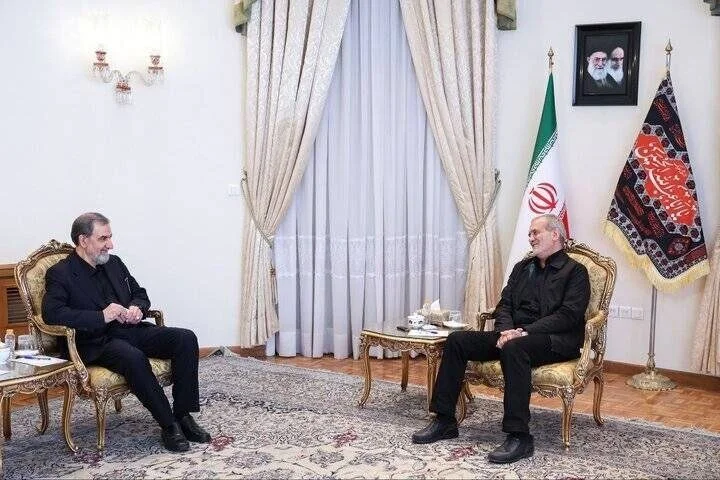
Rezaei appointment highlights lockstep coordination between Iran’s military and political leadership
Pezeshkian names Rezaei as SNSC secretary after the Leader designates him as his representative to the council
TEHRAN — Certain Western and regional media outlets have attempted to cast a new spotlight on alleged rifts between Iran’s military and political leadership following the appointment of Major General Mohsen Rezaei as secretary of the country’s top security body.
President Masoud Pezeshkian appointed Rezaei, a veteran military commander and political figure, as the new secretary of Iran’s Supreme National Security Council (SNSC) on Sunday. The move came after Iran’s Leader, Ayatollah Seyyed Mojtaba Khamenei, designated Rezaei as his representative to the SNSC, the country’s highest decision-making body responsible for formulating and coordinating policies on defense, security and foreign affairs.
Far from representing a rupture between Iran’s political and military establishment, however, Rezaei’s appointment can be viewed as a manifestation of closer institutional coordination at a time when Iran faces continuing external pressure and delicate negotiations over the future of the region.
Rezaei replaced Mohammad Bagher Zolghadr, who has now been named as a political adviser to the Leader. Zolghadr had succeeded Ali Larijani, who was assassinated in a US-Israeli strike in March.
Rezaei assumes the SNSC post amid ongoing talks between Iran and Oman over the Strait of Hormuz, a strategic waterway over which Iran has maintained sovereign control since the joint US-Israeli aggression began on February 28.
The Strait of Hormuz has remained at the center of the broader confrontation between Tehran and Washington, with Iran repeatedly making clear that its control over the waterway is a matter of national sovereignty and strategic security rather than an issue open to outside dictate.
Rezaei himself has placed particular emphasis on Iran’s control of the strategic waterway. Last week, he warned the United States that it would “face serious risks and casualties” if the American blockade of Iranian ports continued. In July, he went even further, saying that control of the Strait of Hormuz was worth more than “dozens of atomic bombs.”
Such statements have been interpreted by some foreign media outlets and analysts as evidence that Rezaei’s appointment could strengthen the position of those inside Iran opposed to diplomacy with Washington. That interpretation, however, overlooks the broader position of the Iranian leadership, which has repeatedly combined a willingness to pursue diplomacy with an equally clear insistence that diplomacy cannot come at the expense of sovereignty, security or the country’s right to defend itself against aggression.
The narrative of a struggle between so-called “moderates” and “hardliners” is not new. It has long been used by Washington and some regional allies in an attempt to portray Iran’s political system as divided into competing camps that can be manipulated against one another.
Iranian political and military officials have repeatedly rejected such a framework, describing it as a form of psychological warfare designed to obscure the reality that the country’s principal institutions can maintain a common strategic position despite differences in political style and approach.
The same narrative has resurfaced following Rezaei’s appointment, particularly after the failure of the US-Israeli military campaign to achieve its stated objectives in Iran. The 39-day war, which began on February 28 and was paused by a ceasefire on April 8, did not produce the outcome anticipated by Washington and Tel Aviv.
The consequences of that failure have even been acknowledged, directly or indirectly, by Western political figures. German Chancellor Friedrich Merz said in late April that the United States had been “humiliated” in its war with Iran. Similar assessments have emerged from US political circles. Democratic Senator Chris Murphy said Sunday that President Donald Trump had “lost this war” with Iran. “America is weaker. Iran is stronger,” Murphy told NBC.
Against this backdrop, attempts to interpret Rezaei’s appointment as evidence of an internal Iranian power struggle appear increasingly disconnected from the country’s institutional reality.
The appointment has also been portrayed by some commentators as evidence of a growing division between Ayatollah Mojtaba Khamenei and President Pezeshkian. Yet such an interpretation leaves little room for the significance of the institutional process through which Rezaei was elevated to the post. His new role followed coordination between the Leader and the president, including their latest meeting, and should therefore be understood within the framework of cooperation between them.
Ayatollah Seyyed Mojtaba Khamenei has already described Pezeshkian as a wise and honest president with a common touch, underscoring the importance of cooperation between the presidency and other state institutions at a critical moment for the country.
Pezeshkian, Parliament Speaker Mohammad Baqer Qalibaf and Foreign Minister Abbas Araghchi have all supported diplomacy and stressed the need to transform Iran’s military achievements during the recent confrontation into lasting political and legal gains. At the same time, they have made equally clear that diplomacy should not be mistaken for weakness. They have warned that Iran would deliver a crushing response to any renewed act of aggression by the United States or Israel.
That position is not fundamentally different from the one expressed by Rezaei. The distinction, therefore, is not between those who favor diplomacy and those who favor confrontation. Rather, the emerging position in Tehran is that diplomacy and deterrence are complementary instruments of national power: negotiations can be pursued when they serve Iran’s interests, while military preparedness remains essential to prevent diplomacy from becoming an instrument of coercion.
This is particularly important as Tehran and Washington confront unresolved issues stemming from the conflict and from US violations of the memorandum of understanding signed by Trump and Pezeshkian in June.
Some commentators have also claimed that Rezaei’s appointment could overshadow the role of the Foreign Ministry in negotiations with Washington. The ministry has rejected such speculation as baseless.
Foreign Ministry spokesman Esmaeil Baghaei said on Monday that Iran is a “country of institutions, not individuals,” describing this institutional structure as the reason for the Islamic Republic’s endurance and ability to withstand difficult circumstances.
He stressed that policy formulation and decision-making take place through a network of state institutions and that major national decisions, including those concerning negotiations, are made through those institutions.
Congratulating Rezaei on his appointment as SNSC secretary, Baghaei said the Foreign Ministry would, as before, make every effort, in full coordination with the top security body, to safeguard and advance Iran’s national interests.
That statement is significant because it places Rezaei’s appointment within an institutional framework rather than presenting it as a transfer of authority from the Foreign Ministry to a military figure.
Indeed, much of the divisive narrative surrounding Rezaei’s appointment appears rooted in his background as a veteran military commander. But focusing exclusively on his military record overlooks the fact that Rezaei has spent decades at the highest levels of Iran’s political and strategic decision-making.
Rezaei was appointed commander-in-chief of the Islamic Revolution Guard Corps (IRGC) by Imam Khomeini in 1981, at the age of 27. He remained in the position until 1997, making him the IRGC’s longest-serving commander. His tenure coincided with some of the most intense years of the eight-year Iraqi imposed in the 1980s, when he was deeply involved in military strategy and wartime decision-making.
His career did not end with his departure from military command. In 1997, Rezaei was appointed secretary of the Expediency Council by Ayatollah Seyyed Ali Khamenei, the martyred Leader of the Islamic Revolution. He remained in the position for more than two decades, becoming deeply involved in long-term economic and strategic policymaking.
During those years, he contributed to discussions and policymaking concerning Iran’s 20-year national vision document, foreign investment policies and the implementation of Article 44 of the Constitution. This article outlines Iran’s economic structure, dividing the economy into three sectors: state, cooperative and private. It also defines the constitutional framework for the role of each sector in the national economy.
In August 2021, late president Ebrahim Raisi appointed Rezaei as vice president for economic affairs. He also served as secretary of the Supreme Council of Economic Coordination and secretary of the government’s Economic Headquarters.
His trajectory therefore cuts across the traditional categories that foreign analysts often use to describe Iran’s political establishment.
Rezaei is not simply a former military commander entering a political institution. He is a figure whose career has moved from military command to strategic policymaking, economic management and the highest levels of the Islamic Republic’s political establishment.
That breadth of experience may ultimately prove to be the most important feature of his appointment.
As SNSC’s secretary, Rezaei is returning to one of Iran’s most sensitive strategic posts with decades of experience spanning revolutionary struggle, military command, wartime strategy, strategic planning, economic policymaking and high-level political decision-making.
His appointment could therefore help synchronize different dimensions of Iran’s national power at a particularly sensitive juncture.
At a time when Iran is simultaneously dealing with military threats, economic pressure, diplomatic negotiations and disputes over the implementation of international understandings, the ability to coordinate military, political, economic and diplomatic institutions becomes increasingly important.
Rezaei’s background gives him experience in each of these areas.
His presence at the SNSC could strengthen coordination between the security establishment, the presidency, the Foreign Ministry and other institutions involved in national decision-making. It could also give greater strategic weight to Iran’s negotiating position by ensuring that diplomatic initiatives are closely aligned with the country’s broader security calculations.
Equally important, Rezaei’s appointment could help bridge different political currents inside the country. His long career has taken him beyond the boundaries of a single institution or political faction. He has served under different administrations and worked within both military and civilian structures.
His appointment is not about one faction prevailing over another. Rather, it indicates that Iran’s leadership is seeking to bring different sources of national power under a more unified strategic framework.
The central issue, therefore, is not whether Rezaei represents the military establishment or whether Pezeshkian represents diplomacy. The more important question is how Iran combines military deterrence, political unity and diplomacy in pursuing its national interests.
Rezaei has demonstrated throughout his career that he understands the requirements of both confrontation and negotiation. His experience in the Iran-Iraq war taught him the importance of military preparedness and deterrence, while his decades in political and economic institutions exposed him to the complexities of statecraft, policymaking and long-term national planning.
For those who view every appointment through the familiar “moderates vs. hardliners” lens, the reality may be more institutional: Iran is seeking to coordinate its military power with its political authority and diplomatic strategy, rather than choosing one over the other.