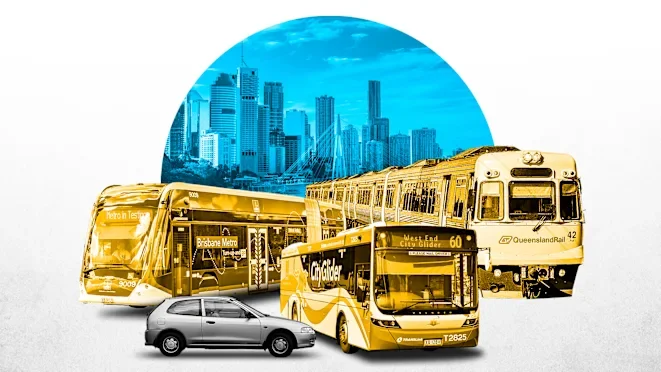
Living in the inner city isn’t always the best way to secure the quickest trip to the CBD on public transport.
GoThere Brisbane analysis of 205 suburbs within 20 kilometres of Central Station discovered some outer locations such as Zillmere had faster public transport commutes than closer suburbs such as Coorparoo.
The analysis looked whether a door-to-door commute into the CBD by 9am was faster on public transport or driving, and the number of routes and frequency within a 10-minute walk, measured from each suburb’s centre of population.
Among the best suburbs was Newstead, which had a 22-minute trip and 54 routes within a 10-minute walk.
Public transport beat the car in 72 suburbs, including Chelmer, Northgate, Zillmere, Taringa, Corinda, Strathpine, Graceville and Sherwood.
On the other end of the spectrum, Upper Brookfield, in the outer west, had no practical public transport commute to the city, with no stops within a 10-minute walk.
The nearest train was 11.4 kilometres away.
In some inner-city suburbs, such as Paddington, Spring Hill and Annerley, a trip on public transport was comparable with a car journey in morning peak.
Franklin Smallwood, a student from Paddington, said he had great public transport options and several routes into the city.
However, he said a car or bus trip often took about the same time.
“The only issue with getting into the CBD is that during peak hours there will often be some completely full buses, but the frequency makes that not a major issue,” he said.
The fastest door-to-door trips via public transport were from Bowen Hills, Fortitude Valley, Milton, Newmarket, South Brisbane, Taringa, Northgate and Wilston.
All the journeys from those suburbs were on a train, and they were all faster than a car.
Despite the train being faster, only one in three suburbs had a train station within a 10-minute walk.
In Brisbane, 58 per cent suburbs only had buses within a 10-minute walk and just five – the city, Spring Hill, Milton, South Brisbane and Newstead – had trains, buses and ferries.
GoThere founder Stuart Crispe said he was a big believer in “letting the train take the strain”.
“I really wanted to see how bus-reliant suburbs stacked up against rail lines, especially since I didn’t give bus options much thought the last time I moved,” he said.
“Data like this would have been genuinely useful to have back then.”
Crispe said the biggest thing that stood out to him was how much dedicated corridors mattered compared with distance from the CBD.
“Some suburbs much further out actually beat closer inner suburbs on travel time because they sit directly on express train lines or busway corridors,” he said.
“Zillmere, for example, is around 14 kilometres out, but its direct train link gives it a huge advantage over suburbs that rely on the roads being clear.
“As road traffic gets worse, places with dedicated rail links like that could become increasingly attractive to commuters looking to bypass bus and car congestion altogether.”
The analysis also found a quick commute does not always have to cost more in housing.
Nundah was a 22-minute commute for a median rent of $670 a week, while New Farm cost $1200 for a 19-minute commute.
Griffith University transport lecturer Dr Kelly Bertolaccini said traditional public transport with fixed routes and schedules worked best in areas of high density but in sparsely populated areas, authorities had to trade off direct routes versus accessible routes.
“Consider the difference between building a bus station in South Bank versus building a bus station in Fig Tree Pocket,” she said.
“Thousands of people could live within walking distance of a stop in South Bank, meanwhile you would be lucky to find a stop location in Fig Tree Pocket within walking distance of 100 people.
“To ensure that buses through lower-density areas service enough people to be viable, designers use additional stops and winding routes that provide greater access.
“Unfortunately, these indirect routes plus the longer total distance from the CBD means these routes will inevitably be less efficient.”
Bertolaccini said in southern Brisbane, along the busway, bus was generally faster than trains.
“Express buses can be as quick as trains, as long as they have separate lanes,” she said.
“Local buses aren’t comparable because the reason they are slow has less to do with being caught in traffic and more to do with their winding routes.
“Adding more stops to existing train corridors is also a great idea, but building entirely new train corridors would likely be cost prohibitively expensive.”
Bertolaccini said Brisbane should also increase housing and development density in areas with established public transport to avoid creating more low-density suburbs where it was impossible to provide transport alternatives.
A Transport and Main Roads spokesman said the government worked with the Brisbane City Council to deliver the new bus network and Metro, and was delivering rail upgrades, including Cross River Rail, the train manufacturing program, European Train Control System and Logan and Gold Coast faster rail.
“While public transport is already a highly competitive option for many Brisbane commuters, we recognise there are opportunities to further improve travel times and service availability for some communities,” he said.
A council spokesman said its Metro and new bus network had made travel easier and faster, and said there was a 30 per cent increase in patronage since 50¢ fares were introduced.
“Local governments collect just three cents in every tax dollar, which is why keeping our city moving requires investment from every level of government,” he said.