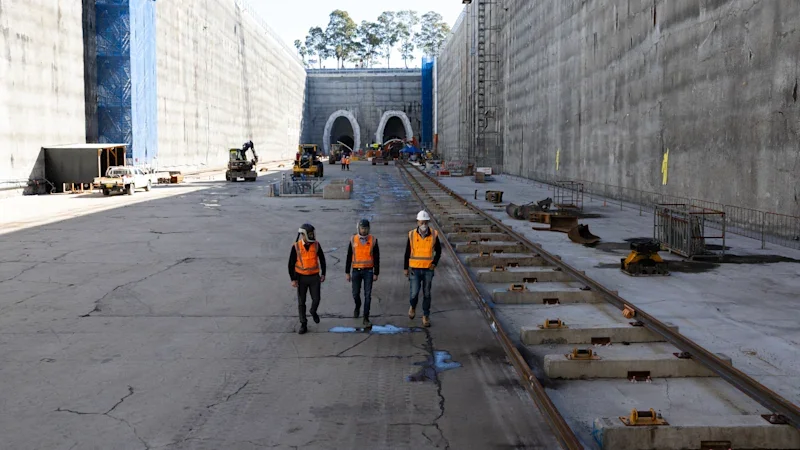
Hidden behind hoarding, there is good reason why a giant hole located a short stroll from Sydney’s largest stadium at Olympic Park is the size it is.
About 200 metres long and 37 metres wide, the hole has been dug to fit four platforms side by side in an underground station at Olympic Park for the $29 billion Metro West line between Westmead and the CBD.
It will make it the only one of 46 stations on Sydney’s rapidly expanding metro network to have four platforms. The others each have only two platforms.
The reason is simple: the four platforms at the new Olympic Park station – one either side of the two tracks – will be built to handle tens of thousands of sports fans and concertgoers quickly converging on it from Accor Stadium or other large venues nearby.
Like the nearby heavy rail station at Olympic Park, those arriving by driverless train at the new Metro West station will exit off one platform while those waiting to board will do so from another platform about 10 seconds later.
That will be repeated for east and westbound driverless trains during “event mode”. During standard operations, only two platforms will operate like those stations on the rest of Sydney’s metro lines.
For those heading west, a train to Parramatta will take five minutes. For those travelling east, a trip from Olympic Park to Hunter Street in the CBD will be 15 minutes. That compares to about 40 minutes on double-deck trains to Wynyard station from Olympic Park.
From its opening in 2032, the metro station at Olympic Park will be capable of clearing queues of more than 26,000 passengers within 70 minutes of a major event finishing. In comparison, the heavy rail station nearby can move up to 40,000 people per hour.
Sydney Metro line-wide delivery director Luke Garden said Olympic Park station was designed for “surges of people” leaving events.
“That’s why it is so much bigger – it needs to take that capacity,” he said.
“At Olympic Park, you just get this surge of people coming, so you really need to control those surges, and you do that inside the station.”
At present, up to 50 per cent of people travel on trains to get to and from Olympic Park during special events.
Garden said the new Olympic Park station would feel “significantly bigger” for passengers than other metro stations because of its configuration to deal with large crowds. The 37-metre wide hole dug for it – referred to as the station box – is almost twice the width of that for other stations.
“A big part of this is going to be about crowd management,” he said.
“The event mode of the station will handle them and hold them in different positions so that we don’t get too much surge loading inside the station.”
At other stations, it was “more about keeping the flow constant” during peaks.
About 80 Olympic swimming pools would fit inside the hole dug at Olympic Park station, compared to 40 for a standard station box such as at Parramatta, Burwood, North Strathfield and the Bays near Rozelle.
After tunnelling finished early this year, the Metro West project is now entering the fit-out stage.
The Bays station near White Bay Power Station will be the first to undergo early construction work within the next two months, followed by North Strathfield and Burwood North.
The final construction contracts for Olympic Park, Parramatta and Pyrmont stations are expected to be awarded by the end of the year. Early designs included more than 20 escalators for the new Olympic Park station to cope with the passenger forecasts.
Premier Chris Minns said the Metro West line would transform the way people move between Parramatta and the city, while re-zonings around its stations such as at Olympic Park and the Bays would deliver tens of thousands of new homes.
“This line will open connections between parts of the city like never before, creating new destinations across the city and revitalising suburbs,” he said.
Work has started craning more than 5300 tonnes of rail down 27 metres into the giant hole at Olympic Park.
Once at the bottom, the rail sections are welded into more than 100-metre-long segments before each is wheeled to different positions along the twin tunnels. They will later be fitted to concrete sleepers to form the tracks for the 24-kilometre line.
John Holland project director Andrew Knispel said it would take until 2029 to complete installation of the rail tracks due to challenges accessing parts of the project while other work was under way.
All up, 60 kilometres of track will be installed within the tunnels and at a stabling and maintenance facility for the 16-strong fleet of Metro West trains near Rosehill racecourse.
More: