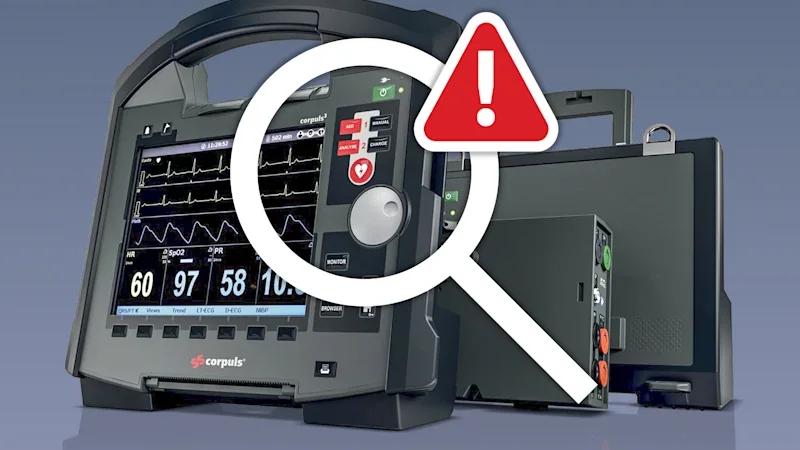
The medical regulator has suspended the sale of the defibrillators used across NSW’s ambulance fleet, raising major questions about patient safety and prompting demands for action from the paramedics union.
The Therapeutic Goods Administration announced late last month that it was suspending two corpuls defibrillators – the model 3 and the model 3T – and it was “likely” there were grounds to cancel the product’s registration.
New South Wales has a multi-year, multimillion-dollar contract to use the corpuls3T defibrillators in its ambulance fleets where paramedics have reported issues with the device for years. South Australia and Western Australia also use the device in their ambulances.
Neither the Australian sponsor for the technology nor the TGA would answer questions about why devices were suspended. The TGA said devices may be suspended where “safety, quality or performance issues may be addressed within the suspension period”.
The suspension comes after an investigation by this masthead and 60 Minutes revealed alarming flaws in Australia’s medical device laws – including a different defibrillator, the CellAED, being given out by paramedics in Victoria despite a lack of human evidence that it could actually save a life.
An analysis of TGA data by the investigation, assisted by artificial intelligence, found that since 2022, 117 adverse events linked to the corpuls3 and 3T were reported to the TGA, including 31 injuries, five deaths and more than 20 cases of the devices refusing to shock patients.
“Members have reported that, in the middle of a resuscitation, one of their devices switched off and deactivated,” said Brett Simpson, NSW president of the Australian Paramedics Association.
“Other members have reported that the device has been charged, ready to potentially deliver a shock to a patient and then has discharged that shock without it being delivered to the patient. Others have reported that they’ve tried to shock a patient and when they hit the button it doesn’t deliver that shock. In the worst case, life-saving interventions are unfortunately unable to be delivered.”
Simpson said he was “perplexed and confused” by the TGA’s decision not to say why the registration had been suspended.
During the device’s three-month suspension, which comes into effect in two weeks’ time, the manufacturers of the device are prevented from selling it, but there are no restrictions on using devices that are already on the market.
NSW Ambulance said it would continue to use the devices, despite the suspension. “There is no current impact on NSW Ambulance operations or patient care,” a spokesman said.
“NSW Ambulance will continue to monitor the situation closely and undertake further assessment as additional information becomes available.”
“I would think that we should only be using devices in medical environments – and elsewhere – that have not been suspended by TGA,” said Associate Professor Elizabeth Paratz, a cardiologist at St Vincent’s Hospital who has published a study of defibrillator availability.
Simpson called for “firm action and decisive decision-making” by the NSW government.
“We’ve got another six years on the contract with these devices and what I don’t want to see and what our members don’t want to see is an increase in these adverse outcomes and these safety issues over the next six years without some sort of plan in place to potentially transition to a new device,” he said.
A clinical safety notification issued last week by NSW Ambulance, and seen by this masthead following the TGA’S suspension, says that “there is no immediate impact on NSW Ambulance operations or patient care”.
“Continue to use corpuls3T devices in accordance with current NSW Ambulance clinical practice. Continue to report any equipment faults or malfunctions through existing incident reporting processes,” it said.
The device’s Australian sponsor Device Technologies refused to disclose the reasons for the device’s suspension but said that it was “working closely with the TGA and our manufacturing partner, corpuls, to support the regulatory review and address any requirements”.
“We are in direct contact with affected customers and will continue to provide timely updates as more information becomes available,” the company said in a statement.
“At this stage, no action is required by customers, and we remain committed to ensuring continuity of care and transparency throughout this process.”
One ambulance service source, speaking anonymously due to confidentiality constraints, said the issue could relate to a recent software update.
Concerns about the device are backed up by adverse event reports to the TGA analysed by this masthead. In more than 20 cases, the corpuls did not deliver a shock. In one case, it was reported to have delivered a “!!! Shock aborted” error message and failed to shock during cardiac arrest; the patient died.
In a 2024 case, the corpuls again was reported to have refused to deliver a shock despite the patient being in a “shockable rhythm”; the patient died. In other cases, the corpuls turned off or showed a black screen during the middle of a cardiac arrest.
“After pressing shock, paramedics observed a visible spark from the anterior pad followed by a pop noise and electrical burning smell afterwards,” one report reads.
The most recent report, from May this year, simply notes “Device displayed ‘defibrillation failure’ alarm while in use on a patient.”
The TGA states adverse event reports do not mean the device caused the adverse event, and cannot be used to prove if a device is unsafe. The 117 reports include those for other corpuls devices listed on the same registration.
Devices listed under the corpuls’ Australian registration have repeatedly been the subject of regulatory actions by the TGA.
In July, a product correction was sent out due to issues with the corpuls3-SLIM’s charging cable, and in April one was issued for a software issue that “occurs randomly” and stops corpuls defibrillators from analysing heart-rhythm data.
Last year, a warning was issued about the machines not automatically detecting the connected electrodes.
Paramedics were advised that this was “not indicative of a device malfunction”, and were told to test the machine at the start of every shift.
The device’s German manufacturer warned in 2021 that the corpuls3-SLIM could fail if it was dropped.
The device’s German-based manufacturer did not return a request for comment by deadline.
About 2000 corpuls 3 defibrillators are deployed in ambulances in NSW, South Australia and Western Australia.
In August 2022, the NSW government announced that Device Technologies had won a $55 million contract to supply the state’s ambulances with 1400 corpuls defibrillation devices and a state-of-the-art clinical notification platform.
A detailed trial of the device occurred later that year, and concerns about the device’s safety and efficacy were raised then.
“Some of those concerns were around where the device was placed in the ambulance, some logistics issues where things like the leads from the defibrillation pads to the device were too short and you couldn’t secure the device properly or the device couldn’t reach the patient in certain instances were raised,” Simpson said.
Problems with the device persisted after it was rolled out across the state, with NSW Ambulance paramedics instructed to keep carrying the LifePak defibrillator device as a back-up.
“It was a requirement that we had to carry two defibrillators with us, or at least certainly have a back-up machine in the ambulances available,” Simpson said. “I’ve been a paramedic with NSW Ambulance for just under 18 years. It was definitely a first for us.”
Late last year, NSW Ambulance informed paramedics it was no longer necessary to carry both devices.
In a statement, the South Australian Ambulance Service said the suspension did not require the withdrawal of the devices, which it would continue to use in “accordance with established clinical guidelines and procedures”.
That state’s union, the Ambulance Employees Association, said its members had raised a number of concerns about the device’s suitability.
“While some of these concerns may have been mitigated over time, the issues have been consistently raised by members and continue to generate concerns regarding the monitor’s reliability and suitability in the operational ambulance environment,” it said in a statement.
St John WA, which operates ambulances for the West Australian government, said the device’s sponsor had advised that “devices currently in use remain appropriate for continued use and will continue to be supported and serviced”.
“There is no current impact on ambulance service delivery,” it said in a statement.