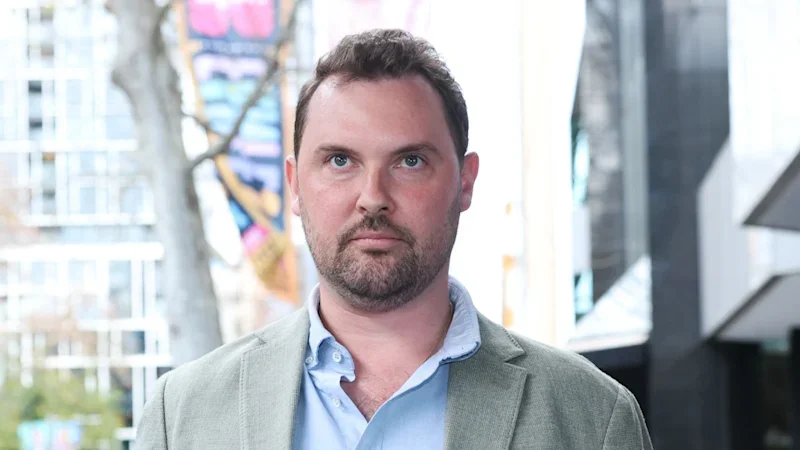
As corruption investigators put the finishing touches on a four-year probe codenamed Operation Rosny, one of their prime targets, Jeremy Greenwood, boarded a plane and dashed to the other side of the world.
After landing at Heathrow Airport in London, the 37-year-old lobbyist caught up with another person in the sights of the Independent Commission Against Corruption, Christian Ellis. The friends and former business partners ultimately met four times as the British capital sweated through England’s hottest June on record – a detail the ICAC presumably knows because it either had them followed or tapped their phones.
Ellis had moved to London in January this year as the ICAC circled. “He’s an Anglophile. He’s always wanted to live there,” Greenwood explained of his friend’s decision. Ellis has declined to assist the ICAC as it unpicks a string of schemes that could involve serious corruption and breaches of the state’s donations laws.
What was discussed during their catchups is unclear, but Greenwood suggests that the elephant in the room – whether Ellis would return to Australia to face the music – wasn’t on the agenda. Asked on Monday whether he had asked Ellis about his plans, Greenwood told the ICAC counsel assisting Dr Peggy Dwyer, SC: “No, I don’t think I have, actually. Look, it may have come up. I’m not sure.”
Unlike his good mate, Greenwood returned to Australia and spent Monday in the witness box. He faces the most serious questions of all witnesses to date. That may help explain why a testy and combative Greenwood bristled at several lines of inquiry, shaking his head and exhaling in frustration. His memory seemed to repeatedly desert him. He also revealed that his wife had started contractions while he was providing evidence.
Lesser known than some of the other players being examined by the ICAC, Greenwood lists the Catholic Archdiocese of Sydney, Greyhound Racing NSW and Manly-Warringah Sea Eagles among his clients; he once worked for former federal attorney-general Philip Ruddock and the now Nationals leader Matt Canavan. He also went to Redfield College, the Opus Dei-linked school attended by other ICAC targets Charles and Jean-Claude Perrottet.
As the pieces of a major corruption puzzle have been put together over recent weeks, Greenwood has remained something of a mystery man. But the lobbyist is unique in that he appears to be a common thread between the three key schemes being probed under the Operation Rosny umbrella.
The first: the ICAC alleges that Greenwood was intimately involved in a plot to divert Catholic Schools NSW funds to a conservative Liberal Party sub-faction called the Reformers. The payments were made to two firms he was a director of, Beckington and JPG Advisory, via what the ICAC says were sham contracts. The money was then passed to Greenwood’s Reformers friends to compensate for their work trying to stack branches across the state.
The ICAC’s lawyers spent much of Monday establishing the extent to which Greenwood was involved with the Reformers. The man himself stressed he was not as committed to the cause as other more determined members. “I’m not someone who’s an ideologue on the right and left,” he offered.
The second: Greenwood’s name had been mentioned in relation to a political figure caught up in an alleged blackmail plot at Strathfield Council. One of the councillors accused of blackmail is Sharangan Maheswaran, who Greenwood knew well via his business.
Far more grave is the ICAC’s third allegation that Greenwood and his friends Christian Ellis and Charles Perrottet were to be the recipients of a $2 million bribe from disgraced Sydney developer Jean Nassif to further his business interests.
Over coming weeks, the ICAC will hear claims of several meetings involving Greenwood and Nassif, who is now on the run in Lebanon.
As bushfires took hold across NSW on November 19, 2019, Nassif’s development firm Toplace formally engaged Greenwood’s company Beckington for media and strategic consultancy services. Nassif was to pay a monthly retainer of $10,000 and an initial fee of $25,000.
But the ICAC will present a “large body of evidence” that shows Toplace also made seven payments of between $100,000 and $150,000 to Beckington, totalling $940,500.
Dwyer, the counsel assisting, will claim those payments were not made in exchange for Beckington’s legitimate lobbying and consultancy services. “Rather we anticipate the evidence will show that these amounts were paid by Mr Nassif as political donations, which were to be used to support key objectives of the Right faction of the NSW Liberal Party,” Dwyer said in her opening address.
The ICAC has intelligence that on December 11, 2019, Greenwood attended a meeting with a member of Nassif’s staff where the developer proposed whopping payments – initially totalling $1 million – to stack Liberal Party branches, potentially across north-west Sydney.
Finally, Greenwood and Charles Perrottet met Nassif on Anzac Day, 2020. At that gathering, the ICAC claims, the developer agreed to pay Greenwood, Perrottet and Ellis “large sums” to support the signing up of new Liberal members to help sway crucial preselections. “This would, in turn, enable Mr Nassif to influence the Hills Shire Council and achieve other political objectives,” Dwyer said late last month.
The trio repeatedly referred to Nassif by the codename “Concord” – the suburb where some of the Reformers first met him at a cafe.
Greenwood’s Nassif connections didn’t really come up during Monday’s evidence – that will probably play out on Tuesday, or later in the ICAC’s eight-week public inquiry. “We’ll return to Mr Nassif,” Dwyer promised on Monday, rather ominously.
More: