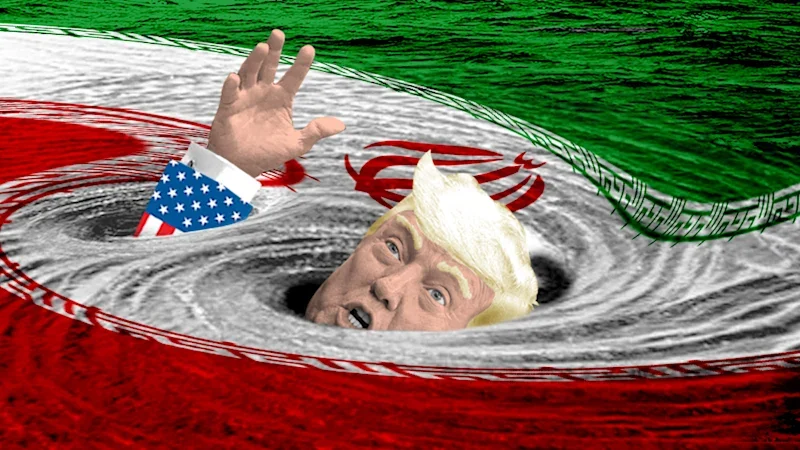
Donald Trump’s America has squandered so much credibility in the Middle East that neither its friends nor its foes seem to be taking it very seriously any more.
Foes first. Trump last week said that the Iran war would soon end because Iran was so weakened: “I don’t think they can go much longer.”
On the contrary, Tehran showed that it’s enjoying humiliating Trump so much that it doesn’t want the fun to end. Two days after Trump’s claim, Iran issued a tough set of six preconditions for opening the Strait of Hormuz.
The regime’s latest demands “make it increasingly difficult for the president to manufacture a face-saving off-ramp from the conflict,” observed Mona Yacoubian, the Middle East program head at Washington’s Centre for Strategic and International Studies.
Five of Iran’s demands were ones that the US had largely agreed to in a June memo of understanding, which was soon abandoned amid mutual recriminations. But now Tehran has added a sixth.
The five reissued conditions include the demand that the US lift its naval blockade, withdraw all naval and air forces from the region, and lift all sanctions against Iran. The sixth, new stipulation is that the US must pay war reparations to Tehran for the current war and for last year’s, too. Trump’s reaction? “We are low-keying it,” he said on Monday (AEST), offering no substantive response. There are no direct negotiations between Washington and Tehran.
The Iranian people are suffering the consequences of the war, notably savage inflation and shortages. But the leadership is using the crisis to justify an extraordinarily brutal repression of internal critics, and revelling in its newfound power over the “Great Satan” and the world economy. This was a power Iran had never tested before the war.
Next came another US foe, the Houthis in Yemen, an Iranian ally. The Houthis on the weekend managed to strike a Saudi oil refinery with an explosive drone. It was the second Houthi attack on a Saudi refinery in as many weeks.
This is important because the Houthis are targeting the Red Sea coast, the western side of the Saudi peninsula. This is the main alternative to the Strait of Hormuz, on the eastern side, for Saudi oil exports.
Since the Strait has been closed, Riyadh has been shipping some 70 per cent of the country’s oil exports via its Red Sea ports and through the Bab-el-Mandeb Strait to the Gulf of Aden.
If the Houthis can impair this flow while the Strait of Hormuz is shut, the global oil crisis will flare anew. There is an alternative route out of the Red Sea, around South Africa’s Cape of Good Hope, but it’s much longer and more expensive.
So much for foes. America’s friends in the region aren’t taking Trump very seriously either. Start with the Saudis. The war has taught the Saudis, like America’s other Gulf allies, that the US is unable or unwilling to defend them fully from Iran’s missiles and drones.
This is a very tough lesson. US Gulf allies including Bahrain, Qatar, the UAE and Kuwait have, for decades, hosted US military bases and facilities precisely because this is supposed to guarantee American protection against Iran.
The evidence of the past five months is that their confidence in the US has been excessive. While interceptors fired by the US and its Gulf allies have destroyed or deflected thousands of Iranian drones and missiles, hundreds have managed to penetrate their airspace. As America has run down its stock of Patriot interceptor missiles, Iranian drones have found increasing success.
And what are the Iranians targeting in the Gulf states? Overwhelmingly, US bases and forces. So the American bases that were thought to be the Gulf Arabs’ protective assets have turned out to be their liabilities. Some of these governments are stepping up military ties with Israel for extra protection.
The US has guaranteed Saudi Arabia’s security since 1951 to protect the supply of US oil. But today, the Saudis are seeking new sources of security beyond the US. Riyadh last week signed a new mutual defence pact with Turkey and Pakistan, nicknamed an “Islamic NATO”.
This is an extraordinary pact, committing a monarchic oil superpower, a NATO ally and a nuclear-armed military dictatorship to each other’s defence. “Riyadh is building options around an American guarantee it no longer fully trusts,” remarks British military analyst Andrew Fox.
One notable aspect of the agreement, signed in Mecca, is that Pakistan is a client of China’s. As a headline in the South China Morning Post points out: “China waits in wings as Mecca pact signals Gulf shift away from US security umbrella”.
Diminished US credibility and power in the Gulf is opening a vector for China to increase its involvement in the region. Beijing already has a de facto alliance with Iran. One result is that Iran allowed its oil to continue flowing to China even as it closed off shipments to other markets.
And America’s closest Middle East ally, Israel, is proving unco-operative. Trump’s so-called Board of Peace announced that Hamas had agreed to its 15-point plan for peace in Gaza, including an Israeli military withdrawal. Trump cheerfully declared that Israel was “very happy” with the deal.
Benjamin Netanyahu on the weekend flatly contradicted him. “Israel rejects the 15-point document,” said the Israeli prime minister. Israel’s military “will not carry out any withdrawal until Hamas is genuinely disarmed”.
“In Gaza and Lebanon, Netanyahu is betting that Trump has run out of steam,” ran a headline in Israeli’s Haaretz newspaper on the weekend. Netanyahu was an important voice encouraging Trump to join his war on Iran, but now will not help him exit it.
It’d be premature to say that the Middle East has entered a post-American era. It still has bases and assets in the region and great heft. But we can see the outlines of a potential post-America Middle East emerging at speed unless a new US president can change the trajectory.
Trump is growing so desperate to end the war and reopen the Strait of Hormuz that, according to a Wall Street Journal report on the weekend, he has been “floating the idea privately to senior aides that he’s willing to walk away without a nuclear deal”.
If that were to eventuate, it would surely be the final humiliation of Trump’s Operation Epic Fail.
Peter Hartcher is both international and political editor. His political column appears on Saturdays.
More: