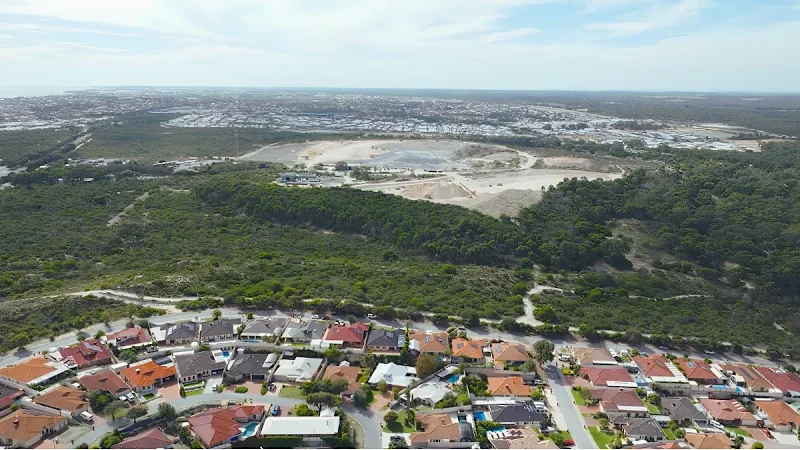
The future of 850,000 Perth residents’ household waste is up in the air as the closure of the Tamala Park Waste Facility faces yet another hurdle.
The facility, run by the Mindarie Regional Council, accepts one-third of Perth’s household waste from seven local governments and was due to reach the end of its operational life around 2028.
But two major components – a piggyback liner and leachate management area – are needed to bring the area up to its full capacity. And the Department of Water and Environmental Regulation has just rejected the Mindarie council’s request.
Five of the seven councils have received exemptions to take their waste to other facilities before Tamala Park’s expected closure date, but none have anything locked in yet, leaving the site in limbo if it will ever reach its final profile height to be able to close.
The first hurdle
The cities of Joondalup, Perth, Stirling, Vincent and Wanneroo, and the towns of Cambridge and Victoria Park, are members of the Mindarie Regional Council.
For the past five years, the MRC, alongside the member councils, have been working on a plan for where they will take their waste once the tip reaches “completion”.
The rough plan was to secure a contract with a waste-to-energy facility south of Perth that would ensure red bin household waste from each of the seven local government areas would continue to be accepted and managed once the landfill reached capacity.
But in June, Joondalup and Wanneroo said that they were no longer willing to back the waste-to-energy plan, which meant none of the member councils could benefit from the MRC’s plan.
“The City of Wanneroo made a decision to formally withdraw its support for the waste-to-energy contract, and the City of Joondalup did not provide any notification of its support,” a Mindarie Regional Council spokesperson told this masthead.
“We are now taking the time required to understand the full ramifications of those decisions.”
The five member councils that initially supported the plan were then granted exemptions to allow them to enter into a waste-to-energy contract or another alternative to the Tamala Park landfill.
But there are now fears that without the piggyback liner and leachate management area applied to the landfill, it will take much longer to reach a level where it can be safely closed.
The second hurdle
The installation of a piggyback liner would create a barrier allowing waste to safely be deposited in the portion of the landfill currently under height.
Meanwhile, the leachate management area would provide a dedicated area where liquid waste – known as leachate – could be disposed of safely through evaporation.
“MRC’s priorities have always been clear: to protect the environment, close the landfill responsibly, and maintain essential waste management services for the near 850,000 people living in seven local government areas across Perth,” the spokesperson said.
“Over the past two years, we have endeavoured to work collaboratively with the department (DWER) as part of our long-standing commitment to the management and minimisation of odour impacts on residents now living in the vicinity of the landfill.”
The spokesperson said the council had also conducted extensive testing, analysis and studies of methods to effectively reduce the volume of leachate within the landfill, which all pointed to evaporation as the best solution.
“MRC is disappointed by DWER’s decision. We are now taking the time to understand the implications of that decision – for MRC, its seven member councils, and the people who depend on the service we provide – and consider what options remain open to us.”
One issue that arises if the member councils stop taking their rubbish to Tamala Park before it reaches capacity is the extensive odour caused by leachate.
The MRC said it had implemented measures that reduced the number of odour reports received from 333 in August 2024 to 39 in July 2026 – a reduction of nearly 90 per cent – but without the leachate management area, it was uncertain if it would remain this way.
A community update from DWER revealed the applications were rejected due to “unacceptable risks from odour emissions”.
“Following a detailed assessment, the Department determined the proposed works presented unacceptable risks from odour emissions and leachate impacts to groundwater and that these risks could not be adequately reduced through regulatory controls,” the announcement reads.
“While the Department acknowledges refusal of the application may have implications for Tamala Park operations, the Department’s role is to make decisions consistent with its statutory obligations to protect the environment and public health.
“Decisions regarding the future operation, management and eventual closure of the landfill remain matters for MRC.”
At this stage, all seven councils are continuing to take their waste to Tamala Park.
The cities of Joondalup and Wanneroo will have to take their waste there until it closes.
“The City of Joondalup remains committed to the earliest practicable closure of the Tamala Park landfill and is planning responsibly for future waste disposal arrangements,” Joondalup Mayor Daniel Kingston said.
The five other member councils have said they are independently looking at waste-to-energy facilities as their future waste disposal options.
Town of Victoria Park mayor Karen Vernon said they did not have a firm date when they would stop taking their residents’ waste to Tamala Park.
“While the Town was hopeful that the MRC agreements would proceed, it is now focused on securing a waste disposal solution that aligns with its strategic objective of achieving 100 per cent diversion of residual municipal waste from landfill by 2030 and delivers a responsible, reliable and cost-effective outcome for the community,” she said.