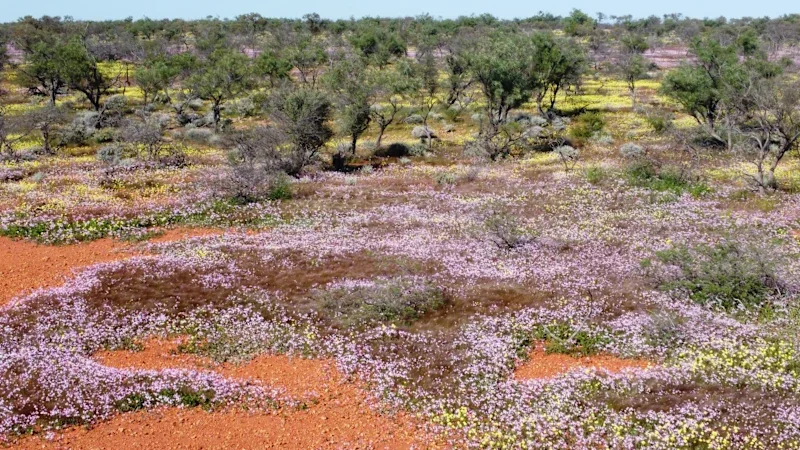
Huge expanses of pink, white and yellow wildflowers are adorning the ochre-red soil at Hamelin Station Reserve, a welcome sign of abundant rain in a nation of uncertain climatic conditions.
Western Australia’s wildflower season has begun early at the Bush Heritage property, which lies on the doorstep of Shark Bay World Heritage Area. The vivid colour palette will soon reach Bush Heritage’s three other nature reserves in midwest Western Australia, properties that protect 400,000 hectares of native bush.
“It’s just such a spectacular show,” says Bush Heritage senior ecologist Michelle Hall.
“These places are globally significant for their vast floral displays and people come from overseas to see them. There aren’t many places in the world where you can see this kind of thing.”
The carpets of native blooms mark an early start to the display of seasonal biodiversity.
It was triggered by generous downpours of rain in recent months, starting with Cyclone Mitchell in February. This year’s rainfall bounty is nudging 250mm, exceeding the average of 200mm.
Yet three years ago, only 25mm fell in the region. Sufficient seed lay dormant through the drought conditions to produce this month’s brilliant outbreak of colour, says Hall.
“The Mid West is particularly known for these amazing carpets of flowers, so it’s nice to be protecting some of them,” she says.
“It’s an extreme arid environment that occasionally gets cyclones coming through. That’s what caused this big display.”
Arid Australia endures a boom-bust dynamic, she says.
“There are long periods of dry weather and then when rain comes, it causes a big flush of activity. It gives a boost to the whole system - the flowers provide food for seed-eating species.
“On our recent visit, we saw crimson chats, spectacular birds that were nesting in the Mulla Mulla, or Ptilotis, or sitting there with mouths full of caterpillars for their chicks.”
A less welcome plant that has flourished in the good seasonal weather is Buffel grass.
“It’s an invasive species that we’re trying to control,” says Hall, adding that pastoralists rely on it for feeding stock in some regions.
“It’s challenging because it spreads really easily and must be kept in check or we’ll get carpets of Buffel grass instead of wildflowers, which is not good for wildflower tourism.”
Hamelin Station Reserve acts as a conservation buffer to the Shark Bay World Heritage Area, and joins a corridor of nature reserves from Shark Bay through crown land to Bush Heritage’s Eurardy Reserve, where spectacular wreath flowers are already flowering along roadways, and further inland to Charles Darwin Reserve.
The not-for-profit organisation recently purchased Wanarra, a 107,000-hectare property that Bush Heritage sought as “the final puzzle piece” in extending the conservation corridor across WA’s midwest landscape.
“The purchase of Wanarra reconnects more than one million hectares of public and private protected land and creates one of the largest continuous conservation landscapes in the region,” says Hall.
Many plant species in the region are found nowhere else in the world, according to Bush Heritage ecologist Fiamma Riviera.
“This is one of the most floristically varied places on the planet – and there’s a real chance there are still more plant species to be discovered.”
Wanarra’s southern half sits within a “biodiversity hotspot”, one of the most biologically rich and threatened regions on Earth. Large areas of critically endangered Eucalyptus woodlands still remain on the property.
Bush Heritage chief executive Rachel Lowry said adding Wanarra as its fourth nature reserve in WA’s arid region is a bonus for conservation in Australia.
“Thousands of Australians have chipped in to make this legacy conservation win possible.
“At a time when the environment is under unprecedented pressure, we’re thrilled to see science, strategic investment and community support coming together to successfully protect and reconnect nature at scale.”