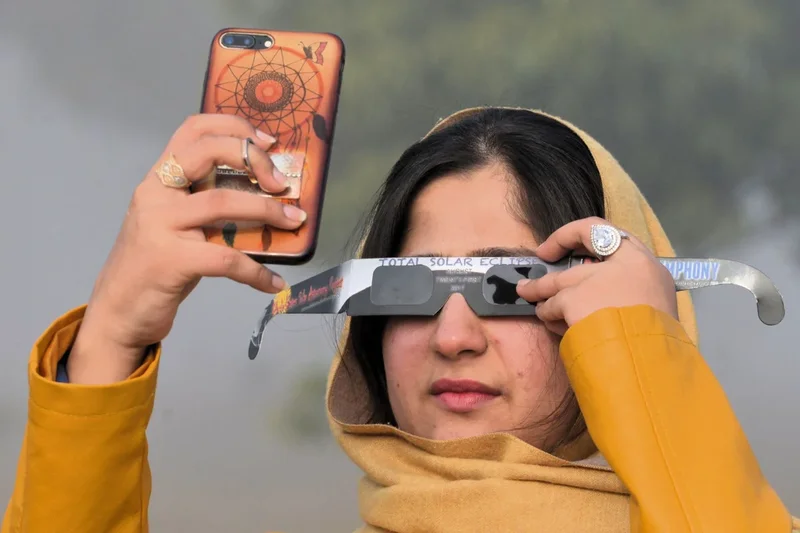
Hundreds of millions of people across Europe will get the chance to see a partial or total eclipse on Wednesday when the Moon passes in front of the Sun.
Many will be hoping to capture the celestial phenomenon on their phones or cameras, though experts have warned that pointing a lens directly at the Sun could cause permanent damage to a device.
Direct exposure to the Sun, even when partially covered by the Moon, risks overheating a smartphone or digital camera.
Pointing a camera at the Sun for a prolonged period could even burn the photodiodes within the internal sensor, creating dead pixels that cannot be repaired.
“The phone sensor could be damaged just like any other image sensor if it’s pointed directly at the Sun,” Nasa said ahead of the 2024 solar eclipse that passed over the US.
“The best practice would be to hold a pair of eclipse glasses in front of your phone’s lenses when photographing the Sun at any point other than totality.”
Nasa also warned skygazers to not look at the solar eclipse through a camera lens, even when wearing eclipse glasses.
“Do not look at the Sun through a camera lens, telescope, binoculars, or any other optical device while wearing eclipse glasses or using a handheld solar viewer,” the US space agency wrote in a post about eclipse safety.
“The concentrated solar rays will burn through the filter and cause serious eye injury.
“When viewing a partial or annular eclipse through cameras, binoculars, or telescopes equipped with proper solar filters, you do not need to wear eclipse glasses. (The solar filters do the same job as the eclipse glasses to protect your eyes.)”
The only time it is safe to look directly at the eclipse without proper eye protection is when the Moon completely obscures the Sun during the moment of totality.
This will only be possible for a between one to three minutes for people directly under the path of totality in Iceland or Spain.
The solar eclipse, which starts near the North Pole before heading south, will be the first total eclipse over Spain in more than 100 years, while the UK will experience its most complete solar eclipse this century.
For a full round-up of where and how to see the 2026 solar eclipse, you can read The Independent’s guide here.