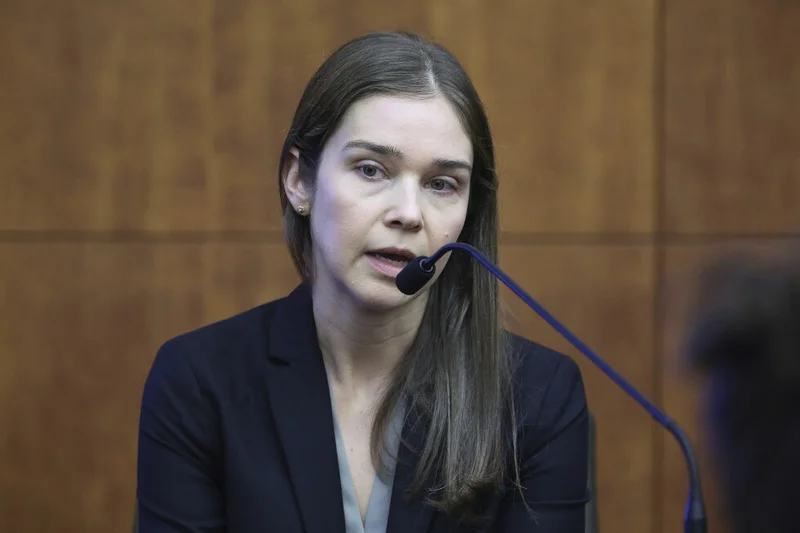
Defense lawyer takes aim at psychiatrist’s care before Lindsay Clancy killed her 3 kids
Defense lawyer takes aim at psychiatrist’s care before Lindsay Clancy killed her 3 kids
Lindsay Clancy ’s lawyer probed her psychiatrist’s expertise, prescribing decisions and overall treatment as the defense sought Monday to suggest that the mental healthcare system overlooked and even accelerated the Massachusetts mother’s decline in the months before she killed her three young children.
In questioning Dr. Jennifer Tufts, defense lawyer Kevin Reddington spotlighted her use of 25-minute video appointments with limited time for talk therapy, the computerized forms that documented her observations, and the series of pharmaceuticals she recommended as Clancy reported various side effects, symptoms and concerns about taking medications.
Reddington portrayed Clancy’s care not as common practice in U.S. mental healthcare, but rather as inadequate and indifferent treatment, at one point implying that the doctor was a box-checking “robot.”
“What did you do? You had a woman who was telling you she felt hopeless,” he asked as they discussed an appointment about two months before the killings.
“I told her that this was something we could address, that there was hope, that there are treatments, that there are different types of programs,” Tufts said, “so she knew that she still had options and a reason to hope.”
“Did you ever suggest to her that ‘maybe you should come in and see me, rather than on the computer?’” Reddington asked.
“Talking to her over the video didn’t seem like an issue. It didn’t seem like there was something I was missing,” Tufts replied.
EDITOR’S NOTE: This story includes discussion of suicide. If you or someone you know needs help, the national suicide and crisis lifeline in the U.S. is available by calling or texting 988.
Clancy, 35, has pleaded not guilty to murder charges in the deaths of Callan, Dawson and Cora Clancy, who ranged from 8 months to 5 years old. They were found in the basement of the family’s home in coastal Duxbury, Massachusetts, and their mother was found lying in the yard. She had jumped out a second-story window and remains paralyzed from the waist down.
Prosecutors argue that the former labor and delivery nurse was an intentional killer who connived to get her husband out of the house by sending him out on errands, then strangled the children with exercise bands on Jan. 24, 2023. In an opening statement last month, prosecutor Shannan Buckingham urged jurors not to view the trial as “a public debate about women’s mental health and how the medical system treats women.”
Clancy’s attorneys don’t dispute that she killed the children. But they that say she shouldn’t be held criminally responsible because she was mentally ill, believing that she heard voices ordering her to take the children’s lives and her own.
The defense contends that she was in the grip of bipolar disorder and postpartum psychosis, a rare postpregnancy condition that can alter women’s sense of reality. A forensic psychiatrist diagnosed her with those conditions after the killings.
Her attorneys say Clancy did everything she could to seek help: She turned to multiple outpatient providers, tried various drugs they prescribed, called a suicide hotline, went to an emergency room, and approached but wasn’t accepted into a hospital-based, full-day treatment program for women with postpregnancy mental health problems. Clancy then even checked herself into a psychiatric hospital for several days.
Rather than improving, her condition worsened on the ever-remixed cocktail of psychiatric medications, some of them problematic for bipolar patients, her attorneys and family say.
Tufts saw Clancy, via video, from September 2022 until the day before the killings. Her diagnosis: generalized anxiety disorder and an adjustment disorder with depressed mood.
The psychiatrist testified that Clancy never told her about manic episodes, a criterion for a bipolar diagnoses, nor about hearing voices or having other signs of psychosis.
Clancy at times said she was “close” to feeling suicidal, hopeless or like she was going to die, Tufts recalled. But she said Clancy denied having a plan to take her own life or harm anyone else and never revealed — as the defense says she did to her husband — that she had thoughts about harming the children.
“I would have be very concerned if I had heard that,” Tufts said.
Clancy is suing Tufts and other practitioners in civil court.
“I do not believe that I’ve been negligent,” Tufts testified in the criminal trial Monday as Reddington questioned how much experience she had treating postpregnancy conditions before Clancy came to her. Tufts had finished her psychiatric residency training in July 2022 and joined a private practice the month before Clancy’s first appointment.
If convicted of murder, Clancy faces life in prison without parole. If found not guilty due to a lack of criminal responsibility, she would be committed to a state mental health facility.