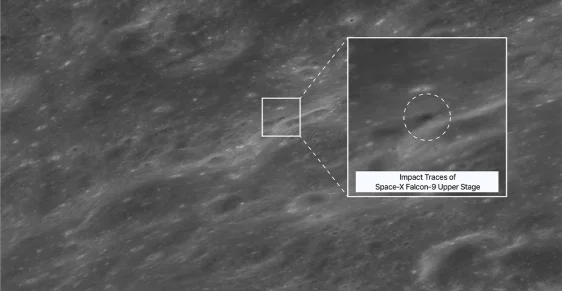
As predicted, a SpaceX Falcon 9 rocket has slammed into the surface of the moon, and now we have photographic evidence of the crash site.
The Korea Aerospace Research Institute was one of the first agencies to share pictures of the small crater left by the impact, posting them to X (formerly known as Twitter). The images were captured by the Danuri spacecraft currently in lunar orbit.
This was the second stage of a Falcon 9 rocket, launched back in January 2025—not one of the reusable first stages that are able to return to Earth. It measures about 12 feet in diameter, 46 feet in length, and weighs around 8,800 pounds.
The discarded payload would’ve been traveling at around 5,400 miles per hour at the moment of impact, which occurred on Wednesday, Aug. 5, in the wee hours of the morning Eastern Time. From the images that have been published so far, the moon has a new pockmark measuring an estimated 100 feet wide and 16 feet deep.
Read more: “The Violent Birth of the Moon”
The collision happened close to the Einstein crater, which is on the western edge of the moon when viewed from Earth. Its position on the lunar surface and the relatively small size of the impact zone will make it tricky to obtain high-resolution photos, though NASA is hoping to get a few snaps in the coming days with its Lunar Reconnaissance Orbiter.
Besides the visuals, more evidence of the crash was recorded by the European Southern Observatory’s Very Large Telescope in Chile, which spotted signatures of lithium (from the rocket) and sodium (from the kicked up moon dust) rising from the lunar surface.
While these second-stage rockets usually crash into the ocean after use, when their payloads are headed for the moon—as was the case here—it becomes harder to control their subsequent direction. According to SpaceX, “a mixture of solar activity and gravity forces” sent the Falcon 9 second stage toward the moon.
The moon, of course, is accustomed to being battered by incoming objects. After all, it was likely formed by a gigantic cosmic collision.
Lead image: KASA/KARI