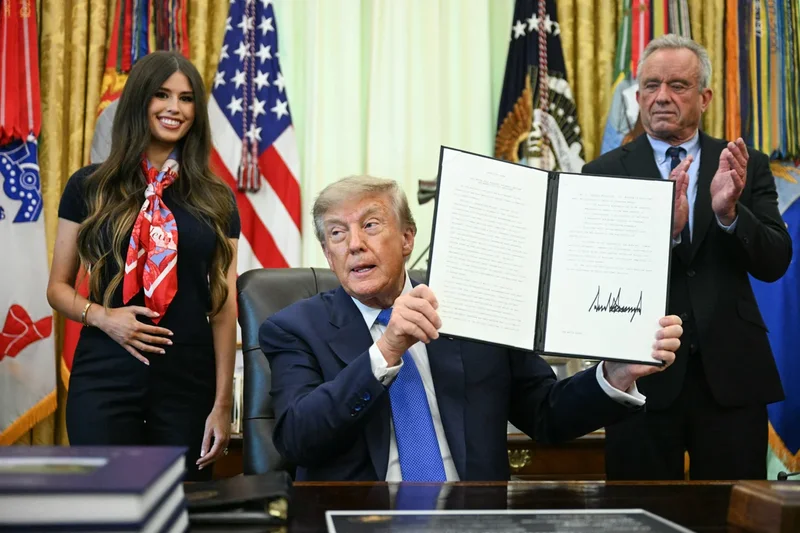
President Donald Trump issued an executive order on Monday aimed at altering the U.S. childhood vaccine schedule. The order would nix the current combined measles, mumps and rubella (MMR) vaccine in favor of giving a shot for each disease individually.
The order, a draft of which was obtained by the Washington Post, directs Secretary of Health and Human Services Robert F. Kennedy, Jr., to “present plans” to the president to break up the MMR vaccine into its separate constituents. On Monday Trump falsely suggested that, for the combined vaccines, “there could be a possibility they’re quite lethal, and separately, it looks like they are not at all lethal but just very effective.” Overwhelming evidence shows that the MMR vaccine is both safe and effective, with a low risk of adverse events.
The order directs federal agencies to classify childhood vaccines into three categories: vaccines recommended for all children; vaccines "recommended for certain high-risk groups or populations"; and immunizations given "based on shared clinical decision-making." It's unclear whether the order will have any real effect on the nation's vaccine schedule, which is set by the U.S. Centers of Disease Control and Prevention.
On supporting science journalism
If you're enjoying this article, consider supporting our award-winning journalism by subscribing. By purchasing a subscription you are helping to ensure the future of impactful stories about the discoveries and ideas shaping our world today.
Vaccines in the executive order's first group—recommended for all children—include those for measles, mumps, and rubella (MMR), diphtheria, tetanus, and pertussis (DTaP), as well as HPV and polio, among other conditions.
Those in the second group, for at-risk populations, include respiratory syncytial virus (RSV) and hepatitis A and B and more, according to the executive order. Among those in the third category, based on decision-making in consultation with a doctor, include hepatitis A and B, COVID-19, influenza and others.
The president also suggested, without evidence, that childhood vaccinations could be a cause of rising autism rates. "We do not know exactly what the cause is with respect to autism," Trump said. "It is essential to our research efforts that we have the very best vaccine recommendations in the entire world, so we're reducing them." The overwhelming majority of medical experts agree—and the scientific evidence shows—that the causes of autism are multifaceted and may include genetic as well as environmental factors, and that rising rates may be attributable to better diagnostics.
Michael Osterholm, director of the Vaccine Integrity Project and an epidemiologist at the University of Minnesota, urged parents in a statement to trust the science. "Parents should continue to rely on the evidence-based immunization recommendations developed by trusted medical and public health experts, including the American Academy of Pediatrics. Today's Executive Order does not change the underlying scientific evidence supporting childhood immunization."
"We encourage parents to discuss questions about vaccination with their pediatrician or other trusted healthcare provider," Osterholm said.
The order is the Trump administration's latest attempt to overhaul and curtail the childhood vaccine schedule. In January, the CDC moved to reduce the number of recommended vaccines for children to protect against 11 diseases; previously, the CDC had recommended children receive inoculations for 17 diseases. That action was blocked by a federal judge in March.
This is a breaking news story and will be updated.