Obon: Japan’s Summer Festival for Honoring Ancestors
Culture Society## Fires and Spirit Animals
Japan’s Obon traditions are rooted in the belief that during this period the spirits of the dead return home, are honored by their families, and are then guided back to the afterlife. On the first day, August 13, welcoming fires (mukaebi) are lit at the entrance to homes or in cemeteries to help ancestral spirits find their way home. On the final day, August 16, farewell fires (okuribi) are lit to send them back. One of the most famous local observances associated with this tradition is the Gozan Okuribi, in which bonfires are lit on five mountains near Kyoto every year on August 16.
During Obon, many families place fruit and seasonal dishes on their Buddhist altars and visit family graves together. The shōryōuma spirit animals are also iconic Obon decorations. These are made by inserting chopsticks or small wooden sticks into cucumbers and eggplants to resemble horses and cattle. The cucumber horse symbolizes the wish for ancestors to return home quickly, while the eggplant cow represents the hope that they will make a slow journey back to the afterlife, carrying the family’s offerings with them.
Obon’s Origins as a Buddhist Tradition
The word Obon is believed to be a shortened form of Urabon’e. The name is thought to derive from the Sanskrit word ullambana, which is often interpreted as meaning “the suffering of being hung upside down.” According to Buddhist tradition, one of the Buddha’s disciples, Mokuren (Maudgalyayana), discovered that after his mother’s death, she had fallen into the realm of hungry ghosts and was suffering greatly. Seeking to save her, he turned to the Buddha for guidance. The Buddha instructed him to make offerings to many monks, and through the merit gained from these offerings, his mother was freed from her suffering. This story became the foundation of Urabon’e, which spread as a Buddhist observance for honoring and praying for the deceased and one’s ancestors.
On the other hand, Japan has long had its own folk tradition of welcoming and honoring the spirits of ancestors. As the Buddhist Urabon’e merged with these existing beliefs, it gradually evolved into the Obon customs practiced today. Even now, temples across Japan hold memorial services and chant Buddhist sutras during the Obon season, and many people visit their local temples to pay their respects to their ancestors.
The offerings to monks were originally made on the fifteenth day of the seventh month, according to the former lunar calendar. For this reason, Obon takes place around July 15 in some areas. However, in most of Japan, it is observed around August 15, which is closer to the actual time of year when it was traditionally held. Obon customs and ceremonies also differ among Buddhist sects.
Bon Odori: A Beloved Summer Festival Tradition
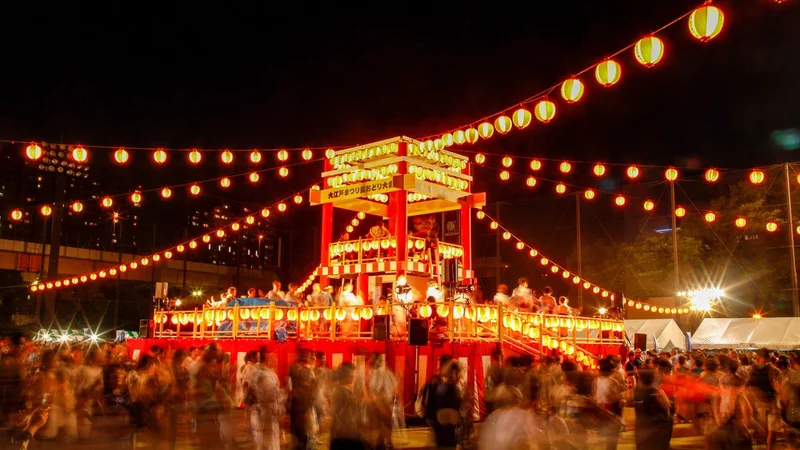
Bon odori, or Bon dances, are also held throughout Japan during the Obon season. They are believed to have originated from nenbutsu odori, ritual dances performed to comfort the spirits of the deceased. Today, however, bon odori is best known as a lively community summer festival, with people of all ages, from children to seniors, joining in. In recent years, it has also become common to see international visitors taking part in the dances.
The music and choreography vary from region to region. The three most famous Bon dances in Japan are the Gujō Odori in Gifu Prefecture, the Awa Odori in Tokushima Prefecture, and the Nishimonai Bon Odori in Akita Prefecture.
(Translated from Japanese. Banner photo: Ōedo Matsuri Bon Odori Festival. © Adobestock.)