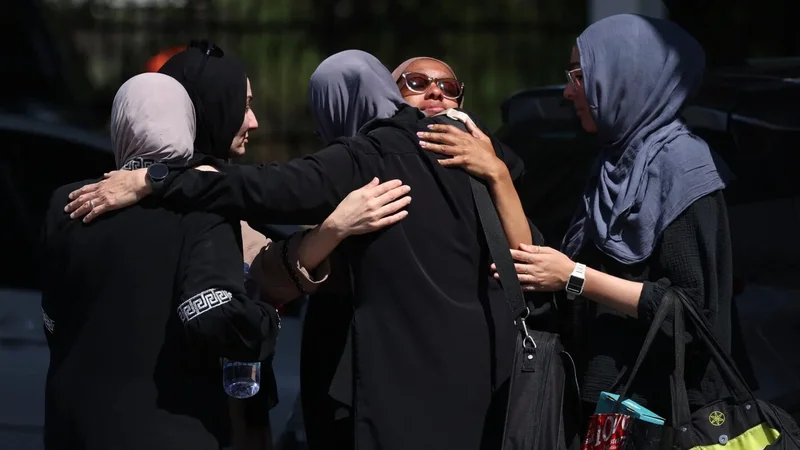
Less than four percent of US safety funding went to Muslim institutions: Report
Over the past decade in the US, since Donald Trump first ascended to the White House in 2017, less than four percent of US government grant funding to keep religious institutions safe has gone to Muslim nonprofits, a new report by the Muslim Public Affairs Council (MPAC) has found.
The funds are awarded annually through the Nonprofit Security Grant Program (NSGP), which is operated by the Federal Emergency Management Agency (FEMA) under the Department of Homeland Security (DHS).
An institution can typically receive a maximum of some $200,000 for each site it operates, and the money must be put toward physical safeguards: security cameras, bulletproof glass, guardrails around properties, and the training of security guards, among other tools.
Nearly 60 percent of the pot has gone to Jewish groups, followed by Christian groups at a little over 25 percent, the figures in the report showed.
"Of the $850m awarded through this program over nine years, Muslim organisations only got 3.8 percent of the funding... it's a really, really small amount going to a community that is under threat, and a growing threat," Dr Sarah Mohamed, a co-author of the report and a senior researcher with MPAC's Center for Security, Technology, and Policy, told Middle East Eye on Monday.
A year ago, the conservative think tank, Middle East Forum, published a report claiming that DHS was using US tax dollars to fund "terror-linked and extremist groups" between 2013 and 2023.
That report listed 49 Muslim-American organisations, and said the NSGP "remains the greatest source of DHS funding to extremist groups".
"Even members of Congress have not been able to verify that," Sameer Hossein, MPAC's managing director in Washington, DC, and the other author of the report, told MEE.
"What we do know for sure is that the terms and conditions that DHS has put out for this year and the previous year under the current administration make it even more difficult for American Muslims and other community organisations to apply for these very critical grants," he added.
That's because the administration has been cracking down on initiatives that go against its policy platform: Diversity, Equity, and Inclusion (DEI); assistance to undocumented immigrants; and boycotts of Israel.
"If you as a grantee were found to be engaging in those prohibited activities, you expose yourself to more legal risk," Hossein said.
So was the limited funding for Muslim groups inevitable, given the current political climate? That's not certain, Mohamed said.
"We don't have any public information about how many institutions applied. So the denominator isn't available for us to be able to say [that]," she told MEE.
MPAC has engaged with Jewish-American groups on the issue, Hossein noted, and they tend to be better resourced and practised at the cumbersome and bureaucratic process of applying for the grant, he said.
Jewish nonprofits were among the first to request a programme like NSGP, following the establishment of DHS, in the wake of the 9/11 attacks.
Anti-Muslim sentiment on the rise
Anti-Muslim sentiment in the US has skyrocketed since the Trump administration assumed power in January 2025.
The president's agenda, largely pre-orchestrated by the far-right Heritage Foundation in its Project 2025 document, puts Muslim-American communities and Muslim countries in the crosshairs.
Republican lawmakers have openly derided Muslims and called for legal action or violence against them - most notoriously Florida Congressman Randy Fine, Tennessee Congressman Andy Ogles, and Alabama Senator Tommy Tuberville.
Trump himself recently shared an image of a group of Minnesota Muslim kindergarteners in hijabs to his Truth Social platform, where he has often called for Somali Americans in the state to be investigated and deported, including hijab-wearing Congresswoman Ilhan Omar.
In the lead-up to the election of the very first Muslim mayor of New York City last year, The Center for the Study of Organized Hate (CSOH) revealed in a 20-page document that Islamophobic and xenophobic discourse surrounding Zohran Mamdani on X had a reach of some 1.5 billion between his Democratic primary win in June and the end of October.
The organisation called on the platform to implement election-specific safeguards, enforce community guidelines against attacks on race and religion, and enhance corrective counterarguments in its algorithm.
CSOH also reported a sharp increase in anti-Muslim content on X since Israel and the US launched their joint war on Iran on 28 February.
The Washington, DC-based social media monitor said it tracked posts that explicitly dehumanised, excluded, and incited violence against Muslims from 1 January to 5 March, during which Trump was consistently threatening to start the war.
On the day the war began, the volume of such posts surged from just under 2,000 per day to more than 6,000, the report said.
In April, MPAC revealed that attacks on Muslim-American individuals and institutions were at a 15-month high under the Trump administration.
The group documented an eleven-fold increase in targeted incidents in the first three months of this year alone.
At least nine of the attacks occurred in March, ranging from vandalism and bomb threats at mosques to sexual assaults against Muslim women, according to a policy paper entitled "The Pitfalls of Operation Epic Fury: How the Undeclared War Against Iran Hurts Americans’ Interests Abroad and at Home."
In May, after a shooting that killed three people outside a California mosque that housed a school with children inside, Muslim-American groups blamed what they said was the mainstreaming of anti-Muslim hate speech by lawmakers and other right-wing influential figures.
"We are deeply disturbed, but not at all surprised," the Council on American-Islamic Relations said in a statement at the time. "Hate against American Muslims is completely out of control."
Now, with Michigan Democratic candidate Abdul El-Sayed potentially on his way to becoming the first-ever Muslim US senator in the country's history, his opponent, Republican Mike Rogers, has released an attack ad on Sayed featuring images of Osama bin Laden.