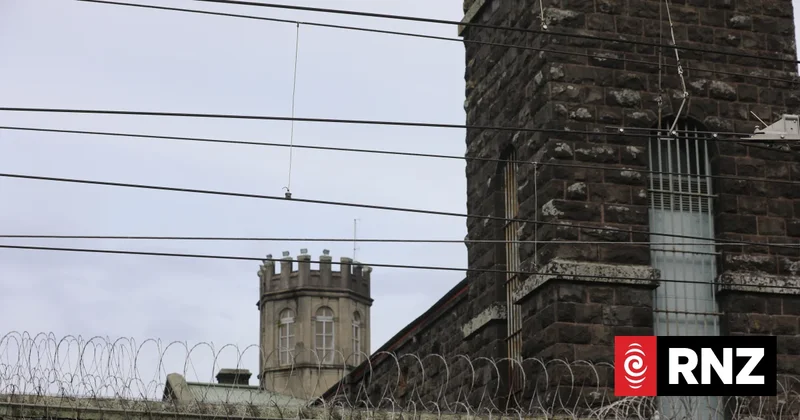
Former inmate calling for old Mount Eden Prison to be preserved
When 23-year-old Greg Newbold shuffled under the imposing rocky archway, it felt like he was stepping into the past.
"I was really shocked when I first went in there," he said. "I mean, I was from Auckland and I'd driven past the prison many, many times, but it looked like a medieval dungeon.
"I said, 'What's this?', and [my co-offender] said, 'This is the remand wing'. I said, 'What? You mean, this is where we stay?'
"He said, 'Yep'."
The now-author and retired sociology professor was arrested for dealing heroin in 1975, and remanded at the old Mt Eden Prison for five months, before he was moved to Paraparaumu to serve his sentence.
He remembered the awful conditions.
"It had high windows, which had no glass in them, because the glass had been smashed, and it just had bars," Newbold recalled.
"In the winter time, pigeon feathers would fly in, because the pigeons used to roost there, and you'd quite often get lice in your blankets.
"There was no plumbing in the prison either. You had to piss in a piss pot."
Constructed as a timber stockade in 1856, the prison's stony exterior was built up over the next 60 years, using volcanic rock mined by the prisoners from Mt Eden itself.
The damp and rugged cells held inmates until 2011, when the last prisoners were moved next door to the new Mt Eden Corrections Facility.
Since then, historian Mark Derby said it had fallen into disrepair.
"When I last saw the prison, it was in an obviously decaying state," Derby recalled from researching his 2020 book Rock College.
"It has been closed now for quite a few years. Nothing's been done to it, it's been sitting empty.
"Clearly, some decision has to be made as soon as possible about this."
Despite some bad memories, Newbold said it should become a museum.
"Oh, it's a museum, it's unbelievable," he said. "There's so much history in that institution and it's a relic of a past era.
"It should never, ever be pulled down."
"They could do it relatively cheaply and they could make money out of it, because people would love to see inside that place."
The prison was a treasure trove of historical misadventures, Newbold said, including a rumoured explosive escape attempt.
"In 1931, the inmates at Mt Eden, who worked in the quarry, they used to get gelignite and bring it in underneath their fingernails, and then scrape the gelignite out," he recounted.
"Finally, they had enough gelignite to create a big blast and they blasted a hole right through the f**king prison wall - right through the wall - and two guys escaped."
Derby suspected that particular escapade had been exaggerated over the decades, but said prison breaks were common.
"It was very easy to escape, but not at all easy to remain at large once you're outside the walls," he said.
"Guys used to do it more or less for a break in routine, knowing that they'd be stuck in solitary for a few weeks on bread and water, once they got back."
The prison's colourful history also contained much darker shades.
Derby recalled the 'Lock Hospital', a short-lived wing of the prison that kept people with contagious diseases against their will in the late 19th century.
"Most of the patients at the Lock Hospital were sex workers," he said. "The youngest I found on record was 13.
"She would have been regarded as the one at fault - the malefactor - not the clients who were responsible for her medical condition."
Derby said many of the people held at Mt Eden Prison wouldn't be considered criminals today.
"Male homosexuals held for consensual sex as adults were in there," he said. "Alcoholics were held there for no other reason than they were a nuisance on the streets.
"We have a lot to learn about the past and it can give us plenty of pointers for the future, I think."
Derby said that uncomfortable history was precisely why the building should be preserved and opened for public viewing.
He said many former inmates he had interviewed felt the same way.
"Sometimes, I would ask them, 'What do you think should happen to it?' They all said that they didn't want to see it demolished, that even though they thought it was a terrible place where terrible things had happened, that wasn't a sufficient reason to see it knocked down.
"It would be a marvellous base to construct a museum from."
A Department of Corrections spokesperson shot down the idea.
"The old prison sits within the confines of the new, fully operational prison, which would pose challenges for use such as a public museum," they said.
They said basic maintenance was done when necessary, but "there are no plans for any additional work to be undertaken on the building".