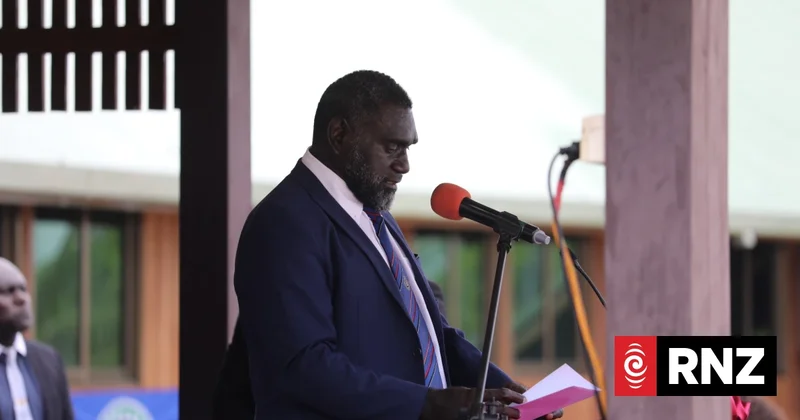
Bougainville's President Ishmael Toroama says if Papua New Guinea's national parliament refuses to back the 2019 referendum result it will undermine the peace process.
Toroama made the comment while addressing last week's meeting in Port Moresby of the Joint Supervisory Body co-chaired by PNG's prime minister, James Marape.
As a result of the meeting, after months of uncertainty, both governments have decided that the referendum results will finally be tabled for deliberation by the national parliament on 27 August.
The historic, non-binding referendum saw 97.7 per cent of respondents in the autonomous PNG region vote in favour of independence.
The referendum was provided for by the Bougainville Peace Agreement, a long term commitment which was forged in 2001 as a settlement after the Bougainville civil war in the 1990s.
Toroama told the JSB last week that Bougainville entered the talks determined to uphold joint agreements and he called on PNG to honour the Joint Consultations report and the Melanesian Framework.
"We are compelled by legal, political and moral responsibilities to respect, accept and adhere to the report and implement the framework," Toroama said.
"These are compliance documents. They reference nothing but the truth."
"They hold us accountable to our own signatures, Prime Minister," Toroama said.
Toroama went on to say he wanted to address the "elephant in the room", the national government's recently formalised position on what it calls a "non-affirming decision".
"I have read the text, and I must tell you frankly: it is a masterpiece of bureaucratic evasion and historical revisionism," he said.
"The PNG government's position argues that the national parliament has an "unfettered discretion" to simply say "no" to the 97.7% referendum vote, and that a rejection would merely reset Bougainville to the existing autonomy framework."
Toroama added that this was a "dangerous legal fiction".
"Firstly, the national government position suggests that if Parliament rejects our independence vote, Bougainville will retain its autonomy status and focus on "milestones" like fiscal self-reliance and drawing down of Section 290 powers," he said.
"The national government is treating our constitutional right to self-determination as if it were a performance review or some corporate evaluation subject to external yardsticks or the shifting political tides of the national parliament.
"Bougainville is moving away from the Autonomy space, let me make that clear," Toroama said.
He also criticised proposals that Bougainville could revisit its political status after meeting further conditions.
"This insults the intelligence of our people. By doing this, the National Government is asking us to trade a constitutional, internationally witnessed referendum result for an ambiguous promise of future political charity," he said.
"We do not need a 'clear pathway to revisit the question', the question has been asked, answered, and sealed in ink and blood.
He argued that rejecting the referendum outcome would contradict the Bougainville Peace Agreement.
"The agreement was built on the promise that the choice of the people would be negotiated in good faith toward a definitive conclusion," he said.
"It was never intended to be an endless loop of consultations where Waigani holds a permanent veto."
"Any attempt by the national parliament to vote down the referendum result, freezes us in a dead autonomy framework, or demand constitutional amendments just to kick the can down the road, is a rejection of the peace process itself. It's unacceptable," he said.
Toroama also challenged recent parliamentary decisions on voting thresholds and sessional orders, saying they were introduced without the joint consultation required under previous agreements.
"Bougainville had no part in those decisions as required by law. Those were unilateral decisions made by the national government and the speaker of the national parliament," he said.
"Bypassing mandatory consultation was, and is, actually, stepping away from the very spirit of our partnership."
He called on PNG's lawmakers to study the Joint Consultations report, describing it as a blue-print for Bougainville's transition to self-governance and eventual sovereignty.
Toroama said Bougainville's final position on independence had been endorsed by the Autonomous Bougainville Government, its House of Representatives and national MPs through a series of consultations culminating in the July 2026 Kuri Resolution.
"This position has been systematically refined through extensive consultation at Bougainville's highest political levels," he said.
Toroama also defended the autonomous PNG region's record on weapons disposal, noting it had been overseen and certified by the United Nations.
He said the overwhelming referendum vote for independence remained beyond dispute.
"During those 40 days, not a single objection, dispute, or challenge was raised against the result by any party or citizen, including the national government and the international community."
"The 97.7% vote for independence is a sealed, certified, and immutable historical fact," he said.
"In the eyes of my people, there is legal justice and there is moral justice. Bougainville demands both," Toroama said.