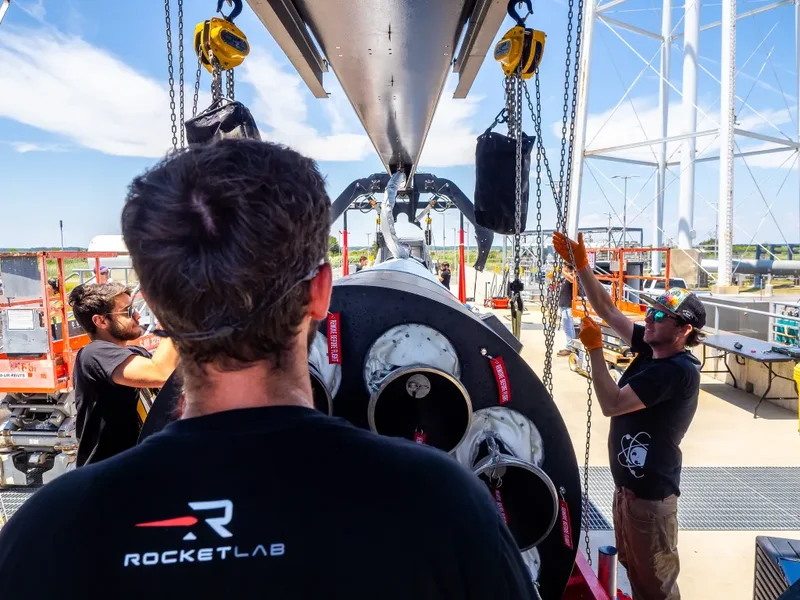
HUNTSVILLE, Ala. — Rocket Lab has developed a containerized launch system for its Electron and HASTE rockets, an effort to make it easier to operate the vehicles from locations beyond the company’s permanent launch sites and give military customers more options for orbital and hypersonic test missions.
The system, called GHOST, short for Global Hypersonic & Orbital Spaceport Technology, packages the equipment needed to support a launch — including ground-support hardware and range-control systems — into standard shipping containers that can be transported and installed at new sites.
Rocket Lab said the same infrastructure can support both Electron, its small orbital rocket, and HASTE, an Electron-derived suborbital vehicle used to carry hypersonic test articles and other experimental payloads to high speeds and altitudes.
The first GHOST installation will be at the Pacific Spaceport Complex-Alaska on Kodiak Island, where Rocket Lab plans to establish two pads under a new Launch Complex 4. The company said the system is expected to make its operational debut there with a suborbital mission in 2027.
The Alaska expansion is tied to a $266 million Space Force contract for 12 suborbital launches, with options for six more. Most of those missions are expected to launch from Kodiak.
GHOST is designed to reduce the amount of fixed infrastructure Rocket Lab needs to establish when opening a new launch location. That could be useful for military missions that require different flight trajectories or access to ranges outside the company’s existing facilities in New Zealand and Virginia.
For hypersonic testing in particular, operating HASTE from additional ranges could give the Pentagon more flexibility over flight paths and downrange areas rather than concentrating missions at NASA’s Wallops Flight Facility in Virginia.
Rocket Lab also sees potential demand from U.S. allies seeking their own launch capability without building a conventional permanent launch complex. Moving launch sites can open different orbital inclinations and suborbital trajectories depending on geography.
Any deployment would still require an appropriate site as well as licensing, range-safety planning, airspace and maritime coordination and security arrangements.
“Whether it’s for missile defense and deterrence, or opening up more trajectories, orbital missions, and sovereign launch capabilities in allied nations, GHOST is the answer to launching anywhere, anytime,” Rocket Lab founder and chief executive Peter Beck said.