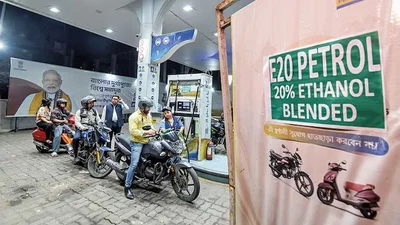
The Centre on Monday defended its nationwide E20 ethanol-blended petrol programme in Parliament, stating that extensive scientific studies and real-world validation have found no evidence of widespread engine damage or reduced vehicle life due to the fuel.
Responding to questions in the Rajya Sabha from MPs Rajeev Shukla and Dr John Brittas, Minister of State for Petroleum and Natural Gas Suresh Gopi said the Ethanol Blended Petrol (EBP) Programme was implemented only after detailed research and validation.
According to the government, studies covering laboratory testing and real-world field trials evaluated engine durability, drivability, corrosion resistance, material compatibility, fuel efficiency, emissions and vehicle stability before E20 was introduced nationwide.
The Ministry said the findings consistently showed that E20 petrol is safe for vehicles when used as per prescribed standards and does not reduce vehicle life. It acknowledged that some older vehicles may experience a marginal reduction in fuel efficiency of around 3-5%, but maintained that E20 also offers benefits such as higher octane, cleaner combustion, smoother engine performance and lower tailpipe emissions.
No widespread complaints
The government informed Parliament that it has not received any widespread or substantiated complaints from vehicle manufacturers, automobile associations or consumer organisations linking E20 petrol to engine failures, fuel pump issues, corrosion, water contamination or abnormal wear.
It further stated that year-wise and state-wise complaints attributable to E20 fuel remain nil.
While acknowledging concerns raised on media and social media platforms, the Ministry said such claims have been scientifically examined and many were found to be exaggerated, misleading or unsupported by technical evidence.
Manufacturer data backs government's stand
To support its position, the Ministry cited service data shared by automobile manufacturers.
According to the government, one leading passenger vehicle manufacturer serviced 2.84 crore vehicles during FY2025-26, including nearly 1.5 crore vehicles that were not originally certified as E20-compatible, without reporting any E20-linked corrosion, abnormal wear or reduction in component life.
Another major two-wheeler manufacturer reported similar field experience, while one automobile company analysed 1.4 crore vehicles operating on E20 over an extended period and found no evidence of ethanol-induced corrosion.
The government added that manufacturers continue to honour vehicle warranties, which it said reflects confidence in the compatibility of ethanol-blended petrol.
Crores of vehicles running on E20
Highlighting the scale of implementation, the Ministry said E15-plus petrol has been in widespread use for more than three-and-a-half years, while E19-E20 blends have been available for over two-and-a-half years.
According to the government, more than 20 crore two-wheelers and over 3 crore petrol cars have been operating on these blends without verified evidence of widespread engine failure attributable to E20 fuel.
It also noted that nearly 8 crore vehicles visit fuel stations every day, covering around 80% of India's petrol vehicle fleet, providing a large real-world database for continuous monitoring.
No advisory on water contamination
Addressing concerns over water contamination, the Ministry clarified that Oil Marketing Companies have not issued any advisory warning motorists specifically about water contamination arising from ethanol-blended petrol.
It said E20 supplied by OMCs conforms to Bureau of Indian Standards (BIS) specifications and undergoes stringent quality checks during procurement, blending, storage, transportation and retail distribution.
The government added that fuel quality is routinely tested at distilleries, depots and retail outlets, while OMCs have carried out over 30,000 inspections at fuel stations in recent weeks to detect adulteration. State governments have also been directed to adopt zero tolerance against fuel adulteration.
Reaffirming its position, the government said the conclusion that there are "no widespread issues" linked to E20 is based on more than 25 years of phased implementation, scientific validation, manufacturer field data, continuous monitoring and stakeholder consultations. It maintained that if ethanol blending had caused systemic engine damage, it would have resulted in large-scale warranty claims, service campaigns and widespread consumer complaints—none of which, it said, have been reported.
Subscribe to Auto Today Magazine
- Ends
Published On:
Jul 21, 2026 13:35 IST