A Gen Z employee asked his manager for a day's leave, saying he was struggling with anxiety. Minutes later, he quit the job.
The exchange, shared on LinkedIn by Abhishek Agarwal, triggered a debate online over workplace communication, mental health, and whether both the employee and manager handled the situation professionally.
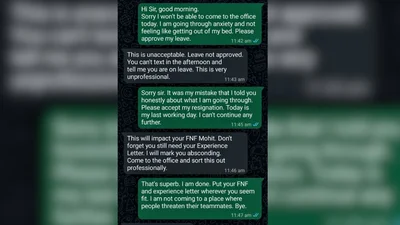
Agarwal shared a screenshot of the WhatsApp conversation along with the caption: "GenZs are challenging workplace culture. And here I am thinking... What did they talk about in that 22 secs call?"
The screenshot showed the employee messaging his manager in the afternoon, apologising for not being able to come to the office. He explained that he was experiencing anxiety and did not feel like getting out of bed, requesting that his leave be approved.
The manager, however, rejected the request, calling it "unacceptable" and saying it was unprofessional to inform the office about taking leave in the middle of the day.
The employee replied that he was sorry for being honest about what he was going through before announcing his resignation, saying it would be his last working day.
The conversation escalated further when the manager warned that the decision could affect the employee's full and final settlement (FNF) and experience letter.
He also said the employee could be marked as absconding if he failed to report to the office and resolve the matter professionally.
Refusing to back down, the employee accused the manager of threatening him and said he would not return to a workplace where teammates were treated that way. He ended the conversation by saying he no longer cared about the FNF or experience letter.
Take a look at the post here:
The exchange gained attention on LinkedIn, with users offering differing views on who was at fault. Many felt the incident showed mistakes on both sides, arguing that while anxiety and mental health concerns deserved empathy, informing a manager about leave midway through the day was not the most professional approach.
At the same time, several criticised the manager for allegedly responding with threats involving the employee's FNF, experience letter and absconding status instead of attempting to de-escalate the situation.
Others objected to framing the episode as a "Gen Z" problem, saying they had worked with plenty of young professionals who were just as committed and responsible as employees from other generations.
Several users concluded that the viral exchange underscored the need for workplaces to balance compassion for mental health with professional communication, while encouraging managers to respond to difficult situations with empathy rather than intimidation.
- Ends
Published By:
Yashna Talwar
Published On:
Jul 21, 2026 13:35 IST