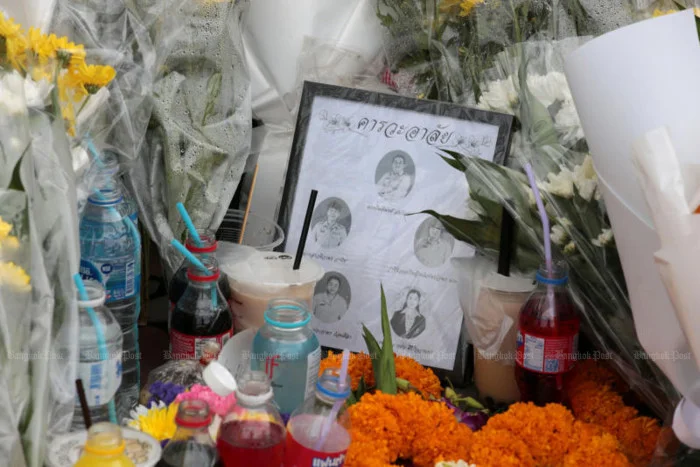
The government is preparing to make school safety a national priority, with the Education Ministry due to submit six measures to the cabinet today following last week's shooting at Debsirin Nonthaburi School.
Deputy Prime Minister Yodchanan Wongsawat said the measures would require cooperation from several ministries rather than leaving school safety solely to the Education Ministry.
The package includes regular mental health screening for students and teachers, training educators to identify people at risk and provide psychological first aid, expanded reporting channels through the Traffy Fondue platform, emergency drills, a zero-tolerance policy on bullying and violence, and tighter security screening to keep unauthorised people and illegal items out of schools.
Mr Yodchanan said schools nationwide had stepped up safety measures following the Aug 7 shooting and that the issue should be treated as a national priority covering teachers and other school personnel as well as students.
Asked whether pressure from teachers could have contributed to the shooting, he said the issue needed to be examined broadly, with the Department of Mental Health, Ministry of Social Development and Human Security and Royal College of Psychiatrists of Thailand involved.
On speculation that bullying may have contributed, he said police investigators would determine whether it played a role.
The government is also dealing with a case in Hat Yai, Songkhla, involving a foreign contract teacher who was dismissed and later allegedly threatened violence. Mr Yodchanan said the Education Ministry was handling the case and stressed that student and staff safety remained the priority.
The need for stronger psychological support was also highlighted at "Strengthening the Shield, Building Resilience: Safety in Educational Institutions", a forum held at Chulalongkorn University yesterday.
Academics said schools needed stronger psychological support and response systems alongside physical security, with greater emphasis on identifying problems before they escalate.
Wilert Puriwat, president of Chulalongkorn University, said the shooting should be viewed as the "tip of the iceberg", pointing to underlying problems that can remain hidden until they develop into crises. He called for psychological support systems backed by clear policies and procedures for early intervention.
Thailand faces a shortage of psychological professionals and limited support capacity in schools, while budget constraints and traditional attitudes can discourage students from seeking help, he said.
Panita Suavansri, director of the Counselling Psychology Programme at Chulalongkorn University's Faculty of Psychology, said school psychological advisers should be independent of academic assessment so students could speak openly without fearing that seeking help would affect their grades.
"Psychological advisers in schools must be individuals who have no conflict of interest related to academic results," she said.
Dhirapat Kulophas, head of the Educational Administration Programme at the university's Faculty of Education, said security guards, weapons screening and CCTV needed to be backed by clear procedures for reporting, assessing and following up concerns.
Teachers should also be trained to recognise warning signs and refer cases to counsellors, administrators or external specialists, while schools should explain what happens after a concern is reported, he said. Transparency would help build trust and show students that complaints would be taken seriously.
Mr Wilert called for greater attention to anger management, emotional regulation, trauma management, empathy and responsible media consumption to help students build resilience.
Nattasuda Taephant, dean of the Faculty of Psychology, said psychology should play a greater role in understanding student behaviour and supporting development.
Jessada Salathong of the Faculty of Communication Arts said the media should avoid sensationalising school violence or giving excessive attention to perpetrators, and instead focus on victims and lessons that could help prevent similar incidents.
The academics said stronger psychological support would help Thailand move towards prevention and early intervention, particularly for students who may not have a safe environment at home.
Ultimately, they said, students need both a safe place to speak and confidence that someone will respond.