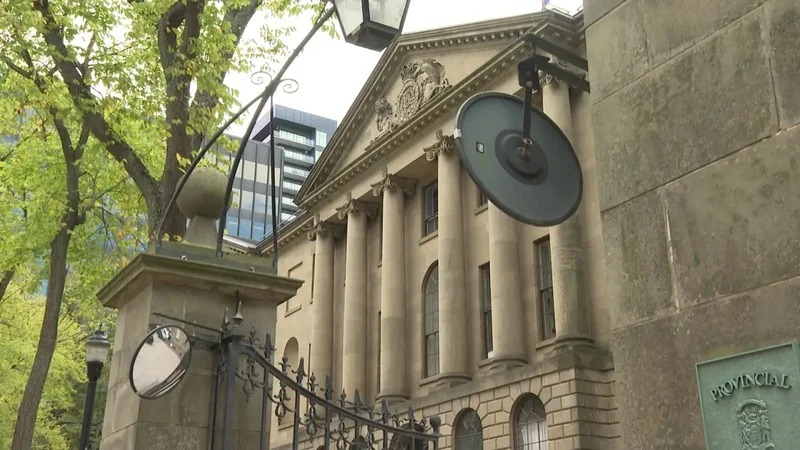
The sergeant-at-arms at Nova Scotia Province House has banned 36 people from stepping foot onto the premises, almost six months after protesters halted the budget vote with singing and shouts during the spring sitting of the legislature.
Two of the 36 people who received letters are Christine Saulnier, the Nova Scotia director for the Canadian Centre for Policy Alternatives and Nina Newington, the president of Save our Old Forests.
They describe feeling astonished at receiving the letters last week.
“I am surprised that it’s a ban going forward because if you count the many months that have passed, it could have been that,” Saulnier, who received a six-month ban starting Sept. 1st and ending March 1st, 2026, said.
Newington received a similar six-month ban, citing her participating in the March 24th demonstration that subsequently resulted in Province House being closed to the public for a week.
“Banning people from the legislature for singing when this government has shown the kind of disregard for democratic process that it has, that seems astonishing to me,” Newington said.
Get breaking National news
According to the House’s Chief Clerk, James Charlton, the bans were put in place to hold people accountable for disrupting the House of Assembly’s business — an intention he notes was indicated by the Speaker of the house on April 2 when the house was re-opened.
He added in an email to Global News that the Speaker of the House, Danielle Barkhouse, decided the bans would be a more moderate response, noting there are no other consequences for demonstrators beyond being prohibited from the legislature on a temporary basis.
Bans range from three months for those who weren’t involved in the demonstration but refused to leave the gallery when asked, to six months for participating in the demonstration, to a total of 12 for participants who were also verbally abusive toward MLAs.
Charlton said in other jurisdictions such as Ontario, protests like those seen in March would result in a lifetime ban from the gallery with the ability to appeal only after a year.
But Saulnier said these bans are an “overreach.”
“It’s very concerning to me that they think this justifies banning people from being able to go down there and show them who’s watching,” she said.
Barkhouse was unavailable for an interview, but issued a statement justifying her office’s approach.
“The nature of the interruption is immaterial,” she said. “The motivation for the interruption is immaterial. That proceedings were interrupted is the only issue and for that, there should be consequences.
“If you interrupt a court proceeding, if you interrupt a play, if you interrupt service at a fast-food restaurant, you’re going to encounter consequences. This is no different. If you don’t enforce the rules, then those rules don’t exist. There’s a time and place for protest and the gallery of the legislature isn’t one of them.”
Newington said she feels this ban is particularly sinister, especially given the sitting of the House of Assembly resumes on Sept. 8 and the six-to-12-month bans will most likely see herself and Saulnier banned from the winter sitting as well.
“I know we don’t have perfect democracy here, and there’s been plenty of backroom deals and all the rest of it, but this actually feels different. It feels really aggressively divisive,” she said.
Saulnier said the most recent bans feel like another attempt by the Tim Houston government to silence opposition.
“I think people are raising very serious questions and they did over and over again,” she said. “But I don’t see a government that’s providing more opportunities for thoughtful engagement. And that this is sending the wrong message. Exactly the wrong message.”