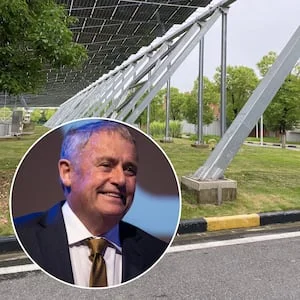
Christchurch Mayor Phil Mauger wants to turn some of the city’s biggest power-hungry facilities into their own electricity generators, with a giant solar project at the wastewater treatment plant the first step in an ambitious plan inspired by a trip to China.
Floating solar arrays in New Zealand are gaining traction as an innovative way to generate renewable energy on wastewater treatment ponds without using valuable land space.
Mauger’s push for solar stems from a recent fact-finding trip to China, where he toured a range of major infrastructure projects, including waste-to-energy plants, high-speed rail networks and trackless trams. But it was an innovative solar installation above a wastewater treatment plant that caught his attention and sparked ideas for Christchurch.
“They had it over the top of their wastewater treatment plant, it’s 5m up in the air, and it’s like a roof, but it’s not a full roof,” Mauger said.
“When it rains, the water can drip down in between them. I came back and thought, wow, this is really exciting.”
The proposal is still in its information-gathering phase, with council staff assessing costs and feasibility, but Mauger is enthusiastic about the potential.
While discussions have also included installing solar arrays over large car parks, including at Parakiore Recreation and Sport Centre, the wastewater treatment plant remains the primary focus.
“The main thing is to put these solar panels where we use the most power,” the mayor explained.
The treatment plant is one of the council’s largest power users, alongside its major aquatic facilities such as Parakiore in the central city and QEII in the east.
Rather than exporting electricity to the national grid, Mauger said the goal would be to generate power on-site and use it directly at council facilities.
“If we’ve got our own solar power and it doesn’t go on the grid, we use it ourselves,” he said.
“It doesn’t go onto the grid, so we don’t have to pay for grid access. It’s got to be win-win all the way around.”
Mauger said solar generation could also help improve resilience if there were disruptions to the wider electricity network.
The council recently installed solar panels on the Christchurch Art Gallery, which Mauger said had been performing well, but he was particularly interested in whether larger elevated installations could provide greater coverage at a lower cost than rooftop systems.
“I’m really keen to see how much cheaper it is to put these ones up that high,” he said.
“I think you’ll be able to get a lot more coverage for a lot less cost.”
Mauger said he expected an initial report within the next month and, if the findings were favourable, would be keen to see the project progress.
He was keen to start with the Bromley site and then expand if and when possible.
He assured Christchurch residents he would “not go berserk and try and cover the whole place in solar panels”.
“Just one step at a time,” he said.
Similar solar projects are already operating at wastewater treatment plants around New Zealand, where ponds and unused space are being used to generate renewable energy without taking up valuable land.
The first was launched in 2020 in Auckland at the Rosedale Wastewater Treatment Plant and features 2700 panels across a hectare of one of the treatment ponds, said to generate enough power to meet a quarter of the plant’s energy needs alongside biogas.
More than 400 panels have been installed at the Dannevirke Wastewater Treatment Plant, and similar solar setups are in place at Cambridge and Raglan.
Anna Leask is a senior journalist who covers Christchurch issues and national crime and justice. She joined the Herald in 2008 and has worked as a journalist for more than 20 years with a particular focus on family and gender-based violence, child abuse, sexual violence and homicides. She writes, hosts and produces the award-winning podcast A Moment In Crime, released monthly on nzherald.co.nz.