By Ivanna Laura
This article was originally published by Redsonadoras on July 24, 2026. An edited version is republished by Global Voices with permission, as part of the Special Coverage “Inside Venezuela’s Earthquake Disaster,” where we examine the aftermath of the earthquakes, share stories from the ground, and explore the human impact, recovery efforts, and challenges facing affected communities.
Going on seven weeks after the two earthquakes, thousands of relatives remain beside the collapsed buildings in La Guaira despite harsh conditions and insufficient support for search efforts. Their determination to find their loved ones keeps them there.
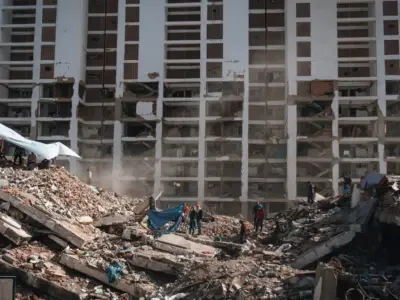
One of them is Miriam Villalta; she tries to speak, but at times she simply cannot. The pain speaks for her. For more than 15 days, she has been living in a tent just a few meters from the Luisa Cáceres de Arismendi housing complex in Playa Grande, La Guaira state, Venezuela. She has no news of her son, Greiber Gómez. She does not know whether he was trapped beneath the rubble when Tower D, where he lived on the third floor, apartment 3-08, collapsed. But there is also no trace of him in shelters, hospitals, or morgues: “I'm not leaving here until my son is found.”
Mothers, daughters, wives, nieces, cousins. In La Guaira, the search for the missing has largely fallen to women. They remain at the disaster sites, not only waiting for news — although waiting is exhausting in itself. They also clear rubble with their own hands, coordinate and organize the distribution of aid, and support and comfort other family members. They are the ones who most often go to the morgues to identify their loved ones among dozens of bodies.
This division of responsibilities is not unusual. Organizations such as UN Women have documented that during humanitarian crises and disasters, women often shoulder a disproportionate burden of unpaid caregiving work, in addition to search efforts, community organization, and support for those affected.
On Monday, July 1, 50-year-old Villalta arrived in Venezuela. She has lived in Peru for the past three years. Her journey by road took seven days. As soon as she saw the news about the double earthquake, she called Greiber. There was no answer. At that moment, she knew she had to return. Now she is searching for her 31-year-old son: “For three years I've only seen my son through video calls.”
More than a month after the June 24 earthquakes, some relatives are still holding on to hope “for a miracle”; Villalta is one of them. Her instincts tell her that Greiber is not beneath the rubble. She believes he may have been injured and transferred to a hospital elsewhere in the country. However, the relatives and friends helping her search have found nothing.
The Luisa Cáceres de Arismendi housing complex, a government-built development under the Misión Vivienda housing program, originally consisted of four towers. Tower C was the only one to collapse completely. According to an unofficial count by relatives, more than 200 bodies have been recovered from its ruins.
Villalta, her eldest son, and her sister begin each day without breakfast. “Aid doesn't arrive until it’s already nighttime,” she says. As the weeks have passed, donations — including food — have steadily declined.
“But we’re still here, fighting for our loved ones,” she insists. “The only people who have shown up are his friends, not his superiors. Firefighters have come to help rescue their colleagues, nurses have come for theirs, police officers have come for theirs—but no one has come for my son.”
As of July 22, the figures updated daily by Delcy Rodríguez’s government reported more than 5,300 deaths, 16,740 injuries, and 17,907 people left homeless. However, the official figures do not mention the number of missing persons — a statistic that would provide greater context for the scale of the catastrophe.
The United Nations initially estimated around 50,000 missing people, while independent initiatives have documented approximately 40,000 missing persons.
‘I know she isn't alive, but I still have to take her out of the rubble’
There is one place where 28-year-old Daniela Castro has found peace — “as strange as that may sound,” she says. She is referring to the ruins of the Opppe-26 building, in the Caribe sector of Caraballeda, La Guaira, where she has spent her days since June 25.
In Building I, apartment 8-05, lived her mother, Yraima Josefina García Miquilena, 65 years old, of slender build, with long black hair and graying roots. Also there were her nephews Breyelis and Breiner Castro, ages 13 and 12, both slim, dark-skinned, with curly hair.
A lot of time has passed, and the search continues. Castro has witnessed rescues on other floors and in other towers, but “they haven't recovered anyone from Building I.”
Across from it stands Opppe-25, a structure that did not collapse completely, although much of its walls now lie on the ground. Leaning against a column and sitting on broken pieces of concrete, Castro rests. “We were the ones who made this go viral,” she says.
She is referring to the video showing several men trying to move a slab of concrete using a rope. According to several relatives, after those images circulated, much more heavy machinery began arriving at the Opppe buildings in Caribe.
Opppe stands for the Presidential Office for Special Plans and Projects. In La Guaira, it is estimated that at least 16 Opppe buildings collapsed and 27 were left uninhabitable.
Since June 24, insomnia has become a constant companion, so at 12:00 a.m. she was still awake. Then, a message arrived: “They recovered a body. I think it’s your mother.” Castro got up immediately and asked her brother to take her there. At 1:00 a.m. she arrived in Caraballeda. The remains were not García Miquilena’s. At 3:00 a.m. she returned to La Vega. “I feel like I’m in limbo,” Castro says.
She looks up. The remains of Opppe-26 are still there, and with them, any hope of finding her mother alive disappears. Castro fears that if her mother’s body is never found, she will forever carry the feeling that her mother is somewhere out there.
“What keeps me here is the desire to see her one last time. I know I’m not going to find her alive, but I won’t have peace until I take her out of the rubble,” she says.