A gigantic female figure opens a window high above her head to look out into the sky. Her face is turned away from viewers as her massive arms pull up the shutters. When this work by Meera Mukherjee was first exhibited in the galleries of the Birla Academy of Art and Culture, Kolkata, in 1993, it carried the title Akash [Sky]. The centre-piece of that exhibition, it towered towards the ceiling of the room, appearing to push itself out into the open. Like her other larger-than-life figures, this sculpture also seemed to demand its place under the open skies, although its permanent home would become the gallery of another Birla art museum in Hyderabad. Like its counterparts of similar or bigger scale, the figure too is made in many parts that were cast in a furnace in molten metal out of clay core units and elaborately striated wax moulds, with its limbs, torso and head later welded together. This piece of Mukherjee is by no means her finest. It cannot claim for itself the majesty and elegiac quality of the two monumental figures that signpost two ends of her career – Ashoka at Kalinga (completed in 1972), which marked her first experiment with the challenges of scale, and the seated meditating Buddha (posthumously completed by her team in 1998), which marked the grande finale of her life and work. Nor does this work have the animistic energy and linear elegance of the artist’s first life-sized figure of 1968, which she made in eight parts and titled He Who Saw. Nonetheless, I choose this work of hers to begin this essay on Mukherjee.
If He Who Saw spoke of the direct impact on her of the primitivist aesthetics and metal casting techniques of the Gharua tribal sculptures of Bastar, that she encountered on her extensive study tours of this region, this other figure, which I have taken the liberty to call “She Who Saw”, marks the different directions in which the artist’s work had travelled over the next three decades – in multisectional casting techniques, in wax patterning of surfaces and in modes of enlargements of human anatomies. The figure’s outsized arms and fingers, large webbed feet, thick neck and small head stand characteristic of Mukherjee’s large sculptures.
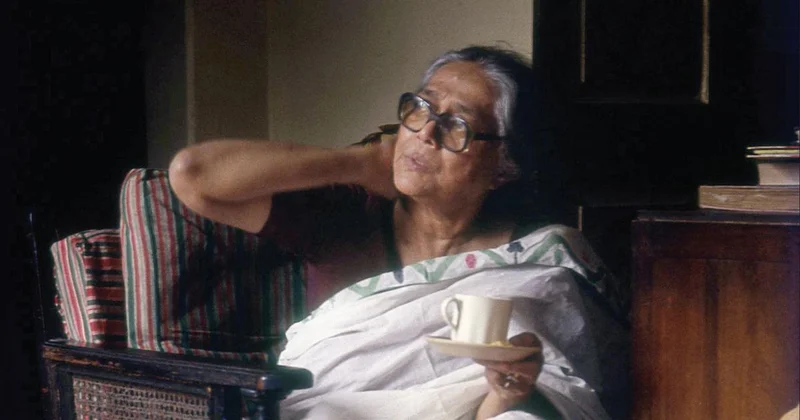
She stands as a pair with another monumental female figure from these years, whose one voluminous arm similarly reaches up to a shutter high above her head. Titled Ihokal, the woman here is weaving, standing at a loom, moving up and down the invisible threads that connect the here-and-now of her life with the here-after. In Akash, her counterpart pulls up a window shutter to just stand seeing, in the same way that Mukherjee as a child would stand spellbound, watching the sky at sunrise, day after day. The sculpted figure is misshapen and ungainly, almost in reverse proportion to the beauty of its maker. But in both cases the appearances deceive us – the hardened bronze-cast torso hides within itself the softness of the wax strands that had melted inside its body, while the woman with the loveliest of faces turned out to be a person of Amazonian will and courage, with an extraordinary capacity for physical labour and hardship. What holds the sculpture and the sculptor tightly together is the common yearning to see, and a restlessness to reach out to the sky. The act of seeing became, in the artist’s own perception, the leitmotif of her journey through life.
Born on May 12, 1923, in an affluent middle-class family in Bowbazar, Calcutta, Meera never took to formal schooling and remained at home until she was 12. The eighth and youngest child of the family, she recalls that she was something of an embarrassment to her well-educated older sisters and brothers. Her academically oriented elder sisters would tease her about having no other future than becoming a house servant. But, as was often the case with the youngest child of such families, there was always for her the indulgence and protection of her parents to do as she wished. It left her the time to observe and participate in the domestic life of the women of the joint family that lived in their 14-roomed ancestral home at Bowbazar – the elaborate preparation of food, the daily making of sandesh out of moulds, the gathering of flowers early in the morning, the performance of puja rituals, and especially her mother’s regular painting of alpona. As with many Bengali families of the same socio-cultural background, the home was where a girl like her informally imbibed her lessons in reading, writing, singing and drawing. This is where she would hear her lawyer father, Dwijendra Mohan Mukherjee, recite English poetry and Sanskrit shlokas with the same ease, and learn from her mother, Binapani, her first songs of prayer and the art of painting floor patterns with rice-flour.
She remembered these childhood years as one of luxury and style. There was her father’s Daimler car that would take them around after dropping him off at the Calcutta High Court; there were special dresses that would come from the departmental store of Whiteaway Laidlaw; and there were family holidays in Nainital, Ranikhet and Shimla. But it was also a time of her encounter with spiritual men of various kinds. At the Bowbazar home, in a living room with mahogany wood panels and a black Italian marble table, the family hosted a constant flow of visitors, the most frequent among whom were monks from the Ramakrishna Mission, while the more memorable for her were the ex-High Court judge-turned-sannyasi, Santadas Brajabidehi, and Sri Aurobindo, whose acquaintance with her father went back to the legal counselling he had provided him in the Alipore Bomb case of 1908.
Over and above all these memories, what Mukherjee recalled most vividly was her bonding with nature within the crowded environs of Bipin Behari Ganguly Street at Bowbazar, where a small garden behind the house and the large terrace were the only open areas for her mind to wander. The garden was where she made the trees her closest friends. And the terrace was where the sky beckoned and enthralled her with the splendour of the rising sun. She writes,
From the terrace one could see an expanse of roof-top sheds (chilekotharghar) and houses of varying heights. Within this dense mass, a coconut or a neem tree would bring a touch of living nature to these structures of brick and wood, and would stand waiting to connect them with the sky above, morning, noon and evening. What I found gripping in this drab setting I do not know. But it is here that I was introduced to the world’s greatest beauty. I would wake up from sleep before sunrise and just sit waiting and watching at the window; sometimes I would make my way to the terrace. Day after day, I would watch wide-eyed the gradual burst of streams of light rippling across the sky like musical strings…and silently soak in the emerging radiance of the dawn to my heart’s content. I can still remember the mind-blowing splendour of those first dawns of my life and keep watching them from across the shores of time…
Excerpted with permission from From the Depth of the Mould: Meera Mukherjee (1923-1998), A Centenary Tribute, edited by Tapati Guha-Thakurta, Jadavpur University Press and Gallerie 88.
We welcome your comments at letters@scroll.in.