Each month, we put a senior fund or investment manager to task with our I'm a fund manager series to find out how they manage their own money.
We want to know where they'd invest for the next year - and next 10 years - and what pitfalls to avoid. We also quiz them about Nvidia, gold, and bitcoin and their biggest investing mistake.
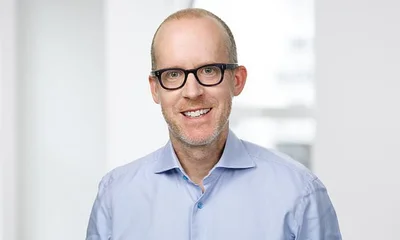
This month we spoke to Mark Costar, senior fund manager of JOHCM UK Growth Strategy. Mark has managed the fund since its inception in 2001.
Prior to joining JOHCM, Mark spent nine years at Clerical Medical Investment Group, where he was responsible for managing approximately £2billion.
The £156million fund invests mostly in the UK. Its top five holdings make up more than 20 per cent of its portfolio.
The investment objective of the Fund is to achieve long term capital growth in excess of the FTSE All Share Total Return Index.
In the hot seat: Mark Costar, senior fund manager of the JOHCM UK Growth Strategy
It invests in a broad range of companies, ranging from FTSE 100 index, which contains the 100 largest companies listed on the London Stock Exchange to smaller less liquid firms.
Among its top 10 holdings are BP, HSBC, AstraZeneca, Kooth and Funding Circle.
If you could invest in only one company for the next 10 years, what would it be?
SigmaRoc is a high-quality compounder with excellent management, strong barriers to entry, pricing power and long-term structural growth.
The balance sheet is in good shape, and it trades on an exceptionally attractive valuation.
One of its closest comparable peers was recently acquired for a multiple approximately 3x where Sigma is currently trading.
What about for the next 12 months?
Gooch \& Housego is a world leader in precision optical components.
The company has an exciting trajectory of growth opportunities ahead including in advanced semiconductors, anti-drone warfare, space and undersea data cables.
The company recently announced a record order book, and we expect further strong progress in the year ahead.
What's your greatest ever investment?
We have been in the markets for over 30 years so fortunately have been able to identify several 10-20 baggers over that time.
The most recent was Rolls Royce which from our best entry price of 70p produced that return when it touched £14 last month.
And what's your greatest ever investing mistake?
Sadly, 30 years in the market also allows you to make a tremendous number of mistakes as well.
There is a depressingly long list to choose from, but one that sticks out from early in my career is Versailles Group which in 1999 appeared to be riding high, but then the wheels came off rapidly and it went bust.
It transpired that it was a massive fraud, and the report and accounts were pure fiction. It was a painful lesson and one we took a lot of learnings from.
Big fan: AstraZeneca has produced above average sales growth and shareholder returns and there is no indication that this cannot continue
Should everyone be adding gold to their portfolio?
Centuries of history point to gold being a valuable diversifier, particularly in time of geopolitical uncertainty.
We would certainly not argue with the weight of that evidence, and that points to a prudent allocation to gold in any sensible portfolio.
What about bitcoin or other crypto currencies?
We struggle to see where the intrinsic value is in bitcoin. As a result, it - or other crypto currencies - can only be considered an instrument of speculation.
We are investors not speculators, so we don't have a strong view on them.
Which sector most excites you?
We think there are tremendous opportunities in areas that the market perceives there is an AI threat, but where there is increasing, credible evidence pointing to the opposite.
Good examples would be in advertising agencies, where AI actually increases not reduces the complexity and fragmentation of the marketing ecosystem, or in education, where AI reduces the half-life of skills, but as a result drives up demand for increased training, support and accreditation.
What sector would you be avoiding?
Utilities typically lack growth and many have over-earned and underinvested. In the UK, there is also a heightened political risk from the new Burnham administration.
Is Britain good value or cheap for a reason?
Investors cannot see past the toxic political narrative in the UK; that colours their judgement and as a result they typically underestimate both its structural attractions and the level of returns on offer.
The UK is number three in world in AI, has an incredibly vibrant start up ecosystem, world class biotechnology and science capabilities and underestimated strengths in the creative industries and education.
There is a reason why corporates are taking over UK companies – they are typically high quality, and they trade at the wrong price.
Big return: Costar's fund invested in Rolls Royce when the share price was 70p. It touched £14 last month
Astrazeneca is one of your biggest holdings. Why?
Pascal Soirot is the best chief executive in the FTSE 100, and he has transformed the company's fortunes over the last decade or so.
The company has focused on therapeutic categories where it has a clear competitive advantage in areas of unmet medical need and has industry leading R\&D productivity.
That has translated to well above average sales growth and shareholder returns and there is no indication that this cannot continue.
You also have big holdings in HSBC and Barclays - do their share prices really have further to run?
Both have performed exceptionally well over the last couple of years, and we have taken some profits as a result.
Nevertheless, prospects look strong and the valuations are still very reasonable.
Further down the size spectrum we also own some exciting faster growing and cheaper financial names such as Vanquis and Funding Circle.
Should investors be looking to rebalance away from the US?
The US has come to dominate global indices and together with its large tech bias investors can inadvertently find themselves heavily overweight this region, which is neither prudent nor advisable.
The UK as we have previously mentioned and selective non tech dominated Asian markets look interesting places to diversify away some of this.
Should passive investors be worried?
Passive has been a very useful conduit for investors and in many ways has helped to democratise the investment process, which can only be a good thing.
Too much passive and systematic money though does have consequences, and we are seeing that in markets today through excessive concentration, higher correlations and discontinuities in the price formation ecosystem.
Active can exploit these inefficiencies and deliver strong returns while doing so. A gradual rebalancing back towards active is likely to happen as a result, and there are signs this process has already started.
Why should investors choose your fund over a passive index fund?
The fund has a 25-year track record of very strong returns, consistently beating the index through multiple market cycles and conditions.
It's a disciplined process that leads to a portfolio of stocks that on average are cheaper than the market, have stronger balance sheets than the market yet are growing considerably faster than the market. We would argue this is a very compelling profile.
You inherit £100k tomorrow as a 25-year old without any assets. How would you invest?
Long term investment in equities is a proven way to compound wealth so with a lifetime ahead of them someone of this age should have a high component of what they can afford to save allocated here.
A low-cost index tracker combined with some proven, active and differentiated funds should certainly help towards that goal.
DIY INVESTING PLATFORMS
AJ Bell
AJ Bell
Easy investing and ready-made portfolios
Hargreaves Lansdown
Hargreaves Lansdown
Free fund dealing and investment ideas
interactive investor
interactive investor
Flat-fee investing from £4.99 per month
Freetrade
Freetrade
Investing Isa now free on basic plan
Trading 212
Trading 212
Free share dealing and no account fee
Affiliate links: If you take out a product This is Money may earn a commission. These deals are chosen by our editorial team, as we think they are worth highlighting. This does not affect our editorial independence.