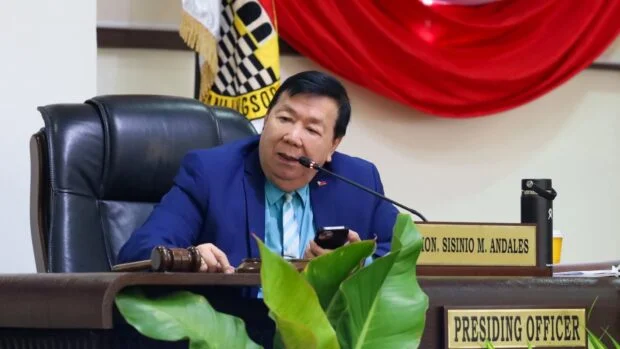
SK tapped to address CICL cases in Cebu City
CEBU CITY, Philippines — City Councilor Sisinio Andales will ask the Sangguniang Kabataan Federation (SKF) to strengthen youth programs aimed at preventing juvenile delinquency and addressing the rising concern over children in conflict with the law (CICL).
Andales will present the proposed resolution during the council’s regular session on Tuesday, Aug. 11, urging the city’s youth leaders to formulate and sustain programs that could keep young people from entering the criminal justice system.
The measure cites data from the Department of Social Welfare and Development (DSWD) showing 1,385 CICL cases recorded in Central Visayas, with children aged 15 to 17 accounting for the majority.
READ: Juvenile drug offenses up in Cebu province
The resolution describes the figure as “disturbing” and calls for stronger preventive and rehabilitative interventions involving families, schools, communities, civil society groups and local governments.
The resolution identifies the SK Federation as a strategic partner because of its mandate to develop and empower young people at the community level.
Intervention to prevention
The proposal does not limit the SK’s role to activities for CICLs already involved in offenses. Instead, it calls for programs that address factors that could place young people at risk of delinquency, including lack of guidance, negative peer influence, substance abuse and other social pressures.
The proposed programs could cover positive values formation, civic responsibility, youth leadership, education, sports, mental health awareness, life skills, anti-drug advocacy and family engagement.
The resolution also seeks community-based interventions that could strengthen the protective environment around children before they become involved in criminal activities.
Drug offenses dominate
Recent data from the Cebu Police Provincial Office (CPPO) show how drug-related offenses have emerged as a major concern among CICLs in Cebu Province.
From Jan. 1 to July 13, 2026, police recorded 105 CICL cases, slightly lower than the 108 cases recorded during the same period in 2025.
Police Lieutenant Ritchil Tesoro, chief of the CPPO Women and Children’s Protection Desk, said the three-case decline represented only a 2.78 percent decrease.
“Last year, we had 108 cases involving CICL. Karon, niubos ta pero kuan lang gyud, up to three cases lang gyud, so 105 ang atoang number of cases karon involving CICLs,” Tesoro said.
(Last year, we had 108 cases involving CICLs. This year, the number decreased, but only by three cases, so we have 105 cases involving CICLs.)
Drug-related offenses accounted for 54 of the 105 cases, or more than half of the total.
The cases involved violations of Republic Act No. 9165, or the Comprehensive Dangerous Drugs Act of 2002, including drug possession, sale, and maintenance of a drug den.
The number also marked a 34.09% increase from the 39 drug-related CICL cases recorded during the same period in 2025.
Rape and robbery followed with seven cases each, while homicide cases fell to three from five. Alarm and scandal cases dropped to one from five.
Older teenagers account for most cases
The CPPO data also showed that teenagers aged 15 to 17 accounted for most of the recorded CICL cases.
Seventeen-year-olds accounted for 35 cases, followed by 34 cases involving 16-year-olds and 25 involving 15-year-olds.
Only two cases involved children aged 7 and 11.
The figures also showed a significant gender disparity: 99 of the 105 cases involved boys, while six involved girls.
Tesoro previously identified several factors that could contribute to children’s involvement in criminal activities, including inadequate parental supervision, peer pressure, social media influence and the vulnerability of children without parents or guardians.
“Most of these children, walay mga ginikanan, wala silay mga guardian nga magbantay sa ilaha. So, usa ni sa mga reason. And then, peer pressure, and then social media influence,” Tesoro said.
(Most of these children do not have parents or guardians to look after them. This is one of the reasons. Other factors include peer pressure and social media influence.)
She also warned that adults could exploit children, particularly in theft and robbery cases.
What happens to CICLs
Republic Act No. 9344, or the Juvenile Justice and Welfare Act, sets different rules depending on a child’s age and capacity to understand the consequences of an offense.
Children 15 years old or younger at the time of the offense remain exempt from criminal liability but must undergo an intervention program.
Children above 15 but below 18 also remain exempt unless they acted with discernment — meaning they understood the nature and consequences of their actions.
Social workers assess discernment, with the resulting certification submitted for court evaluation when necessary.
The law therefore places emphasis on intervention, rehabilitation and reintegration rather than treating children in the same manner as adult offenders.
Why intervention often falls short
Tesoro previously pointed to parental participation as one of the challenges in sustaining intervention and diversion programs.
“Usahay ang bata dili na motunga. So mao gyud na ilang gina-raise nga issue. Dili motunga ang bata, dili ma-continue ang atoang diversion program because of the non-cooperative parents,” she said.
(Sometimes, the child no longer attends. That is one of the issues being raised. When the child does not attend, the diversion program cannot continue because of uncooperative parents.)
Some children also fail to complete community service because their parents do not encourage them to finish the program, she said.
The lack of dedicated facilities for CICLs also remains a concern.
Tesoro said CICLs should not stay in regular jails and should instead receive temporary care through appropriate child-protection facilities. She cited the need for facilities such as Bahay Pag-asa, where children can receive interventions from social workers, doctors, psychologists, and other professionals.
Central Visayas already has a Regional Rehabilitation Center for Children and Youth in Argao, Cebu. DSWD-7 reported that the facility served 113 cases from January to May 2026 and housed 84 residents as of May.
Disclaimer: The comments uploaded on this site do not necessarily represent or reflect the views of management and owner of Cebudailynews. We reserve the right to exclude comments that we deem to be inconsistent with our editorial standards.