Sydney Opera House, July 21
It is the “curse” – la maledizione – that drives the drama of Verdi’s Rigoletto. We hear it in the overture’s first portentous notes and in Rigoletto’s despairing cry at the close. Rigoletto believes it ultimately derives from his ugliness, the hunchback that condemns him to a life of humiliation and corrosive bitterness, making him over-protective of the one thing of beauty in his life, his daughter, Gilda.
This classic production by the late Elijah Moshinsky transfers that ugliness to the world at large, in particular, the Duke of Mantua’s court, the centrepiece of designer Michael Yeargan’s rotating set. Creating a surprising sense of depth and space on the Joan Sutherland Theatre’s limited stage, it juxtaposes a palace of glittering debauchery, the false sanctuary of Rigoletto’s home and the seedy tavern of the final tragedy, all connected by murderous dark alleyways.
The Opera Australia Chorus evidently enjoy their debauchery in Rigoletto. Keith Saunders
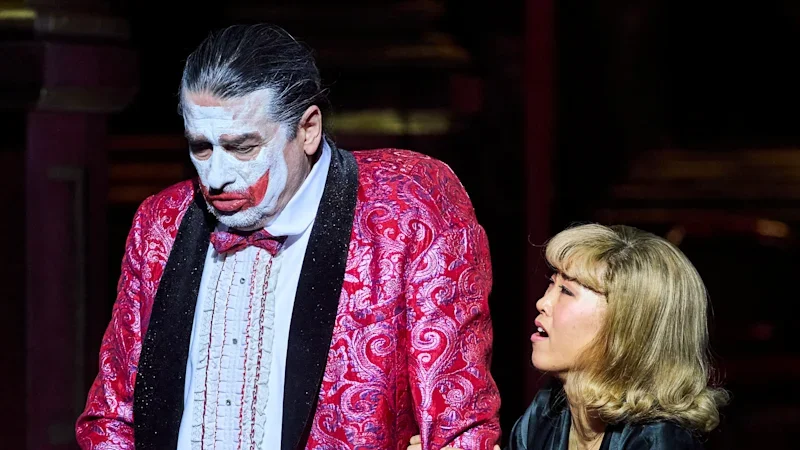
For this revival, Dalibor Jenis sings the title role with a voice of strength and depth, grained with worry and fierce in self-loathing. He is impressive throughout, but never more so than in the crucial reconciliation scene with the seduced Gilda in Act 2 where impotent frustration over his fate mixes with fragile tenderness.
This was also Gemma Nha’s finest moment as Gilda. Here she displayed a wide emotional and tonal range, beginning Tutte le feste al tempio with winning quietness, before rising to thrilling passion. Earlier she had sung Caro Nome in Act 1 with a bright penetrating sound and a tight vibrato that crazed the tonal surface.
Her dramatic persona moved lightly between pertness, filial loyalty and youthful yearning. Kang Wang as the Duke also emphasised lightness rather than power, his attractive tenor sound and strong command of the upper range creating an autocrat of insouciant suaveness rather than overbearing menace.
La donna e mobile had buoyant clarity. Such a nice young man! With an effectively threatening edge to his low notes, David Parkin was an aptly brutal Sparafucile (literally “shoot gun” – you get the idea). As his seducing sister, Maddalena, Sian Sharp sang with colour and strength, injecting an important element of human warmth into the sound.
Gennadi Dubinsky, as Monterone the wronged father, was imposing though slightly less searing in delivering the plot’s actual curse in Act 1 than in his portentous and incisive power in shackles in Act 2.
Dalibor Jenis as Rigoletto and Gemma Nha as Gilda.Keith Saunders
The Opera Australia Chorus seemed to enjoy their depravity, and sang with an energised, full sound, the male members delivering conspiratorial whispered precision in the kidnap scene and a quite passable soft-shoe shuffle.
Under conductor Sesto Quatrini, the Opera Australia Orchestra highlighted the shudders and flashes of Verdi’s highly original orchestration with discreet balance. Simon Meadows (Marullo), Virgilio Marino (Borsa), Jonathan Alley (Ceprano), Dominica Matthews (a haughtily, ungracious Giovanna), Jennifer Black (Countess Ceprano) and Katherine Wiles (Page) adeptly filled out a cast in which nobody acts particularly admirably.
This production is a gem of Opera Australia’s repertoire though it doesn’t seek to problematise male possessiveness, which is the story’s real curse.