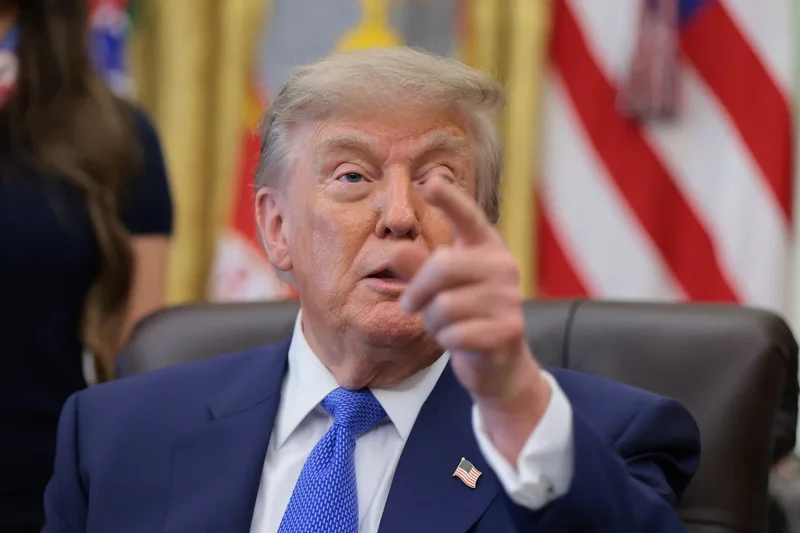
Donald Trump says the US Navy has cleared mines from the Strait of Hormuz and now has “100 per cent” control of the key waterway, which Iran says will remain closed until Washington meets its demands.
Trump told reporters in the Oval Office: “It’s open now,” claiming the US was “the only one that has control of the Strait of Hormuz right now”.
Trump, meanwhile, demanded war compensation from Iran on Monday in a shocking reversal of the six-point ultimatum presented to Washington as Tehran’s conditions for reopening the Strait of Hormuz.
Iran’s top security official said earlier that they would allow traffic to pass through the key channel only once the US meets six terms, including “payment in full” for damage inflicted during the war.
But Trump snubbed the proposal in a message on Truth Social, saying: “It is an interesting idea because now I am likewise demanding compensation from Iran,” Trump said, adding: “I have instructed my representatives to put this firmly into any, and all, future negotiations.”
Trump demands war reparations from Iran after Tehran called for compensation
Donald Trump has said he will demand war reparations from Iran for the deaths and injuries of US soldiers and civilians over decades.
He made the demand after Iranian negotiators called for compensation for the destruction caused by the war, which has killed thousands and severely damaged Iran’s military and economy.
Trump wrote on Truth Social: “Now I am likewise demanding compensation from Iran, for all of the people that they have killed and gravely wounded with their roadside bombs and many conflicts, for which they are famous, as led initially by Gen Soleimani, including the families of those killed on the USS Cole, and thousands of others killed in combat.
“Additionally, compensation should be paid to the families of the hundreds of thousands of innocent protesters that Iran has killed over the last 50 years, not to mention the 52,000 that have been killed in the last five months.”
Catch up: Trump says ‘it always works out’ as plan to reopen Strait of Hormuz stalls
Donald Trump has declared that it “always works out” as he said the US will scale down the intensity of its efforts to reopen shipping through the Strait of Hormuz.
Talks to end their war and reopen shipping through the Strait of Hormuz appeared to have stalled, after Tehran demanded a series of conditions, including the payment of compensation, before it reopens the waterway.
"We are only semi-negotiating with them. We are just watching Iran with its huge inflation and the fact they have no money," he told Axios. "It will work out. It always works out. It's like a chess game.”
Tehran is in negotiations with Oman to partially open up the Strait, but set out six conditions the US must meet, including a permanent end to the war and aggression against Iran and its allies in Lebanon, Palestine, Yemen, and Iraq.
Trump used elaborate ruse to fly out of Turkey following summit because of Iran threat - report
Donald Trump secretly switched from Air Force One to a smaller military jet after last month’s Nato summit in Turkey amid an Iranian assassination threat, The Washington Post reported.
After publicly boarding an older Air Force One, Trump was reportedly moved via an airport catering truck to an Air Force C-32A and flown to the UK, while journalists were led to believe he remained on Air Force One.
The US has not independently confirmed the report.
“As the President has said recently, there are many enemies of America who have their sights on him, and we use every tool at our disposal to address those threats,” White House communications director Steven Cheung said in a statement.
During a gaggle with reporters aboard the aircraft, Trump was asked directly if there was any credible threats on Air Force One by Iran, according to the Associated Press.
“Well, I have a threat all the time. I’m number one on their list before you,” Trump said. He added to the travelling reporters, “But if I go, you go.”
Iran president says supreme leader shared message of ‘unity and cohesion’
Iranian president Masoud Pezeshkian has said that Ayatollah Mojtaba Khamenei had a message of “unity and cohesion” during a recent meeting that lasted seven hours.
Pezeshkian said Khamenei, who hasn’t made an appearance since becoming supreme leader, was in perfect health.
On Monday, Khamenei’s office announced several key appointments, including the selection of a former wartime commander and veteran political insider to lead the country’s highest security body.
In pictures: Life goes on in Iran despite continued conflict with US
Reports claim Trump could end Iran war without nuclear agreement but people have come with receipts
Reports suggest that US president Donald Trump could walk away from his Iran war without a nuclear deal – and some people are posting receipts.
Trump launched the US into a war with Iran in February of this year with a range of reasons cited for why. One rationale posed by Trump’s administration was that it was to keep Iran from having nuclear weapons, even as back in August 2025 it claimed to have done significant damage to Iran’s nuclear capabilities via strikes.
Read the full story on Indy100:
The forgotten Iranians caught in the deadly stalemate of Trump’s war
This article first appeared on our partner site, Independent Persian
“We’re constantly terrified by the sound of explosions. The electricity and water keep being cut off. We are without jobs and have no food. It feels like no one is coming to help the people of southern Iran. We don’t want war.”
These remarks reflect dozens of messages and firsthand accounts received by Independent Persian from residents of the southern provinces of Hormozgan, Bushehr, Khuzestan and Sistan and Baluchestan.
With intermittent US military strikes on southern Iran in recent weeks under a very precarious ceasefire, residents say they are now grappling not only with the threat of explosions but also prolonged power outages, water cuts, internet disruptions, shuttered businesses and a complete lack of meaningful government support.
Read more here:
Recap: Trump demands compensation from Iran in snub to latest demands
After Iran on Saturday demanded the US meet six new conditions, including compensation for the war, before they reopen the Strait of Hormuz, Donald Trump on Monday indicated he was surprised by the terms - and demanded compensation from Iran.
“I see that Representatives of the Islamic Republic of Iran are asking for compensation for the damage done to them during the last five month Military Conflict ... even though it was never mentioned in any of our negotiations or meetings!” he wrote on Truth Social.
“But it is an interesting idea because now I am likewise demanding compensation from Iran ...”
He concluded: “I have instructed my representatives to put this firmly into any, and all, future negotiations.”
Hopes of reopening the Strait appeared less likely in light of the post.
Comment: Has Donald Trump begun to plan for life without Benjamin Netanyahu?
Netanyahu’s belated snub of the US-backed Gaza peace plan shows his dilemma ahead of ‘massacre’ election he faces in October – without the Israeli right he is finished, and without Trump’s backing he is toast, says Donald Macintyre
What to make of Trump's claims for compensation from Iran
Donald Trump on Monday responded to Iran's conditions for a peace deal with his own demands that Iran pay compensation for people killed in wars, attacks and protests, in a rhetorical escalation likely to complicate efforts to reopen the Strait of Hormuz.
Trump said in a post on Truth Social that Iran had never mentioned such terms in their prior meetings. But the Iranian demands were largely in line with the terms of a preliminary peace deal signed in June, which has since broken down.
Referring to Tehran's crackdown on demonstrations in late 2025 and 2026, he also said Iran had killed some 52,000 protesters. The US based Human Rights Activists News Agency (HRANA) put the figure closer to 6,500 in February.
Trump also said Iran should compensate families of the 17 U.S. sailors killed in an October 2000 attack in Yemen on the naval vessel USS Cole, which has been blamed on al Qaeda, not Iran.
While Washington continues to insist a deal to reopen the Strait of Hormuz is coming, Iran says its terms must be met first. Also, an agreement with Oman would give Tehran more leverage over the key waterway than it had before the war began, further complicating future talks with the US.