- Published
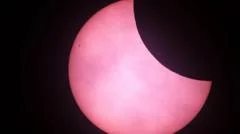
Stargazers keen to see the partial eclipse of the sun will get help from the experts to watch it safely across the South West and the Channel Islands.
There are a range of free and ticketed events to help people enjoy the spectacle, with venues including a spectacular beachside spot, an observatory and even a pub with its own observatory.
Charlie Payne, who has been helping to organise an event on the Isles of Scilly, advised people who plan to go it alone to "pick your favourite place to watch the sunset."
She said an ideal spot was "somewhere where you've got really clear views and a clear line of sight to the horizon" and stressed people should not look directly at the sun as it could seriously damage their eyesight.
'A really big deal'
In Devon and Cornwall, the eclipse will start at about 18:18 BST, peak at 19:15 and finish at about 20:10.
In Guernsey and Jersey, those timings will be about 18:21, 19:17 and 20:10.
The Cosmos Community Observatory on the Isles of Scilly is hosting a free event between 18:00 and 20:00 on the lawns of the Karma Hotel on St Martin's.
People would be able to view the partial eclipse through telescopes with solar filters and eclipse glasses at the event on Scilly, which is only open to those who live or are holidaying on St Martin's.
Payne said: "It's a really big deal. These kind of eclipses don't happen very often and one almost this deep, almost near to totality is pretty rare".
In Cornwall, Kernow Astronomers have stocked with 420 eclipse glasses to give out at their event at the National Trust car park at Carnewas, at the Bedruthan Steps near Newquay, on the county's north coast.
Frank Johns, of the club, said: "We really have got a good view to the west and you can see right towards the ocean."
The Smugglers Rest is Talland Bay, near Looe, is holding a paid ticket event.
Bosses said they planned to use proceeds to help pay for an access ramp at the venue on Cornwall's south coast.
Like the other paid-for eclipse events, organisers have advised checking for ticket availability before travelling.
In Devon, stargazers from Plymouth Astronomical Society are also to help people enjoy the spectacle safely and said they were planning to give out a number of eclipse glasses at Lowery Cross near Yelverton.
Organisers said they would be there from 17:00 with their telescopes and would help people view the eclipse at the free event.
Members were also due to be there when it started to get dark to view the Perseids meteor shower, they added.
The Norman Lockyer Observatory in Sidmouth is hosting a paid-for ticketed event from 17:00 for people to see the partial eclipse and also the Perseids meteor shower later when the sky got dark, from about 21:30.
There will also be storytelling from 20:30 and astronomers will help people see the partial eclipse safely, with a live stream of the event from a venue in Spain which is expecting a full eclipse.
The Poltimore Inn, at North Molton on the edge of Exmoor, has its own observatory and is hosting a paid-for event.
Landlord Alan Boddington said, even though this is not a full eclipse, "it is still going to be quiet and dark and the birds will think it is night time".
Boddington said the pub, which is in a dark sky reserve, is believed to be one of just a handful in England with their own observatories.
In Guernsey, Dr Jean Dean, from La Société Guernesiaise's astronomy section, advised people to head to the west coast of the Channel Island to enjoy the spectacle.
She said people needed to use eclipse glasses or have their back to the sun and project it onto a piece of card.
Eclipse glasses have been given out are Les Bourgs Hospice charity shops in St Martins and St Sampsons.
Dean warned that if anyone looked directly at the sun they would "burn your retina in your eye and you will be permanently blind".
She stressed people should not use the eclipse glasses with other optical equipment such as binoculars, but could put them over spectacles.
Jersey Astronomy Club said it was setting up several solar telescopes by the slip at Le Braye on St Ouens Bay and it planned to have a supply of solar glasses for people to wear.
The club warned people not to attempt to look through binoculars or telescopes which did not have proper solar filters as they could collect more light than the human eye could cope with, risking blindness.
It said, without proper solar filters, "the only safe way to observe an eclipse is to use the telescope or binoculars to project an image, not into your eye but onto a piece of white paper or card", and removing or taping over the front of the finder scope "to prevent any accidents".
Follow BBC Cornwall on X, external, Facebook, external and Instagram, external. Follow BBC Devon on X, external, Facebook, external and Instagram, external. Send your South West story ideas to spotlight@bbc.co.uk, external.
Follow BBC Guernsey on X, external and Facebook, external. Follow BBC Jersey on X, external and Facebook, external. Send your Channel Island story ideas to channel.islands@bbc.co.uk, external.