By Kim Boram
SEOUL, Aug. 11 (Yonhap) -- The central bank is highly likely to deliver another rate hike in the near future, unless there are other external shocks or factors, to bring inflation under control, the outgoing senior deputy governor of the Bank of Korea (BOK) said Tuesday.
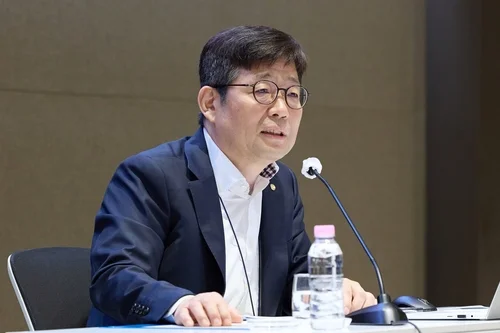
"The economic cycle moves, and monetary policy responds to the cycle in advance," BOK Senior Deputy Gov. Yoo Sang-dai, also a member of the BOK's Monetary Policy Board, said in a press conference. He will leave the central bank next week.
"The BOK raised the benchmark rate in July as it had to manage the economic cycle, and it will likely increase it further if there are no particular shocks or factors."
The central bank hiked the benchmark interest rate by 0.25 percentage point to 2.75 percent at its last monetary policy board meeting in July, marking the first rate increase in 3 1/3 years.
The BOK said the rate hike was aimed at combating mounting inflationary pressure as consumer prices had stayed above 3 percent for the second consecutive month in June, well above the BOK's 2 percent target.
Yoo said current high inflation is being driven by both demand- and supply-side factors amid export-led economic growth and higher oil prices stemming from the protracted military conflict in the Middle East.
"When the Russia-Ukraine war broke out in 2022, inflation was high due to cost-push effects in the aftermath of the COVID-19 pandemic," he said, adding that the benchmark rate rose to 3.5 percent.
"But this time, despite tensions in the Middle East, we face strong demand-driven inflation, which is rising at a slower and steadier pace amid solid economic growth."
Yoo noted that since the July rate-setting meeting, key economic data, including second-quarter gross domestic product (GDP) growth and July consumer prices, would influence the upcoming monetary policy decision slated for Aug. 27.
The South Korean economy expanded 0.6 percent in the April-June period from a quarter earlier, exceeding the BOK's earlier forecast of 0.2 percent growth.
Consumer prices rose 2.8 percent in July, falling below the 3 percent mark for the first time in three months as oil prices showed signs of stabilization.
"For the central bank, the most important things are whether core inflation will stay high and whether economic growth will continue for a while," he said. "Monetary policy aims to respond to economic cycles, minimizing swings in the cycle and stabilizing inflation."
brk@yna.co.kr
(END)
- From 'BTS Boulevard' to U.S. governor's praise: BTS sweeps N. America on 'Arirang' tour
- Gemini, BTS collaboration on display at Las Vegas Sphere
- TWICE's Jeongyeon leaves JYP to pursue acting career
- U.S. Marines stage live-fire drills involving FPV drones for 1st time in S. Korea
-
Pyeongtaek city fails to reach U.S. military via hotline over reported white phosphorus leak: official
-
From 'BTS Boulevard' to U.S. governor's praise: BTS sweeps N. America on 'Arirang' tour
- TWICE's Jeongyeon leaves JYP to pursue acting career
- U.S. Marines stage live-fire drills involving FPV drones for 1st time in S. Korea
- Pyeongtaek city fails to reach U.S. military via hotline over reported white phosphorus leak: official
-
(LEAD) Police raid Starbucks Korea over controversial promotional event
-
TWICE's Jeongyeon leaves JYP to pursue acting career
- From 'BTS Boulevard' to U.S. governor's praise: BTS sweeps N. America on 'Arirang' tour
- Seoul cautious about Ukraine's defense request amid claims more N. Korean troops being sent to Russia
- (2nd LD) Gov't to enact special law this year to designate special zone for AI investment projects
- HD Hyundai Heavy wins 956 bln-won engine generator supply deal in U.S.