In their first season after Pep Guardiola stood down, Barcelona won the Spanish league. In their first season after Pep Guardiola left, Bayern Munich won the German league. And so, in their first season after Pep Guardiola walked away, Manchester City will…?
The precedents may be encouraging but the reality is that, even as they mounted a Premier League title challenge last season, City finished seven points behind Arsenal, after ending up 13 adrift of Liverpool the previous year. Guardiola left City as their greatest ever manager, but with his greatest side being broken up, a process that continued with the summer departures of John Stones and the captain Bernardo Silva.
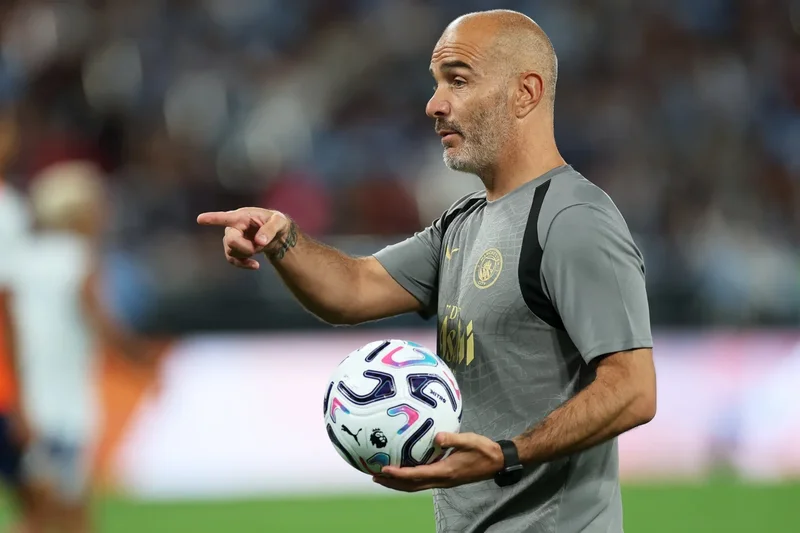
Enzo Maresca, a replacement that offers echoes of Tito Vilanova – another sidekick in a Champions League-winning campaign – was Guardiola’s assistant in the treble campaign of 2022-23, but inherits a very different side.
The Italian returns to the Etihad having called Guardiola the best manager of the last 20 or 25 years and noted Manchester United and Arsenal’s difficulties after the departures of Sir Alex Ferguson and Arsene Wenger respectively. His is a formidably tough task in one respect but at least, Maresca may console himself, he no longer has to deal with BlueCo at Chelsea.
The fact that it took a £17m compensation package to bring in Maresca – six months after he left Chelsea – and delayed his appointment, underlined that City’s summer has been expensive and awkward at times. They had a World Cup-winning captain in the squad, and Rodri would have seemed the logical successor to Silva with the City armband, except that he is in the last year of his contract, wanted by Real Madrid and subject of a £38.4m bid from Barcelona. He may be on the brink of going. It could leave City having broken the transfer record for a British player this summer and yet with a weaker midfield, if they lose both Silva and Rodri.
All of which may indicate City have less allure – even to the players they already own – without Guardiola. A team that was definitively too old in 2024-25 could look young now. The rebuilding job has been costly, with almost £700m spent in the last four transfer windows and perhaps more to come in the next few weeks, but is unfinished. Maresca has targeted full-back additions and, if Rodri goes, a midfielder could be required, with Morocco’s Ayyoub Bouaddi and Chelsea’s Enzo Fernandez both of interest.
City have started to shape Maresca’s side, though. The £116m deal for Elliot Anderson secured their top target, with the added bonus that Manchester United also wanted him. Josko Gvardiol, Abdukodir Khusanov and Phil Foden have signed new contracts; if the Mancunian could recapture the form that earned him the Footballer of the Year award and yielded 27 goals in 2023-24, it would be a triumph for Maresca, though Foden ended last season without a goal in 29 games and losing his place to Rayan Cherki.
City’s overhaul leaves them better stocked in some areas than others. In Gvardiol and Khusanov, plus Marc Guehi and Ruben Dias, they have four quality centre-backs, giving the possibility the Croatian or the Uzbek may be used on the flanks. Gianluigi Donnarumma became a fixture in goal, with the consequence that James Trafford left a year after rejoining; City’s capacity to bring in high fees was shown by a £45m deal.
Elsewhere, however, it will be intriguing who Maresca prefers. Erling Haaland’s importance is a given to such an extent that he scored 38 goals last season and didn’t finish in the top three of City’s player-of-the-year vote. Nico O’Reilly won it; does Maresca see him as more of a left-back or a midfielder, though?
Some of the acquisitions in the last couple of years spent much of Guardiola’s last few months on the bench, in Nico Gonzalez, Tijjani Reijnders, Omar Marmoush and Savinho. In the case of the Brazilian, in particular, it was because Jeremy Doku kicked on and Antoine Semenyo arrived.
The broader picture is that City recruited a group of fine players; but if part of the challenge is to construct a team, part of the problem is that some of their predecessors, and men Maresca coached, were great players.
That will be an issue for the Italian: the shadow of the past, whether Guardiola himself or an all-conquering team who set standards that are hard to match. In the Catalan’s last couple of years, City lacked the consistency they had shown in the past. Their fortunes tailed off in the Champions League, with exits in the knockout phase play-offs and the round of 16. They kept facing Real Madrid, but they also lost to too many others.
They nevertheless displayed a potency in one-off games. They did a cup double last season, beating eventual champions Arsenal in the Carabao Cup final and the Chelsea that Maresca left behind in the FA Cup showpiece.
The Italian took Chelsea to fourth in his only full season in charge and left them in fifth. His greatest feat, like City’s in Guardiola’s valedictory year, came in knockout competitions. Maresca won the Club World Cup with the Blues.
When he was last at City, and in a more meaningful sense, they became the best team in the world. They are not now; but as Maresca tries to restore them to those heights, part of the task is to rival another of Guardiola’s old assistants, in Mikel Arteta, part is to prove a worthy successor to a legend and part is to avoid the fate of David Moyes at United and Unai Emery at Arsenal.