Sometimes you find yourself in situations that would previously have been unthinkable. Years ago if someone had told me that I would one day be meeting drug dealers in a car park, handing over cash and begging them to please stay away from my son, I’d have thought they were insane.
Likewise, the very idea of being in an A&E department pleading with the duty doctor to section my suicidal child for his safety.
Yet those are just two examples of how desperate, broken and chaotic life becomes when you are the mother of a child with severe mental health issues who is self-medicating with drugs. A child that has lost the will to live but is unable to access any treatment because NHS protocol requires patients to be clean first.
For nearly ten years, until my son Aidan was taken from us at the age of 23, life had become one long battle. With mental health services. With social services. But most of all with Aidan himself, as we tried everything we could to make him better, not realising then that we couldn’t.
Ours was a happy, loving home. I worked as an accountant and my husband Anthony had a senior role in NHS management. We lived with our three boys in a five-bedroomed home in the beautiful town of Chipping Norton in the Cotswolds. Aidan was the oldest, Leo our middle child and Milo the youngest.
Growing up Aidan threw himself into everything and was a happy, inquisitive and loving child. He got consistently good reports at school and really found his groove when it came to sport, especially loving rugby and hockey. He represented Team GB in inline hockey at the Junior Olympics when he was 12 and came home with two gold medals.
It was while attending secondary school that things started to unravel.
When he was about 14 he started to refuse to go to school. I would try everything to get him to attend: pleading, shouting, even bribery. Sometimes I would get him in the car only for him to leap out at the traffic lights and run off.
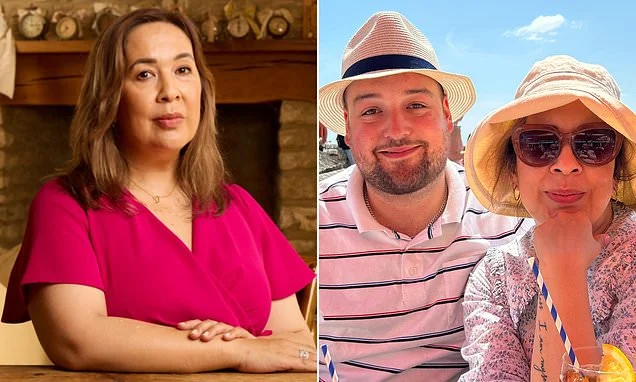
Aidan Hughes, right, had always been a happy child, but his behaviour changed dramatically in secondary school when he grew secretive
Like so many teenagers he was secretive and not great at opening up, but when he did he would say that he felt lonely and isolated and had no friends.
When I spoke to the school they were astonished and said that seemed so far removed from the child they knew.
With hindsight I suspect Aidan was self-medicating even then, hanging out with the wrong crowd – and his old friends didn’t want any part of it.
One day around that time, he came home from school and was behaving very strangely. His speech was slurred and his face was sagging on one side.
I asked him if he had taken anything and he assured me he hadn’t and just felt a bit unwell. I kept an eye on him all night and in the morning he seemed fine.
However, the next day I got a call from the school to say that a pupil had taken in a supply of Xanax prescription tranquilliser pills and about ten kids, including Aidan, had swallowed them and some had been hospitalised. The child in question was expelled.
I hoped that my son’s encounter with drugs would be a one-off incident. How wrong I was.
I look back now and see how green we were as parents, how slow to realise what was happening in front of our eyes. But I had never even seen a drug before all this, let alone taken one.
It was only when my younger sister called me that I realised we had a very big problem on our hands. She had twin boys in the year above Aidan at school and said to me: ‘Lisa, the Xanax incident wasn’t a one-off. His drug use is a big issue and you have to do something.’
His mother Lisa says she was initially in a state of denial and hoped Aidan's use of drugs (he'd taken Xanax at school) would be a one-off incident
I think I was still in a state of denial, unable to comprehend that my sweet boy would be part of this murky world, until I realised that Aidan was stealing from us. He took money from my purse, he swiped any cash we left lying around the house and he maxed out a credit card we had for emergencies. He hooked it up to PayPal and was making cash transactions to various people.
One name kept coming up time and time again: Nico. I never found out who he was, but strongly suspect he was a dealer.
We did get the police involved and they gave Aidan a ticking off, but that was it.
By the time he was 16 he was chronically anxious, incredibly low and his drug use was out of hand. He was taking cocaine, cannabis, ketamine and various prescription pills too.
I imagine there are people reading this thinking: why didn’t you lock him in his room? Stop him leaving the house?
We tried all that, but, ultimately, it was impossible. Aidan was 6ft 1in and 15 stone and if he was determined to go out there was nothing we could do. On one occasion I did try to physically hold him back and he knocked me to the ground.
We threatened to take his phone and he said: ‘But then you’ll never know where I am and you’ll never be able to get hold of me.’
So we installed a tracker on it, but he found it and deleted it as soon as he left the house.
By this stage family life at home was fraught with anxiety. Anthony and I wanted to do all we could to try to protect our younger boys, but kids are savvy, they could see what was going on.
I didn’t know it at the time but I later found out that Leo was using the money he made from his part-time job to try to keep local dealers off his brother’s back.
We bought home drug testing kits and tested Aidan until – eventually – he said: ‘What’s the point, Mum? You know that it’s going to be positive.’
When Aidan was 16 and still at school he cut his wrists. He would later go on to make serious attempts on his life, but I don’t believe this was one of them. It was a cry for help.
I had been getting ready to go to work in the morning and saw that his bedroom door was propped open – that never happened, it was always closed – and there he was lying in bed bleeding.
In a blind panic, I bundled him into the car to take him to the hospital, my mind in a complete spin as I tried to get him to elevate his arms, talk to him, ring his father to meet us at the hospital, all the while negotiating the rush hour traffic.
Lisa says she tried everything to mitigate her son's drug use. But when she held him back, he knocked her to the ground
By this time we were truly desperate and nobody was helping us. All the agencies and organisations that should have been stepping in were totally ineffective.
To me the NHS mental health service feels like a system designed to keep out the very people most in need.
When he was 15, Aidan had been part of a police investigation into whether he was being exploited as part of county lines drug dealing.
There was no evidence of this at all, but that brought social services to our door.
Naively, I thought they might help us but instead they wrote a long report branding us ‘neglectful parents’ for failing to keep our son safe. We had been telling them for months we needed help.
At one point there was a discussion about moving Aidan into something they call a ‘foyer’ – a form of supported accommodation for vulnerable young people.
Taking a child with serious mental health issues and addiction and putting him in a facility with other troubled kids seemed a recipe for disaster, though, and it didn’t happen.
CAMHS (Child and Adolescent Mental Health Services) were no better. They place so much emphasis on giving the child in question ‘agency’ and took everything Aidan said at face value. Kids are manipulative and he knew what to say in order to get them to back off. They were for ever saying they didn’t want to label or medicate him.
There was one time when I was in a room talking to a psychologist, while Aidan was in another where he was hearing voices, shouting and throwing furniture. The psychologist suggested when he got like this I should encourage him to do star jumps!
Aidan left school after doing his GCSEs. He passed just four, and was never able to stick at a job.
Aged 17 he was working in a leisure centre, which he loved at first. Then I started getting phone calls to go to collect him because he would lock himself in cupboards. I had to coax him out and when he emerged he would be in such a state of distress, sweating and trembling. Despite all this we were repeatedly told he didn’t meet the threshold to access mental health services.
His first overdose came when he was 18. His brother Leo found him passed out in his bedroom, and immediately thought he was dead. Police and an ambulance crew arrived and I remember seeing little Milo’s frightened face. Then just ten years old, he was woken by the commotion and watched through the bannisters as the whole thing unfolded.
We had tried hard to protect the younger boys but it had become impossible. Police and paramedics were regular visitors as Aidan continued to self-harm and make attempts on his life.
At times there were flashes of the old Aidan, but Lisa says she knew it wouldn't last. After his mental health declined, he died from an overdose at 23
The stress at home reached an unbearable level and in 2022 Anthony and I separated, with Aidan, then aged 20, going to live with my husband in his new flat. We saw it as an opportunity to try to restore some calm and order for the younger boys, who stayed with me, having lived through so much. They say that addiction is a whole family illness and I think that’s true; everyone lives on edge dreading what might come next.
Mostly, we did not recognise our child, but then there were flashes of the old Aidan and brief spells of something like normality. After a major incident he would always be very sorry. He wanted desperately to get better and make us proud. I learnt to cling to those times because I knew they wouldn’t last.
The beginning of the end came a year ago. He had split up with his girlfriend Lucy and was beginning to spiral. She was a lovely girl and for a while his mental health improved but, eventually, his demons returned and she couldn’t cope with his behaviour. As his mental health declined, his drug taking increased to the extent that he was held by some dealers whom he owed money for several days and roughed up. They shaved his head to teach him a lesson. I went to meet the dealers myself to pay them off and beg them to stay away from him.
I remember handing over £500 to one in a dank car park stairwell. But no matter what we did, he would always return to that terrifying world.
A few months before his death, Aidan went missing, finally turning up at his dad’s flat. He had tried to take his life and very nearly succeeded. He had hit rock bottom and didn’t care if he lived or died. It was just so sad. Nobody could reach him.
We called an ambulance and at first Aidan wouldn’t go to hospital saying there was no point and nobody could help him. Eventually he was persuaded and, having been checked over, he was discharged after a few hours with a safety plan... which was to call an ambulance if he felt suicidal. I was pleading with the duty doctor to section him but they wouldn’t.
I can remember thinking: ‘For the love of God, what is it going to take? Why won’t somebody just help us?’ As I drove him home, Aidan said: ‘I told you they wouldn’t help me. I can’t even kill myself properly.’
It was early morning in January of this year that the call came from Anthony to say Aidan had died. It was an overdose.
By then it was a call I had been expecting. Any mother in my shoes knows you spend your life in a state of panic, jumping out of your skin when the phone rings or there’s a knock on the door.
For all the anger, desperation and hurt, there was a release in knowing he was at peace and no longer in this terrible pain. Aidan was no angel. He made poor choices, but he was also a gorgeous human being who went down the wrong path and just couldn’t find his way back. It’s why I want some good to come from this and gave evidence about the gap between addiction and mental health services to an NHS Urgent Care pathway group.
This gap has to improve urgently to stop more families going through what we did.
While the official agencies didn’t help, the charity Addiction Family Support was a godsend.
I met other parents going through the same and they picked me up when I was on my knees and taught me to stop blaming myself for what happened.
He has left a huge hole in our lives and, seven months on, we are all still struggling to come to terms with his death. Both his brothers wrote brave and beautiful eulogies that were read at his funeral about their treasured memories of him as a big brother.
Milo reflected on how sad it was, as he looked out at the room full of people, for Aidan to not to appreciate how loved he was.
Today, I can’t walk down our high street without someone stopping me to say how fondly they remember Aidan and what a loving and kind boy he was.
It’s just the greatest tragedy that he couldn’t direct any of that kindness towards himself.
As told to Emily Hall