The Scorched Artery: How a Heatwave and Drone Strikes Are Redrawing Europe’s Supply Map
Rio Times · Analysis
Europe is being strangled by weather and war on the same Monday, with a heatwave drying out its commercial arteries while the Ukraine conflict reaches deep into Russian territory and plunges a grain-export port into darkness—a dual crisis with immediate consequences for food prices from São Paulo to Santiago.
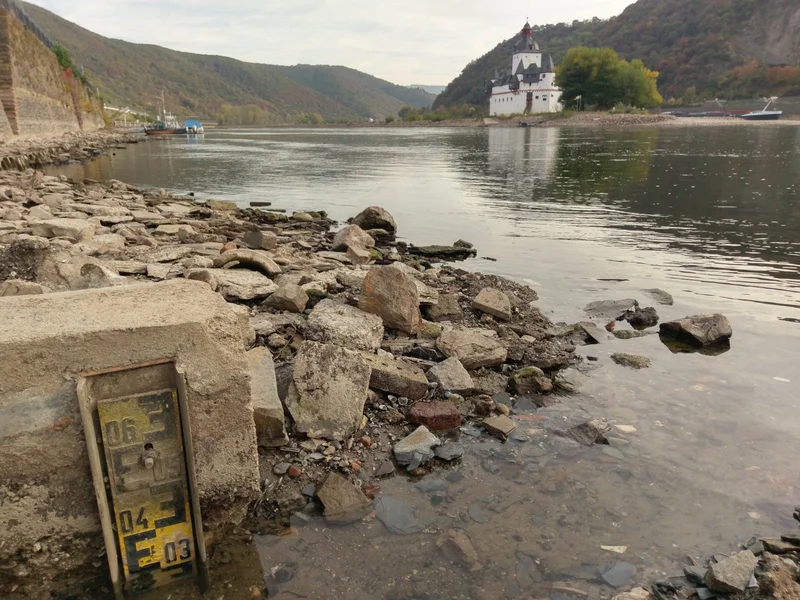
The Rhine Runs Low
The first thing to understand is that Europe’s economy floats on its rivers. The Rhine, the Danube, the Elbe—these are not scenic backdrops for river cruises but the continent’s freight backbone, moving everything from German chemicals to Romanian wheat at a cost no railway or highway can match.
On Monday, those arteries were constricting. A heatwave that began in North Africa and has parked itself over the continent for a week is pushing water levels toward the danger point where fully loaded barges become an impossibility. Captains are already lightening loads, which means more trips, higher costs and delivery delays that ripple through supply chains.
The timing is brutal. European industry is still absorbing the energy-price shock of the post-invasion gas cutoff, and anything that raises logistics costs now is felt acutely. Chemical plants along the Rhine that survived 2022’s energy crisis by drawing down inventories are being told that the raw-material deliveries they need in September might not arrive on schedule.
For Latin American importers of European machinery, pharmaceuticals and specialty chemicals, the Rhine’s distress translates into lead-time uncertainty. A Brazilian automaker waiting for German transmission gears, or a Mexican hospital waiting for Dutch imaging equipment, faces a delay that no amount of expediting can fix. The river does not negotiate.
The heatwave is also scorching crops in the fields. French wheat yields are being revised down, and Romanian sunflower fields are withering. This is happening at the same moment that Black Sea grain exports are being disrupted by the war, creating a double hit to global grain supplies.
The European Commission’s emergency-response centre has activated its Copernicus satellite mapping to track the heatwave’s spread, and several German states have imposed water-use restrictions that affect industrial cooling. None of this is panic—yet. But the trajectory is clear, and the summer is only half over.
The Drone That Crossed the Line
A thousand kilometres from the drying Rhine, a different kind of crisis unfolded in the early hours of Monday. Ukrainian drones struck an oil refinery in Nizhnekamsk, Tatarstan, a republic deep inside Russia that had previously felt immune from the war. At least 13 people were killed, including a child, and about 39 wounded, making it one of the deadliest Ukrainian strikes on Russian soil since the invasion began.
The attack was militarily significant but politically seismic. Tatarstan is not a border region; it is a Muslim-majority republic whose loyalty to Moscow has been carefully cultivated through a mix of autonomy promises and economic investment. A refinery strike that kills Tatar civilians challenges the Kremlin’s narrative that the war is a distant ‘special operation’ that ordinary Russians need not think about.
The Kremlin’s response was swift but telling. Rather than escalate militarily in a way that would be visible to Western publics, it escalated legally. The Supreme Court barred the liberal, anti-war Yabloko party from September’s parliamentary elections, squeezing the last organised opposition force from the ballot. It is a move that signals nervousness: a regime confident in its popularity does not need to ban a party that polls at single digits.
The Nizhnekamsk strike also scrambles the calculations of the Global South countries that have positioned themselves as mediators. Brazil, which under Lula has attempted to craft a peace-making role without alienating either Moscow or Washington, now faces a war that is becoming less containable by the day. A Ukrainian capacity to hit targets deep inside Russia raises the stakes of any ceasefire proposal that leaves Russian territory vulnerable.
Indian and South African diplomats, who have been working their own back-channels, face the same dilemma. Mediation works when both sides have a stable concept of what they are fighting for and against. When the geography of the war expands unpredictably, the negotiating brief becomes obsolete before it is written.
For Europe, the drone strike is a reminder that the war is not settling into a frozen conflict. It is evolving in ways that could pull Nato countries into direct confrontation, especially if Russia retaliates against Ukrainian logistics hubs in Poland or Romania, something that Russian military bloggers have been openly advocating.
Odesa in the Dark
If the Nizhnekamsk strike showed the war’s offensive capability, the Russian missile barrage on Odesa showed its punitive intent. President Zelensky reported that 300,000 families across the Odesa region lost power, about a third reconnected within hours, after residential buildings were struck, and at least 14 people were injured. The attack was not aimed at military targets; it was aimed at civilian stamina.
Odesa is not just any city. It is the port through which Ukrainian grain reaches the world, and the repeated attacks on its infrastructure are a deliberate strategy to strangle Ukraine’s economy. Every time a grain terminal is damaged, a ship is delayed, and a loading schedule is thrown into chaos, the Kremlin scores a point against Kyiv’s ability to fund its war effort.
The grain dimension is where Europe’s heatwave and the Black Sea conflict converge into a single crisis for Latin America. The region imports significant quantities of Black Sea wheat, particularly North African countries that are themselves grain-deficit, and any reduction in supply pushes up global prices that Latin American consumers feel at the bakery counter.
Brazil is a net wheat importer, sourcing primarily from Argentina but also exposed to global price swings. Colombia, Venezuela and the Caribbean island states are even more dependent on imported grain. When the heatwave cuts European harvests and missile strikes cut Black Sea exports, the combined effect is a grain-price spike that hits Latin American households already strained by inflation.
The psychological dimension matters too. A city of one million people plunged into darkness is a powerful image, and it is being broadcast on social media in real time. The solidarity that sustained Ukraine’s allies in the first year of the war is fraying, but images of residential buildings burning in Odesa are a counterweight to the ‘Ukraine fatigue’ that has taken root in Western capitals.
The UN Security Council met on Monday to discuss Ukrainian prisoners of war, a session called by Kyiv’s foreign minister that produced no new commitments. The diplomatic ritual continues, but the gap between what is said in New York and what happens in Odesa or Nizhnekamsk widens by the week.
Estonia’s Political Vacuum
Quietly, almost without notice, a government on Nato’s eastern frontier lost its majority on Monday. The Estonian cabinet, led by Prime Minister Kristen Michal, lost its parliamentary majority after two MPs quit the governing parties, cutting the coalition to 50 of 101 seats and leaving the country in political limbo seven months before scheduled elections.
The timing could hardly be worse. Estonia is the alliance’s most exposed Baltic state, with a Russian-speaking minority that the Kremlin has repeatedly claimed to be protecting, and a border that is a few hours’ drive from St. Petersburg. A caretaker government with no parliamentary majority is in no position to take difficult decisions about defence spending or host-nation support for Nato troops.
Estonia has been one of Europe’s most forceful voices on Ukraine, arguing that any negotiated settlement rewarding Russian aggression will only invite more of it. The government’s fragility will be noted in Moscow, where state media have already begun portraying the Estonian crisis as evidence that the ‘Russophobic’ line is unpopular with voters.
The real risk is less about Estonia’s immediate security—Nato’s Article 5 guarantee remains intact—than about the political signal it sends. If a frontline state cannot sustain a stable government during a major security crisis, what does that say about the depth of public support for the current strategy? The question will be asked in Brussels, Washington and, most pointedly, in Warsaw and Vilnius.
For Latin America, the Estonian story seems distant, but it is not. The credibility of Nato’s collective defence is a global public good; if it erodes, every region that depends on a rules-based order—and that includes the maritime states of Latin America—faces a more dangerous world. The South Atlantic is not the Baltic, but the principle that borders cannot be changed by force is the same principle that protects Brazil’s Amazon sovereignty and Argentina’s claim to the Falklands.
The Estonian crisis also highlights a broader European vulnerability: political systems are struggling to process the accumulation of external shocks. Heatwaves, wars, energy prices, migration—these are not separate policy problems but a single stress test that is revealing cracks in democratic resilience.
The Grain Corridor’s Fragile Thread
The Black Sea grain corridor has been one of the quiet successes of the war’s diplomacy, a UN and Turkey-brokered arrangement that has kept Ukrainian grain flowing even as missiles fall. But Monday’s attacks on Odesa are a reminder of how fragile the arrangement remains, and how easily it could collapse.
Russia has repeatedly threatened to withdraw from the deal, and each threat triggers a spike in wheat futures that reverberates through global markets. The corridor is not insured in the conventional sense; it is sustained by a web of commercial risk calculations, political assurances and naval prudence that could unravel in a single weekend of heightened tensions.
For Argentina, the world’s seventh-largest wheat exporter, a permanent disruption of Black Sea supplies would be an economic windfall. Argentine grain would command a premium, and the government would collect export taxes that it desperately needs to service IMF debt. But the windfall comes with a political cost: being seen to profit from a war that has killed hundreds of thousands.
Brazil faces a more complicated calculation. The country imports significant quantities of wheat but also exports corn and soybeans to the same North African and Middle Eastern markets that depend on Black Sea grain. A global grain shortage pushes up Brazilian import costs but also creates export opportunities. The net effect depends on the relative price movements, which are impossible to predict with any accuracy.
The larger point is that the global food system is more interconnected than policymakers typically acknowledge. A missile strike in Odesa changes the price of bread in Fortaleza, and a heatwave on the Danube changes the feed cost for poultry farmers in Pará. These are not distant abstractions; they are supply-chain physics that operate across continents with the remorseless logic of scarcity.
The Monday news cycle captured this interconnectedness with unusual clarity. The heatwave and the war are not two stories but one, and the one story is about the fragility of the physical infrastructure—rivers, ports, power grids, grain terminals—on which global prosperity depends.
The Festival Season’s Anxious Pulse
Amid the grim headlines, Europe’s August festival season continues, and it is worth paying attention to. From the Sziget festival in Budapest to the open-air cinemas of Rome, Europeans are gathering in large numbers to dance, drink and distract themselves from the news.
This is not mere escapism. It is a form of social resilience, a collective decision to insist on pleasure even when pleasure seems inappropriate. The festival-going masses are not ignorant of the heatwave or the war; they are choosing, consciously or otherwise, to affirm life in the face of forces that deny it.
But the shadow is there. Festival organisers report higher security costs and more stringent safety protocols, a response to the creeping fear of public-space violence that has been stoked by years of terrorist attacks and, most recently, a deadly shooting on a Berlin street on Monday morning. The Charlottenburg killing, which left one man dead in a daytime dispute, is statistically insignificant but psychologically potent: it feeds a narrative that even the safest European cities are becoming edgier.
The cultural dimension matters for the analysis because culture is where political moods are formed before they show up in polls or elections. A festival season that feels anxious rather than liberated, that is visibly shadowed by climate and war, is a harbinger of a European electorate that will be less generous, less outward-looking and more inclined toward leaders who promise protection rather than openness.
For Latin America, a Europe that turns inward is a Europe that negotiates trade deals more stingily, that funds development programmes less generously and that is less interested in the cultural exchanges that have historically bridged the two continents. The Mercosur-EU trade deal, already stalled, becomes even harder to close if European publics are in a fortress mentality.
The crowd at Sziget danced on Monday night, and on Tuesday they will check their phones for news of the heatwave and the war. The two realities coexist, and the tension between them is the defining emotional condition of this European summer.
What Latin America Needs to Watch Next
Latin American policymakers and investors should be watching three indicators over the coming weeks, all of which are being shaped by the European crisis. The first is the Rhine water level at the Kaub checkpoint, which is the critical gauge of barge navigability. On 4 August it fell to about 24 centimetres, its lowest since records began in 1880, and with barges already sailing far below capacity, European industrial supply chains face a shock that will be priced into global markets.
The second indicator is the Black Sea grain freight index, which tracks the cost of insuring and shipping cargoes from Odesa. A sustained spike in the index signals that the grain corridor is in trouble, and that signals higher food prices for Latin American importers. The third is the Estonian political crisis calendar: if a new coalition cannot be formed within 30 days, snap elections become likely, and the Baltic security calculus becomes more uncertain.
For Brazil specifically, the interagency task force on food security should be modelling scenarios for a simultaneous European heatwave and Black Sea disruption. The country has a strategic grain reserve, but it has been drawn down in recent years, and a global price spike would test the government’s ability to insulate domestic consumers without driving farmers into the arms of the opposition.
For Argentina, the opportunity is clearer but no less risky. A grain-price windfall could ease the government’s fiscal crisis and improve its bargaining position with the IMF. But windfalls have a way of breeding complacency, and an Argentine government that is rescued by a European crisis is a government that postpones the structural reforms that the economy still needs.
The broader analytical lesson is that Europe’s twin crisis—climate and war—is producing second-order effects that will shape Latin American politics and markets for the remainder of 2026. The distance from the Rhine to the Paraná, from Odesa to Rosario, is not as great as it appears on a map.
Monday’s news cycle was unusually dense with signals. The Rio Times will continue to read those signals and translate them for readers who understand that global affairs is not a collection of foreign curiosities but a single, interconnected field of risk and opportunity.
The Scenarios Redrawing Europe’s Supply Map
European Union emergency planners are quietly gaming three scenarios for August and September, none of them good. The first is a prolonged heatwave that forces the closure of key inland waterways for two weeks or more, triggering a continent-wide logistics crisis that echoes the early COVID supply disruptions. This scenario would cut European GDP growth by an estimated 0.3 percentage points and trigger emergency financial-support measures for affected industries.
The second scenario is a Russian decision to formally withdraw from the Black Sea grain deal, combined with intensified strikes on Odesa’s port infrastructure. This would push global wheat prices above their 2022 peaks and trigger food riots in import-dependent countries, many of them in Africa and the Middle East, but with spillover effects on Latin American inflation and political stability.
The third scenario is an escalation of the drone war into Nato territory, either through a Russian strike on a Ukrainian logistics hub in Poland or a Ukrainian strike on a target in Transnistria, the Russian-backed breakaway region of Moldova. Either event would invoke Nato’s Article 4 consultation mechanism and could, in the worst case, trigger a direct military confrontation between Russia and the alliance.
The probability of each scenario is unknowable, but the fact that all three are being gamed simultaneously is itself significant. It means that Europe’s leaders are no longer confident in their ability to manage the crises they face; they are preparing for breakdowns rather than betting on recoveries.
For Latin America, the takeaway is that European stability, long taken for granted as a background condition of the global economy, is no longer a given. The continent that provided the model for Latin American integration—the inspiration for Mercosur and the Pacific Alliance—is now a source of instability that Latin American economies must hedge against.
The image of a dried-up Rhine and a darkened Odesa, both on the same August Monday, will linger as a visual shorthand for a Europe besieged by threats it cannot control. The question is whether the continent’s political systems, already stretched, can absorb the next shock. The answer will be written in the water levels, the missile trajectories and the polling numbers of the weeks to come.
Frequently Asked Questions
How does a European heatwave affect Latin American food prices?
Europe’s commercial waterways—the Rhine and Danube—carry grain, coal and chemicals. When low water disrupts barge traffic, supply chains slow and commodity prices rise. Combined with Black Sea shipping disruptions from the Ukraine war, this tightens global grain supply and raises wheat and corn prices across Latin American markets.
What does the Estonian government crisis mean for Nato security?
Estonia is a Nato frontier state bordering Russia. Its government losing its majority seven months before elections creates political uncertainty at a time when the Ukraine war is escalating. While Nato’s collective-defence guarantee remains intact, the crisis signals reduced domestic consensus on security policy, which Moscow will seek to exploit through disinformation and political pressure.
Why should Latin America care about Ukrainian drone strikes inside Russia?
The strikes demonstrate the war is expanding geographically, making mediation harder and raising the risk of a wider conflict. Brazil, under President Lula, has positioned itself as a potential peace broker. A war that becomes more unpredictable makes any mediation more difficult and increases global instability that affects commodity markets, supply chains, and the multilateral system Latin America depends on.
Sources: news.africa-business.com, uneca.org, insights.aib.world
Connected Coverage
- Global Economy Briefing — August 10, 2026
- Kenya Mandates US$50,000 Travel Health Insurance For Foreign Visitors Via ETA
- Europe Intelligence Brief — Saturday, August 8, 2026
- USA & Canada Intelligence Brief — Saturday, August 8, 2026
- Guinea Signs Mining Convention With State-Owned Nimba Mining Company
- US Judges Allow Trump To End Protections For South Sudan And Myanmar Migrants
- Pretoria To São Paulo: Africa’s Single Market Opens A Trade Door For Latin America
- USA & Canada Intelligence Brief — Friday, August 7, 2026
Explore the cluster: World · Europe and Russia
This article was produced by The Rio Times’ automated newsroom system. How we use AI · Report an error
LatAm Markets: Live Signals → — real-time movers, turnover leaders and FX across Latin America.