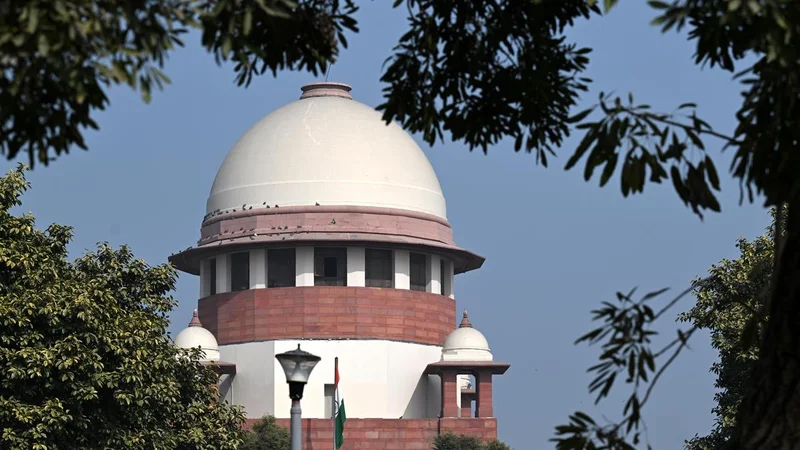
The Supreme Court on Tuesday (August 11, 2026) asked the Union government to consider a petition seeking a time-bound emergency mechanism against online threats of rape, murder or physical violence, non-consensual intimate or AI-generated material and harmful deepfake impersonation.
Also Read | SC says AI-generated hallucinated precedents ‘catastrophic’ to judicial process, sets aside NCLT order
A Bench headed by Chief Justice of India Surya Kant said the issues raised by petitioner-advocate N.K. Goswami has raised serious issues, including that digital harm travels at technological speed, causing instant and often irreparable damage to ordinary persons, while conventional legal remedies moved at a slow and institutional speed, and frequently ineffective.
The court asked the Ministries of Home, Law, Information and Technology, National Commissions for Women and Protection of Child Rights to examine the plea to frame a mechanism for emergency response to online threats,doxxing, child exposure and deepfake impersonation.
“What is the value of a legal remedy if it arrives only after the damage has become irreversible?” Mr. Goswami asked the court.
The court recorded the plea for the setting up of a “narrow, time-bound, URL-specific and judicially or legally supervised emergency mechanism against some of the gravest forms of online harm—specific threats of rape, murder or physical violence; dangerous doxxing; disclosure of children’s school, location and other private particulars; non-consensual intimate or AI-generated material; and harmful deepfake impersonation”.
The plea said that “an online threat could be posted in seconds. A residential address can be circulated in minutes. A child’s school details can be copied across platforms. A fabricated video can be downloaded, mirrored, archived and redistributed thousands of times before the victim even discovers it”.
“By the time an FIR is registered, a civil injunction is sought, a platform grievance is processed or a criminal prosecution begins, the original injury may already have multiplied beyond recall,” Mr. Goswami submitted.
The petition describes the mismatch as a “speed gap” between digital harm and legal remedy.
“The delay in remedy may itself become denial of remedy,” Mr. Goswami said.
The petition said that though criminal prosecution could punish the wrongdoer, it did not ensure immediate URL-specific disabling of the harmful material or preservation of digital evidence before viral dissemination.
“Punishing the offender tomorrow may not protect the victim tonight,” the lawyer submitted before the CJI Bench.
Published - August 11, 2026 12:43 pm IST