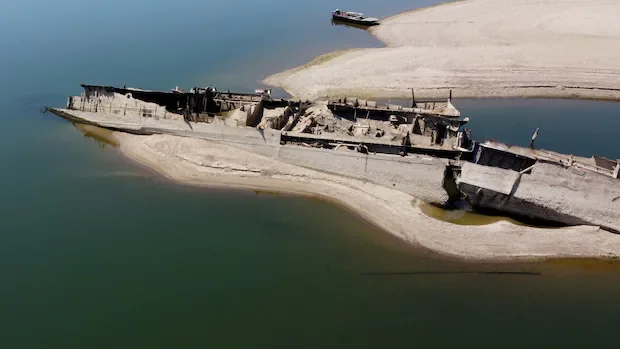
Sunken Nazi warships are resurfacing as Europe's drought deepens
Scientists say fossil fuel emissions supercharging heat waves causing drought, wildfires across Europe
Nazi German warships scuttled in the Danube River during the Second World War are resurfacing as water levels plunge — a striking sign of the extreme heat and drought gripping Europe this summer.
The fifth heat wave since May is set to scorch western Europe beginning Tuesday, with parts of Spain, France and Italy nearing 40 C before the heat dome pushes temperatures further above average in central and northern Europe.
The European Union's Copernicus climate monitoring service confirmed Monday that June and July were the hottest on record in western Europe. The period saw an estimated 25,000 heat-related deaths.
- Western Europe wildfires at 'point of fragility' with temperatures rising again
- 1 dead, hundreds of structures destroyed in wildfires across B.C.
The sweltering heat has contributed to devastating wildfires and pushed water levels in vital waterways, including the Danube, to record lows.
Climate scientists say the exposed wrecks are a vivid sign of a much broader problem: fossil fuel-driven climate change is intensifying heat and drought, with consequences for wildfires, agriculture, shipping and energy systems across Europe.
"If we keep emitting greenhouse gases at the rate we're doing now, then this is only going to get worse," Richard Allan, a climate scientist at England's University of Reading, told CBC News.
And what we're seeing this summer, he says, is just the "tip of the iceberg" for the effects of global heating.
WATCH |
Fossil fuel emissions made Canada's wildfires more likely, study says:## What the drying Danube reveals
Historians estimate that the Nazis scuttled up to 200 warships near the Serbian city of Prahovo in September 1944 in an effort to stop advancing Soviet forces.
The New York Times reports that one or two or the wrecks might normally be visible in summer, but residents have counted about a dozen this year.
Elsewhere, the drying Danube has revealed a German military motorcycle in Hungary, an unexploded 700-kilogram British bomb in Slovakia and what are believed to be the ancient remains of a mammoth in Bulgaria.
- AnalysisWhy Europe can't air condition its way out of extreme heat
- AnalysisHow many people die from heat-related illnesses? The truth is, we don't actually know
But the extremely low water levels have raised much more urgent concerns for several countries along Europe's second-longest river.
The Danube originates in Germany and runs 2,850 kilometres through nine other countries — Austria, Slovakia, Hungary, Croatia, Serbia, Romania, Bulgaria, Moldova and Ukraine — before emptying into the Black Sea. Its tributaries extend into several other countries.
The Romanian government restricted water use for crop irrigation last month and has taken steps to keep its only working nuclear power plant running, including blowing up a rock obstruction to redirect the river's flow.
Hungary switched a turbine back on at its only nuclear power station Monday after citizens and companies voluntarily curbed their power use last week because the river's flow was too low to cool reactors.
Hungarian Prime Minister Péter Magyar said Friday the "succession of unprecedented events," from the extreme heat to the severe water shortage and state of the Danube, has more people realizing "that we must take much better care of our natural resources, our water, our land and our clean air than we have done so far."
PHOTOS | Here's what the Danube River looks like as water levels drop amid record hot summer:## 'Clear example' of climate change
In June and July 1944, in the months before German forces sank their warships in the Danube, temperatures in Europe were around average — and perhaps slightly cooler than normal — compared to the 1991-2020 average, according to NASA's National Centers for Environmental Information.
During the same period this year, the average surface air temperature across the western half of the continent was 2.79 C higher, Copernicus reported this week. Much of eastern Europe, including areas of the Danube River basin, was also much warmer than average.
"This is a clear example of how climate change is intensifying heat extremes, with heat and drought increasingly reinforcing one another," Samantha Burgess, strategic lead for climate at Copernicus, said in its press release.
By the time a major river system such as the Danube reaches levels this low, Allan said, damage to forests and agriculture has already occurred.
"These big river systems are the last to go," he said. "That's like the end point in the sense that soils have already dried out, vegetation has already dried out and we've seen these massive wildfires."
Allan said next year could be even worse.
He said the emergence of what's been dubbed a super El Niño — a particularly stronger cyclical warming in the southern Pacific Ocean that affects global weather patterns — has not been a factor in the heat that has punished Europe and much of the Northern Hemisphere so far this summer.
- Britain's 'exceptionally serious' drought tests a country famous for its rain
- PhotosHow Europe's punishing heat wave is affecting people — and how they're responding
"Usually ... the planet will be warmer the year following the emergence of El Niño," he said. "So, we can expect very high, unprecedented global temperatures in 2027."
Those effects, Allan said, would come on top of the warning already being driven by climate-harming greenhouse gas emissions.
"If we keep emitting greenhouse gases at the rate we're doing now," he said, "this is only, like, the first signs of what's going to happen in the future."
WATCH | Europe's firefighters struggle to control wildfires amid searing temperatures: