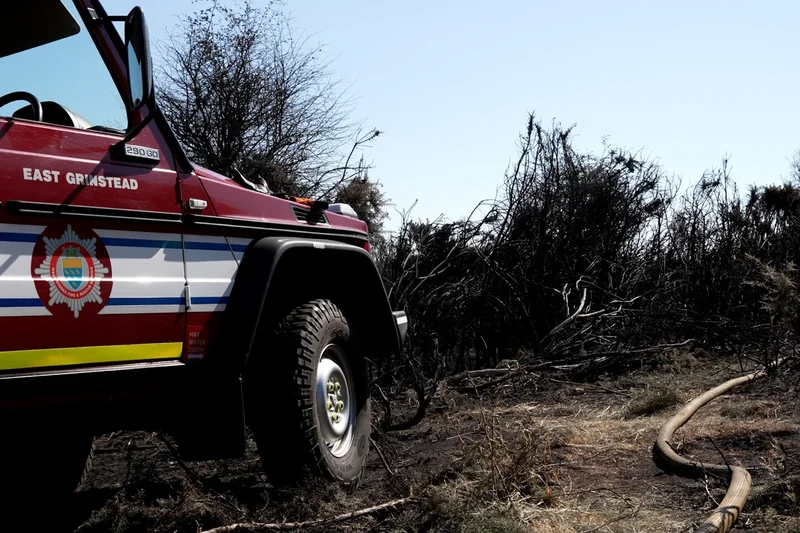
Firefighters have warned they need more funding as they face increasing pressure from “an unprecedented summer of dangerous and volatile wildfires.”
As three quarters of England was plunged into drought on Monday, the Fire Brigades Union (FBU) has said crews across the country would need access to the best equipment as the consequences of climate change become a “national priority”.
"Firefighters are having extra demands put on them as a result of an unprecedented summer of dangerous and volatile wildfires,” said Steve Wright FBU general secretary. "Our country is facing unpredictable environmental challenges, and it must be a national priority to ensure we have enough properly equipped firefighters ready to face these threats."
Major wildfires have hit areas such as the Pennines, the Cairngorms in Scotland, Llanwonno in the Rhondda Valleys in South Wales, and Dunwich Heath in Suffolk as the UK experiences tinderbox conditions.
More than 120 firefighters were working on Monday to contain the latest blaze, which is affecting a square kilometre of heathland in the New Forest, Hampshire and has closed the A31, following a vehicle fire.
The Met Office warned last month that the extreme conditions this summer, which have seen numerous temperature records broken, would become the new normal due to climate change.
Climate information scientist Mike Kendon said: “What we used to think of as extreme, we increasingly consider as normal.”
The union also warned that while fire brigades didn’t have a statutory duty to attend floods, they often tackled them out of moral obligation and would need the correct equipment to do so as flooding becomes more common.
"Flooding is also a major issue which our members do not have a statutory duty to attend but they often to do out of a sense of moral obligation,” said Mr Wright.
"Rather than leaving it to individual firefighters and brigades making these decisions, we believe it should be a statutory duty for firefighters to attend floods. However, with those extra responsibilities must come increased funding, improved access to the best equipment and better national resilience.”
The Environment Agency (EA) said on Monday that 71.3 per cent of England is experiencing “flash drought”, as a dry start to August followed the country’s driest July on record.
Flash droughts develop very quickly because of a combination of very low rainfall and high temperatures. In Monday’s announcement, the agency said the East Midlands, Lincolnshire and Northamptonshire, Kent and East Sussex, and Solent and the South Downs have become the latest areas to move into drought.
It comes after two record-breaking heatwaves in May and June that led to the deaths of more than 2,800 people, followed by further heatwaves in July. A fifth heatwave will hit parts of the UK this week as temperatures could reach 36C in parts of the south and east of England on Thursday.
Amber heat health alerts have been issued for most of England including the Midlands, South East, North West and South West, while a yellow alert will be in force for the North East.