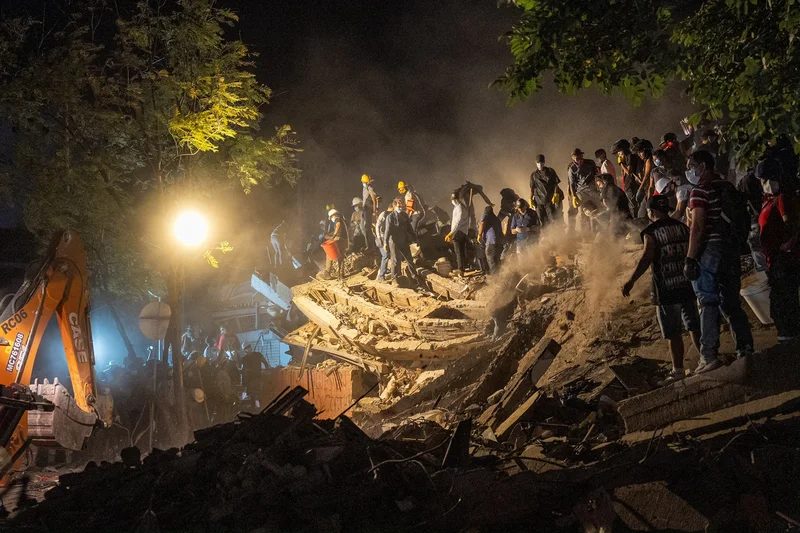
Colombia is still counting its dead. The country woke up this Tuesday under a state of emergency after a magnitude-7.4 earthquake shook the western part of the country the day before for four endless minutes and was felt as far away as Panama and Ecuador. As a result of the quake — the strongest since 1979 — at least 132 people have died, according to the latest tally from the Colombian Association of Capital Cities (Asocapitales), and over 500 are injured, while dozens of buildings have collapsed. The figures are still considered preliminary.
A large share of the deaths are concentrated in the city of Pereira, in the coffee-growing region. Cali, the capital of Valle del Cauca and the country’s third-largest city, was also badly hit; a curfew was imposed and several areas have been militarized, especially where rescue operations are still underway amid the rubble. Quibdó, the capital of Chocó, where the epicenter was located, as well as Manizales and Armenia, near Pereira, are among the other most affected cities, with collapsed buildings, closed airports and intermittent services.
In Cali, which had been preparing to host the popular music festival Petronio Álvarez this weekend, rescuers are still digging through rubble searching for survivors. In the coffee region the quake has revived the trauma of another earthquake — the one that devastated Armenia in January 1999 and left nearly 1,200 dead.
The disaster struck just three days after President Abelardo de la Espriella’s inauguration. He delivered his first speech from a military facility, where he pledged to govern from the regions and for the regions. “I entrust our country to the Lord Jesus Christ,” he said after midday, when he delivered the government’s first report and declared a national disaster from Bogotá, where he flew from the Caribbean city of Barranquilla, the city he proposes to make an alternate capital for a country with a very complex geography.
On his first Monday in office, still settling into his role as head of state, the president said that his fellow Colombians will get through this “with help from God,” from the government and from international cooperation, and he called for national unity: “Today all Colombians, regardless of ideological differences, must unite around a single cause: the victims of this natural disaster.” He said he was “personally taking leadership” of the emergency response. The earthquake represents a huge initial challenge for the new administration.
In the afternoon De la Espriella made a brief visit to Chocó with part of his cabinet, then traveled to Valle del Cauca. The president set up a national Unified Command Post (PMU) in Bogotá and others in Quibdó, Cali and Armenia. He also decided to deploy teams led by several newly appointed ministers to some of the hardest-hit areas.
Both Vice President José Manuel Restrepo and Interior Minister Rodrigo Lara are in the coffee-growing region, while the defense minister, the retired General Jorge Eduardo Mora, and Health Minister Ana María Vesga are in Cali. Beyond the cabinet and his inner circle, De la Espriella has not yet replaced the heads of some key disaster-response agencies, although he announced that he will appoint geological engineer David Suárez Tamayo on Tuesday to head the National Unit for Disaster Risk Management. That situation was worsened by the breakdown of the usual handover of power by the previous government, led by leftist Gustavo Petro.
International solidarity has been quick to come, less than two months after the June earthquakes that devastated neighboring Venezuela and left more than 6,000 dead there. The United States has announced $15.5 million in aid for emergency shelter, food, protection and damage assessment from the quake. The Development Bank of Latin America and the Caribbean (CAF) will also donate $500,000 to Colombia to address the emergency. Just weeks earlier, CAF had announced a $9 billion financial package to boost the country’s development for the 2026–2030 period, which coincides with De la Espriella’s four-year term.
Other allies ideologically close to the new Colombian government have expressed support and a willingness to help, such as Argentina’s Javier Milei, Chile’s José Antonio Kast and Ecuador’s Daniel Noboa. All three attended De la Espriella’s inauguration in Cali last Friday. Leaders from the other end of the ideological spectrum also offered assistance, including Brazilian President Luiz Inácio Lula da Silva, Mexican President Claudia Sheinbaum and Spanish Prime Minister Pedro Sánchez. The United Nations, which has a long history of presence in the country, said it stands ready to help in any way needed.
Sign up for our weekly newsletter to get more English-language news coverage from EL PAÍS USA Edition