Six weird signs you’re actually ageing well
Save
You have reached your maximum number of saved items.
Remove items from your saved list to add more.
AAA
There’s plenty of information out there about the warning signs of ill health.
But aside from scary symptoms to watch out for, there are also plenty of strange or, frankly, seemingly random indicators that you’re actually in good health. Often, they’re daily occurrences you wouldn’t think twice about, like sweating or passing gas.
So, we spoke to experts to get their takes on the weird signs of ageing well.
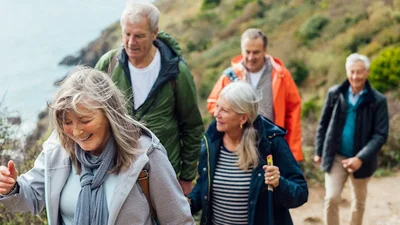
These movements, moments or activities might not strike you as important but can be strong indicators of overall good health and ageing well. Getty Images
You can put a sock on while standing up
It might seem like a simple task, but being able to put on a sock while standing up actually brings together several important aspects of physical function, requiring continuous integration of information from the visual, vestibular and somatosensory systems to control the body’s centre of mass over the foot, while simultaneously coordinating movement of the other limbs.
Research has shown that poor one-leg balance is associated with a higher risk of falls and increased mortality rate. In one widely cited 2022 study, published in the British Journal of Sports Medicine, researchers tested 1702 individuals aged 51 to 75. They found that those who couldn’t stand on a single leg for at least 10 seconds were 84 per cent more likely to die from any cause over a subsequent 7-year period.
“Balance becomes increasingly important as we age because it allows us to move safely through our environment and respond to everyday challenges, such as uneven ground or an unexpected trip,” says Associate Professor Kim van Schooten, a senior research fellow at Neuroscience Research Australia.
“The good news is that balance can be improved and maintained throughout life. Staying active, maintaining strength and regularly practising activities that challenge balance can help preserve this ability as we age.”
You can hold a deep, flat-footed squat
Being able to hold a deep squat isn’t a prerequisite for good ageing because anatomy such as ankle range of motion, hip socket structure and femur/tibia proportions will factor into whether someone can perform one. However, it’s an excellent sign you’ve maintained functional capacity, reflecting that your hip and ankle mobility and posterior chain are all strong.
Van Schooten stresses the most important thing is being able to do physical activity safely: “Having the strength and capacity needed for everyday activities, such as getting out of a chair, picking something up from the floor or negotiating stairs. Regular resistance training, combined with staying physically active, is one of the most effective ways to preserve these abilities as we age.”
Holding a deep, flat-footed squat is a sign that you’ve maintained strong functional capabilities. Getty Images
You can get up from the floor without your hands
A deceivingly complex movement, this requires strength, balance, coordination, joint range of motion and power – all crucial components for healthy ageing.
They’re important because they support independence and allow people to continue doing the activities that matter to them, like playing with young family members on the ground, says van Schooten.
“There is also an important safety aspect. Research suggests that about half of older people who fall are unable to get up without assistance, and spending a long time on the floor can lead to serious complications including dehydration, pressure injuries and muscle damage, beyond any injury caused by the fall itself.”
Ensuring you’re doing regular strength and balance training, as well as practising the movement itself in a safe and supported way can help build physical ability and confidence.
You pass gas regularly
If you’re passing wind multiple times throughout the day, you can rest assured it means you have a healthy gut microbiome.
In Fibre Factor, Dr Joanna McMillan estimates the average person passes gas 13 to 21 times a day. In most cases, it comes from the fermentation of fibre by gut bacteria.
Key to maintaining good gut health is activity, but not necessarily just intense physical activity. A 2024 study found that “high light” physical activity like gardening was linked with faster colonic transit. Experts often recommend going for a 10-minute walk after meals, as it encourages digestion and contributes to the kind of cumulative, low to moderate activity that is key to keeping your bowels moving well.
You sweat early when you exercise
Never let anyone shame you for perspiring soon after you begin a workout! An efficient, well-timed sweat response is a strong indication that your thermoregulation is in good nick, says Professor Garron Dodd, head of the Metabolic Neuroscience Laboratory at the University of Melbourne.
“In someone who’s fit, the sweat response switches on at a lower rise in core temperature,” Dodd explains. “The body anticipates the heat load instead of waiting until it’s in trouble. That earlier, more sensitive onset is the mark of a well-trained cooling system, not a fault.”
Sweating and flushing during exercise are your autonomic nervous system and cardiovascular system doing visible work, and we lose that capacity as we age.
“It’s a big part of why heatwaves are so dangerous for older people. A responsive thermoregulatory system is a marker of physiological resilience,” Dodds says.
To encourage healthy thermoregulation, Dodd suggests regular aerobic exercise and deliberate heat exposure, like doing an activity in warmer temperatures or visiting a sauna.
You have a firm grip
There’s strong evidence for grip strength being a proxy for overall health and musculoskeletal strength.
“If your grip is weaker than expected, it should prompt you to look more broadly at your physical fitness and muscle health, rather than focusing on your hands alone,” says Professor Grant Tomkinson.
In a 2015 study of 139,691 adults from 17 countries of varying incomes and sociocultural circumstances, researchers determined that grip strength was a better predictor of premature death than other factors like blood pressure.
Grip strength improves when you improve your overall strength, especially through movements requiring gripping like carrying heavy shopping bags, farmer’s carries, deadlifts and pull-ups.
Tomkinson says resistance training at least twice per week for adults, or three times per week for older adults will naturally challenge the muscles of the hands and forearms, while also training the larger muscles of the body.
Make the most of your health, relationships, fitness and nutrition with our Live Well newsletter. Get it in your inbox every Monday.
Save
You have reached your maximum number of saved items.
Remove items from your saved list to add more.