- This story is developing, more to follow
- See more Daily Mail on Google - save us as a Preferred Source
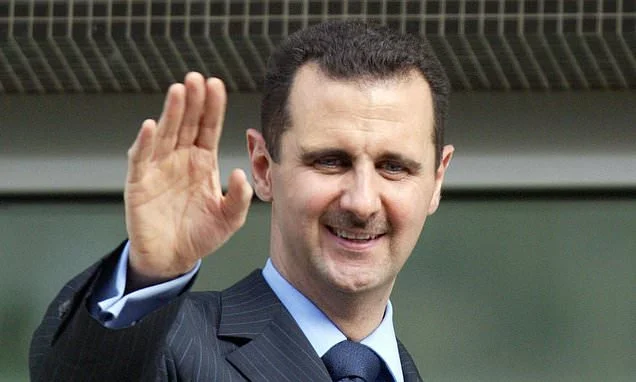
A Syrian court has sentenced former ruler Bashar al-Assad to death in absentia, after convicting him over charges of 'war crimes' and 'crimes against humanity' during the country's civil war.
The ruling against Assad, who fled with his family to Moscow as Islamist-led forces closed in on Damascus in December 2024, is the first under the transitional authorities.
He was also convicted of the premeditated murder of multiple people, including children, as well as torture and arbitrary detention.
This year, Syrian courts began trying figures from the former government, both in person and in absentia.
al-Assad, whose brutality gave him the nickname 'The Butcher', fled Syria when he was toppled in December 2024 by a collection of rebel forces led by Hay'at Tahrir al-Sham (HTS), whose leader Abu Mohammad al-Julani is now the president of the country.
Under his rule, Syrian government forces killed civilians en-masse as part of its strategy to defend against the civil war that decimated the nation between 2011 and December 2024.
The government is believed to have been responsible for killing 90% of the more than 300,000 civilians estimated to have died in that period.
Between 2011 and 2023, an additional 154,000 were forcibly disappeared or arbitrarily detained by government forces, while more than 135,000 people, including women and children, were tortured, incarcerated or killed in Ba'athist prison networks.
A Syrian court has sentenced former ruler Bashar al-Assad to death in absentia
But al-Assad is perhaps most infamous for his forces' use of chemical weapons during the civil war. According to a study by the Global Public Policy Institute, pro-Assad forces carried out around 330 chemical attacks between 2012 and 2019.
The most common chemical used was chlorine gas, though Sarin gas and sulphur mustard were also used as well. All three are banned from use in war by international law.
Stephen Rapp, the US' former Ambassador-at-Large for War Crimes Issues, said in 2014 following the release of evidence of torture under the Assad regime: 'This is solid evidence of the kind of machinery of cruel death that we haven’t seen, frankly, since the Nazis.'
He added at the time: 'If it is as it appears thus far, we’re talking about more than 10,000 individuals being killed in custody over the period from 2011 to 2013, including largely men but also some very, very young men and boys and women… It’s shocking to me, as a prosecutor. I’m used to evidence not being so strong.'
The civil war also saw the exodus of 6.6million people from the country, who all fled for fear of their lives.
The deposed ruler is now believed to live in three apartments in a luxury high-rise with a mall downstairs in the Moscow after his former ally Vladimir Putin airlifted him and his family out of the country.
Since fleeing, he took up his old job as an eye doctor - a role he trained for in London as a young man - to treat the elite of Moscow.
A friend of the family told the Guardian in 2025, a year after he was deposed: 'He’s studying Russian and brushing up on his ophthalmology again.
'It’s a passion of his, he obviously doesn’t need the money. Even before the war in Syria began, he used to regularly practice his ophthalmology in Damascus'.
He trained in ophthalmology in London in the early 1990s, but was recalled back to his home nation following the unexpected death of his brother in a car crash in 1994.
Shortly after, he entered military academy and took over as the heir apparent to the regime.
Now he spends much of his time playing online video games, despite being freely allowed to move around Moscow and his country villa outside of the Russian capital.
He has been provided with bodyguards from a private security firm paid by the Russian government.
The friend said he now lives 'a very quiet life', adding: 'He has very little, if any, contact with the outside world. He’s only in touch with a couple of people who were in his palace, like Mansour Azzam [former Syrian minister of presidency affairs] and Yassar Ibrahim [Assad’s top economic crony].'
Part of this comes from Putin's apparent dismissal of al-Assad following the fall of the regime in Syria.
A source close to the Kremlin told the newspaper: 'Putin has little patience for leaders who lose their grip on power, and Assad is no longer seen as a figure of influence or even an interesting guest to invite to dinner'.
The former dictator was sentenced to death alongside Atef Najib, the former head of political security in southern Syria’s Deraa province, who was reportedly tried in person.
More to follow.