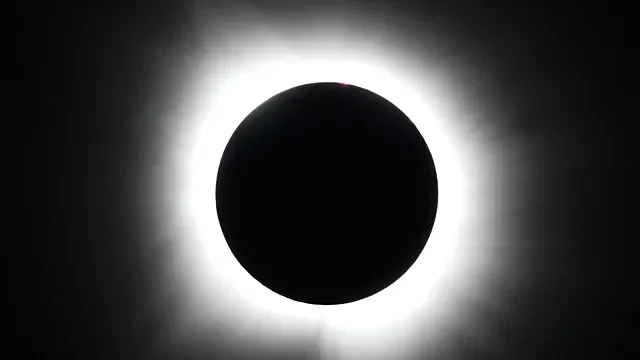
Spain is preparing for a rare celestial spectacle as a total solar eclipse crosses the mainland on August 12, bringing brief darkness to parts of the Iberian Peninsula and offering millions across Europe a chance to witness one of astronomy’s most striking events.
For the first time in more than a century, a total solar eclipse will cross mainland Spain, with the Moon passing directly between the Earth and the Sun.
The eclipse will also be visible across parts of Greenland, Iceland and Portugal, while a partial eclipse will stretch across much of Europe, North America and West Africa.
Totality will last for up to two minutes and 18 seconds along the eclipse path, although the duration will vary depending on location.
Jake Foster, an astronomer at the Royal Observatory Greenwich, says witnessing a total eclipse from the same location is exceptionally rare.
“Well in order to see a total solar eclipse from the very same location more than once, you could be waiting over 200 years for that to happen,” he says.
Partial eclipses are more frequent, but their visibility can still depend heavily on location.
Darkness sweeps across the sky
The Moon’s shadow, known as the umbra, will travel roughly 8,260 kilometres across the Earth, beginning near the North Pole and moving south.
Much of its journey will pass over the Atlantic Ocean before reaching Portugal and Spain, where large crowds are expected to gather.
The maximum period of totality will occur off Iceland’s west coast. By the time the shadow reaches Spain, totality will have shortened to around a minute in some areas before the eclipse moves into the Mediterranean.
Beyond the path of totality, millions more will see the Sun partially covered.
The eclipse will be visible in varying degrees across Canada, the northern United States and much of Europe and West Africa, with the amount of solar coverage decreasing farther from the eclipse path.
A rare chance for science
Solar eclipses are not only spectacular to watch. They also provide astronomers with a valuable opportunity to study the Sun.
During totality, the Moon blocks the bright surface of the Sun, revealing its faint outer atmosphere, known as the corona.
Foster says the corona remains an area of significant scientific interest.
“Solar eclipses are still incredibly exciting, even if you've seen a few of them,” he says. “They're still incredibly useful for research.”
The brief period of darkness allows scientists to observe features of the corona that are difficult to study under normal conditions.
Another eclipse on the horizon
The 2026 eclipse will be followed by an even longer total solar eclipse the following year.
That event is expected to produce up to six and a half minutes of totality as it sweeps across parts of Spain, North Africa and the Middle East.
For eclipse enthusiasts, the rarity of the phenomenon is part of its appeal.
Foster says there is no limit to experiencing what he calls a “bucket list event”, even for those who have witnessed eclipses before.
Safety remains essential
With crowds expected along the eclipse path, astronomers are urging spectators to protect their eyes.
Specialised eclipse glasses are essential for viewing the Sun safely, including during the partial phases when only a small portion of the solar disc remains visible.
As the Moon moves across the Sun and daylight briefly fades, observers across Spain and beyond will have a rare opportunity to experience one of nature’s most dramatic astronomical events.