Standing there, on a street corner in a famous favela, flanked by three policemen huddled together, speaking Portuguese, I realised the feeling was oddly familiar.
Dread hung in the air.
My phone had just been stolen by two men passing by on a motorbike in one of Rio de Janeiro’s tourist hotspots. I was anxious, had no idea what was going to happen next and instantly felt guilty about taking the afternoon off.
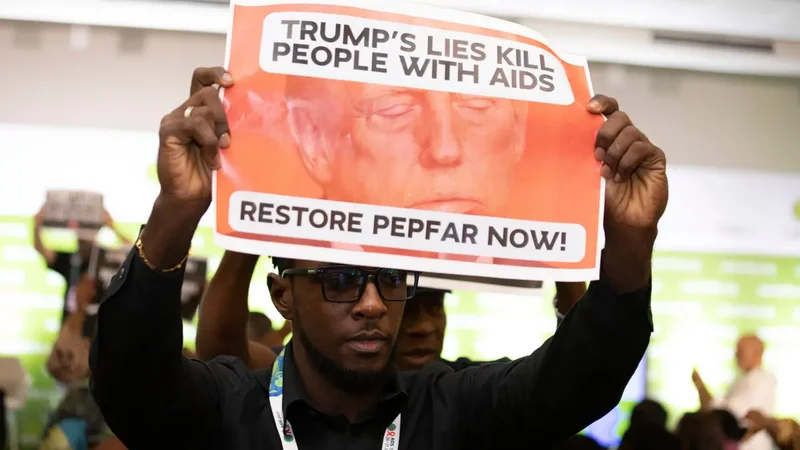
About 15km away, the 26th International Aids Conference had, for days, been filled with the same nagging uncertainty. Different place, much bigger stakes but the same question filled the corridors: What happens next?
With around 7 000 delegates, it was one of the smallest gatherings since the biennial conference’s inception in 1985. It also took place amid an unprecedented funding crisis.
In the passageways talk turned to layoffs, rather than viral load reductions.
In 2025, the world’s largest HIV donor, the United States government, made sharp, sudden cuts to HIV funding in developing countries, including South Africa. The result: 1 714 HIV clinics and drop-in centres in 46 countries closed and more than 16 000 full-time staff lost their jobs.
Most of the services were run by NGOs funded through the US government’s Aids programme, Pepfar. In just a year, Pepfar cut its support by a quarter. More cuts are coming.
Other wealthy countries have since either cut or flatlined their contributions too, pushing donor funding for HIV down to levels last seen before 2008.
Almost none of the organisations that lost US support have managed to replace it. Many are scrambling to survive, let alone finding money to send staff to international conferences.
And here’s the cruel irony.
Just as the money was disappearing, science delivered something extraordinary: lenacapavir (Len), an injection given just twice a year that makes people who use it for HIV prevention extremely unlikely to contract the virus.
But a breakthrough works only if people can get it.
Len costs money to make, buy and roll out. If too few people use it, even a drug this good won’t make a meaningful dent in new HIV infections.
Which leaves a much bigger question: Does the world still have the political will to use the tools we have to end Aids?
How the HIV world has changed
The conference signalled the end of an era — one where Aids occupied a unique place in global health.
It was treated as exceptional. And it was.
Consider this: the fight over who discovered HIV became so fierce that it reached the highest levels of government. In 1987, US president Ronald Reagan and French prime minister Jacques Chirac signed an agreement to settle a dispute between American and French scientists over the discovery of the virus and the rights to an HIV blood test.
That same month, the scientists at the centre of the dispute, Robert Gallo in the US and Luc Montagnier in France, published a joint account in the scientific journal Nature, setting out the chronology of HIV’s discovery.
Few diseases have commanded that kind of scientific and political attention.
In fact, the likes of late former South African president Nelson Mandela and former US president Bill Clinton regularly attended International Aids Conferences, while celebrities such as Magic Johnson, Princess Diana, Whoopi Goldberg, Bono, Elton John and Charlize Theron publicly fought the stigma and discrimination that came with HIV.
All this helped HIV attract extraordinary levels of international funding. Two huge funding mechanisms were created: Pepfar and the Global Fund to Fight Aids, Tuberculosis and Malaria, a multilateral fund.
That money helped fuel fast-moving science, build extraordinarily influential activist movements and deliver lifesaving treatment to poor countries that otherwise would not have afforded it.
Few other diseases have many conferences dedicated to them.
The International Aids Society alone organises three big biennial meetings: the International Aids Conference, the Conference on HIV Science and HIVR4P, which focuses on HIV prevention. Africa has its own biennial meeting, the International Conference on Aids and STIs in Africa. And every year, scientists gather for the Conference on Retroviruses and Opportunistic Infections, where some of the most significant HIV research findings have been unveiled.
That’s without counting special World Health Organisation and UN meetings devoted to Aids.
But the world has changed. Or at least, the funding has.
And the old funding model isn’t coming back.
Which leaves a difficult question: What happens to the HIV movement when Aids is no longer exceptional?
**Will Aids conferences continue? **
It’s not just the size of the available pot of money that changed in 2025. Who fills that pot has changed too and there have been some positive shifts.
About 60% of the $17.6 billion available for the global HIV response in 2025 came from poorer countries, up four percentage points from 2024.
African countries have also increased their contributions to the Global Fund, even though many are themselves recipients. In 2025, they committed $51.6 million.
But the increased commitments pale in comparison with what’s needed.
No donor can simply step in and fill the hole left by the US — not even the Gates Foundation, the world’s largest private funder of global health.
Before the recent US cuts, Congress provided about $5.4 billion a year for Pepfar’s bilateral HIV programmes — 25 times the $216 million the Gates Foundation spent on its HIV programme in 2024.
The new financial reality will almost certainly change the number, size and shape of Aids conferences too.
Over the years, the gatherings have served an important purpose. Scientific breakthroughs were announced. Health and finance ministers — and sometimes presidents — came together to develop regional HIV plans. Donors met grantees. Activists protested. Journalists found stories. Collaborations were born.
But something else had started to change.
Once treatment turned Aids in Africa from a death sentence into a manageable chronic condition in the 2000s, many political leaders, ironically, seemed to see the epidemic as less urgent.
Over the past decade, Aids conferences have become less visible. Far fewer prominent political leaders attend. Delegate numbers have fallen from a high of about 24 000 at the Washington, DC conference in 2012 to about 7 000 in Rio this year — aside from the unusually small gatherings during Covid. Media rooms are a fraction of the size they were in the mid-2000s.
HIV science has matured too. Game-changing discoveries come less often, while the number of ways to share them has exploded. Scientists no longer need thousands of people in the same convention centre to announce a finding to the world. We have webinars, livestreams and social media — all cheaper and faster.
But that doesn’t make Aids conferences irrelevant.
They remain places where scientists, public health officials, activists and HIV organisations exchange ideas and build alliances. And, as I felt strongly in Rio, they help people feel less alone in a field that has lived through enormous loss and is facing another uncertain period.
But do we still need as many conferences, in the form we have them now?
**A new generation, a different movement **
It’s not just the funding environment that has changed.
An unavoidable generational handover is under way.
The activists who shaped HIV programmes and helped get us through the darkest years of the epidemic command enormous respect. They should.
But nostalgia won’t decide what comes next.
Young activists live in a different world, with a whole new set of worries competing with HIV for their attention: finding a job, affording a home, staying safe and inheriting a planet increasingly battered by climate change.
For them, the sun doesn’t orbit around HIV; HIV orbits around the sun.
The HIV movement has to find ways to fit into their reality.
TikTok, gaming and WhatsApp — and whatever comes next — may influence how young people organise, learn and connect as much as, or more than, PowerPoint presentations in convention centres.
“Integration” — combining HIV with other health services — has become the buzzword of the funding crisis.
But there’s a danger in confusing integration with shutting specialised services.
Many specialised clinics serving sex workers, transgender people, gay and bisexual men, people who inject drugs and young people have closed, leaving people to seek care at general clinics. The consequences for South Africa’s Len roll-out are worrying: uptake among several of the groups with the highest chances of contracting HIV remains extremely low.
Perhaps the question isn’t whether to integrate, but how.
Perhaps we need to ask whether integration should apply to the HIV movement.
Is it time to integrate Aids conferences too — bringing HIV, TB and sexual and reproductive health together rather than continuing to build conferences around a single disease?
What’s next?
I don’t have the answers.
That is perhaps the most frightening part. The HIV movement can no longer plan decades ahead with any confidence. Five years sometimes feels ambitious. Too many things beyond its control — politics, funding, wars, economies — can change too quickly.
Integration may be inevitable. But the HIV movement has to work out how to integrate without losing what made its specialised structures — and its conferences — effective in the first place.
Which brings me back to the question that struck me on that street corner in Rio: What happens next?
Mitchell Warren, who heads HIV advocacy organisation Avac and has attended every International Aids Conference since 1996, has a useful way of answering it.
“What comes out of a conference [or movement] is more important than what happened at the conference. Three to six months from now, we need to ask: are we working differently because we gathered in Rio?
“If the answer is no, there’s no need to continue to convene. But I hope the answer will be clear: coming together and planning together strengthened our Aids response. That’s the measure of success.”