Note to readers: this is a topic I’ve been looking to cover since the mid-stages of the FIFA World Cup, when I stumbled across a 30-minute YouTube video by the (Spanish-language) independent media outlet El Mercurio Ahora o Nunca on the very topic at hand. But each time I got down to writing this post, something more time-sensitive would come along, such as the recent “migrant” invasion of Ceuta or FIFA’s internal war, which continues to intensify…
The 2026 World Cup wasn’t just the biggest grossing sports event in history, generating an estimated $15 billion in revenues. It was the biggest betting event in history, with more than $50bn (£37.4bn) in wagers placed globally, according to the BBC.
In the US alone, the 2026 World Cup produced a 30% greater bet count and a few percentage points more total betting volume than the men’s and women’s NCAA basketball tournaments together, Caesars Sportsbook told ESPN.
Even compared to the 2022 edition, this year’s World Cup drove a massive surge in betting activity in the US. DraftKings reported a 650% jump in bets taken, while BetMGM saw a 211% increase from four years ago.
A large chunk of that growth comes down to timing and access, reports Inc.com:
Co-founder and CEO of Odditt Matt Bresler explained that the last time there was a World Cup, US mobile betting was live in a handful of states and still a niche product in most of them. “It was the first World Cup ever played in a market where mobile sports betting was legal for most of the population,” he says. “That combination had never existed.”
Since the Supreme Court overturned the Professional and Amateur Sports Protection Act, or Paspa, in 2018, granting individual states the right to legalise sports gambling for the first time in decades, dozens of states have done just that. Encouraged by industry lobbyists and lured by the promise of increased tax revenue, 39 states and Washington DC have legalised sports gambling since 2018.
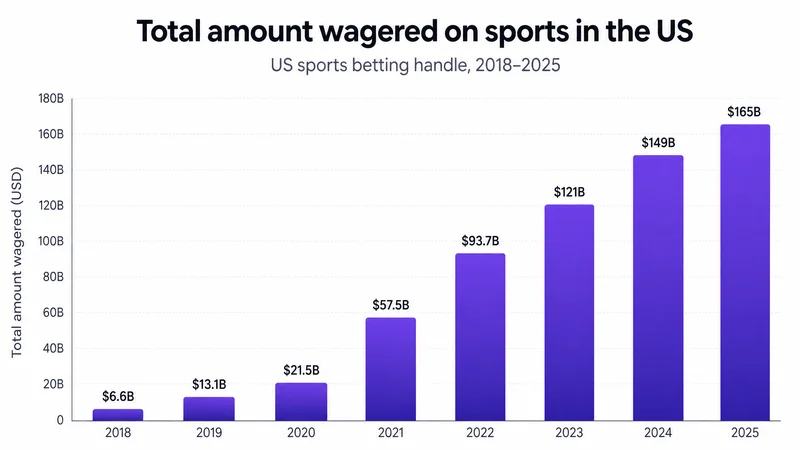
The response by punters has exceeded the wildest dreams of the online gambling companies. In 2025, US citizens wagered $165 billion at legal sportsbooks, of which they lost a whopping $16 billion. According to a recent article in Forbes, “gambling is now America’s favorite pastime as Americans spend more on sports bets than movies, arts, museums, and music combined”:
In 2025, Americans placed roughly $166 billion in bets on sporting events. That’s more than the entire U.S. movie, music, book, and museum industries generated in revenue combined.
The North American box office totaled $8.87 billion in 2025, which is still 22% below pre-pandemic levels. Recorded music revenue hit a record $11.5 billion. Live music like concerts and festivals brought in $18.51 billion. Meanwhile, book publishers tracked by the Association of American Publishers reported $14.6 billion for the year. And the U.S. museum industry generated an estimated $16.4 billion. Add it up and the total comes to roughly $70 billion, which is less than half what Americans wagered on sports.
“It fills that void, and it will crowd out other forms of entertainment, other forms of hospitality, for sure,” said Martin “Marty” Conway, an adjunct lecturer in Georgetown University’s Sports Industry Management program. Sports gambling, in all respects, has become more ubiquitous, and as a result, is becoming more accepted as yet another form of entertainment. “They’ve taken something that was just who’s going to win, and now you’re actually able to get involved in certain other events of the game. That’s a form of engagement as opposed to what we knew previously.”
Research also suggests this money is drawn away from more productive uses. Baker and co-authors studied consumer transactions from a sample of some 230,000 Americans from 2018 to 2023. They found that betting activity, for example, “crowds out” financial investment into brokerage accounts typically used for long-term savings.
It’s not just the amount of money being frittered on sports gambling in the US that should give pause; it’s the rate of increase. As the graphic below shows, just eight years ago, $6.6 billion was spent on legal sports gambling (it’s impossible to know how much was being spent on illegal sports gambling). That amount has increased more than 20-fold since then. While the growth rate has slowed in recent years, it is still above 10% per annum.
That is on top of the huge sums of money that have also flowed into prediction markets over the past couple of years, where bets on sports are also common, including in states where online gambling is still illegal. According to a Pew Research Center analysis of data from The Block, a digital assets media firm, combined monthly global trading volume on these platforms has risen from less than $5 billion in September 2025 to about $24 billion in April 2026.
Companies such as Polymarket and Kalshi claim they are not gambling operators, which require approval to operate, but rather offer “event derivatives”, overseen at a federal level by the US Commodity Futures Trading Commission (CFTC). This distinction has so far enabled prediction markets to operate across most US states, including Utah and Hawaii, where gambling has long been illegal. More than a dozen lawsuits have been filed that challenge that interpretation.
The prediction markets industry, if one can even call it that, can count on the undivided support of the Trump administration, however. President Trump, whose son, Donald Trump Jr, has deep ties to the two biggest prediction market companies, has already weighed in on the issue, claiming it to be “critically important” that the CFTC maintain “exclusive authority” over prediction markets, rather than states. “It is a major Industry, and we must protect it.”
Compounding Crises
Meanwhile, the economic fallout from the rapid growth in online sports gambling is compounding at an alarming pace, while revenues and profits for the companies involved are skyrocketing. This is all happening at a time when the US is suffering an acute cost-of-living crisis, with a recent poll suggesting that over 70% of middle-income Americans saying their income cannot keep up with the pace of inflation.
It seems that as economic conditions deteriorate for the vast majority, more and more people are turning to sports gambling as a desperate last resort. At the same time, sports books are trying making it harder to actually win money by making parlays — a single sports wager that links two or more individual picks — the default product. As Aakash Gupta points out, the product is getting worse for the customer yet the customer continues to wager more anyway.
As the FT reports in its March article, “The cost of America’s sports betting habit“, the staggered pace of legalisation across states has offered researchers a natural experiment in quantifying the economic consequences of this emerging trend, with non-gambling states serving as a control group:
The most obvious effect has been the rapid and persistent adoption by the people who live in the dosed states, according to the first of a trio of new studies. “You look at the sheer amount of play that people are doing, we see that more than quadruples across individuals in the state” after legalisation, says Wayne Taylor, a professor of marketing at Southern Methodist University in Dallas, Texas.
Taylor and co-authors analysed the credit and debit card activity of 1.2mn Americans from 2019 to 2023. They discovered an immediate leap in the amount of US gambling spending — from below $1 to almost $5 per person per month across the entire population — when online sports betting was introduced. Alongside that came an almost fourfold rise in the rate of “irresponsible gambling”, defined as spending 1 per cent or more of one’s income on bets.
These effects were swift and have stuck. “That’s the biggest change from six years ago,” Taylor says. “It’s become part of the American lifestyle now.”
A second study cited by the FT article found that $1 of online sports betting deposits corresponds with a reduction in net investment of about 99 cents. They also registered a sharp rise in credit card debt and the frequency of account overdraft, as well as a decrease in available credit. Credit ratings are also taking a sizable hit:
A third study, by Hollenbeck of UCLA and co-authors, used a proprietary consumer credit database covering more than 4mn Americans from 2016 to 2023 to identify a complementary laundry list of ill financial symptoms post-legalisation.
The average credit score fell nearly 1 per cent, the likelihood of bankruptcy filing increased by 25 to 30 per cent, and the amount of debt in collections increased 8 per cent.
“The effects are fairly small, but they are population-level, and it implies that the effects on the finances of people who are gambling a lot are probably pretty negative,” Hollenbeck says.
As NPR reports, a recent study from the New York Fed found that sports betting is linked to plummeting credit in the more than 30 U.S. states where the activity is legal, as well as in neighboring counties where it was not.
Credit delinquency rates, primarily driven by missed payments on credit cards and auto loans, rose about 0.3% overall in states where sports betting is legal, despite legal sports bettors making up only 3% of the population. But, looking only at the 3% of the population who took up sports betting after their state legalized it, credit delinquencies spiked by more than 10% among gamblers. Credit delinquency means credit payments are at least 90 days past due.
That is not to say that everyone ends up losing their shirt. As a few FT readers were at pains to point out, the vast majority of gamblers (between 90%-95%, according to most studies) have no trouble keeping their betting under control. So, why stop something that for the vast majority of people is harmless fun, and risk driving it underground?
The answer may be found in the ubiquity and ease-of-use of online gambling. Never before has it been so easy to place a bet on a sporting event, or a combination of sporting events. Via our smartphones, we all have a giant virtual casino in our pocket or handbag, and it’s open 24/7. It will also happily accept our credit — until the day our bank, or banks, put a block on it.
According to another new study, more than 25% of US citizens say they have an account with an online sports book such as DraftKings or FanDuel. Of those, an estimated 11% are now problem gamblers. And crucially, they are more likely to be from lower income households, according to a study of financial transaction data from 184,000 homes.
Perhaps most perversely, it is these lower-income households who are now helping to foot state executives’ spending bills through the taxes levied on legal gambling revenues. As Warren Buffet points out in his first televised interview since stepping down as Berkshire CEO, the legalisation of online sports gambling is essentially an indirect tax cut for the rich:
Warren Buffett, in his first sit-down since stepping down as Berkshire CEO, gave the cleanest indictment of legalized gambling in a decade. He called it a tax cut for the wealthy. The math proves him exactly right.
Americans wagered $165 billion at legal sportsbooks in 2025.… pic.twitter.com/edLe9hAO2Z
— Aakash Gupta (@aakashgupta) April 26, 2026
The money quote:
“Rich people love it because they don’t have to pay. States rais[ing] money from people for whom a dollar really means something actually relieves the taxes on me and other rich people. It’s not direct but it’s the net effect. I don’t like things that make a sucker out of people… I don’t think the function of government is to play its people for suckers.”
But that is precisely what successive US governments going back decades have been doing. The 2008-09 bailout of Wall Street, from which Buffet benefitted more than handsomely, is arguably the most pernicious example. To see the Trump family benefit directly from the rise of prediction markets is also no surprise given the way they also rinsed their own followers with multiple meme coin launches.
As Yves has consistently argued, the US’ imperial decline is likely to mirror many aspects of the USSR’s own collapse, as the country undergoes a gradual hollowing out driven by internal decay. But as this process accelerates, we are likely to see more and more blatant looting from the upper reaches of the financial and business elite, just as happened in Russia.
Some FT readers are also noticing this trend, such as Ececececr:
Legalized gambling, prediction markets, legalized weed, lack of criminal enforcement and prosecution, only fans, repeatedly letting violent criminals go, etc are all end stage policies designed to loot and financialize what’s left of the American system.
It’s true, of course, that the US is not the only country with a serious online gambling problem. In my native United Kingdom, where sports gambling has been legal for decades, an estimated 1.4 million people — roughly 3% of the population — have a gambling problem, according to the Gambling Commission’s 2025 annual survey.
In Brazil, $68 billion was wagered via Pix, the country’s payments system, last year, just one year after online gambling was legalised. That does not include credit card payments and wagers made on illegal sites. According to Patricia Marins, the total figure probably reaches around $100 billion:
[T]here is no need to deduct the winnings, since the prize money is eventually spent in the same place anyway. We are talking about a “drug” distributed and heavily advertised across Brazil.